Good News on the Staff Shortage
Is the talent crisis over?
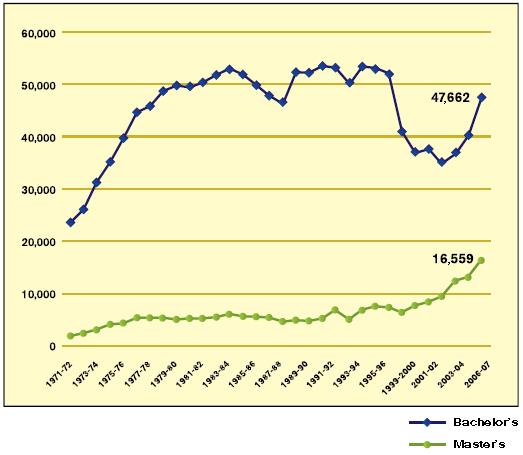
Chart: Accounting degrees awarded - 1971-2007 (Source: AICPA)
CPAs rate their jobs. Join the survey. Get the answers.
by Rick Telberg/At Large
Having trouble finding more good accountants? If so, you are far from alone.
For Cheryl Mills, a senior manager at a CPA firm in New York City, retaining qualified staff has become an uphill battle. “We have lost 60 percent of our workforce this year,” says Mills.”The rapid turnover makes investing in staff difficult.”
Echoing that sentiment, Neil Schembre, who works at a small firm in Fanwood, N.J., says, “Staffing is the lifeblood of my business.”
But help may be on the way. The triennial AICPA survey of the supply and demand of accounting graduates reports that 2006-2007 college accounting enrollments were up almost 19% to more than 203,000 students across all degree programs since the last survey in 2003-2004. The only degree program showing a decline was the Masters in Taxation, where enrollment was down slightly more than 9%, according to the AICPA report.”Almost all sizes of firms expect hiring numbers to remain steady or to increase, with 67% of the largest firms projecting increased hiring. The largest firms also expect to hire as many or more nonaccounting majors; 58% said they would hire about the same number, and 33% said they would hire even more non-accountants.”
“Staffing is the one most critical area. The rest cannot be done or achieved without properly trained, motivated, committed and enthusiastic staff,” Linda L. Churchill, a partner at a CPA firm in Tampa, Fla., says.
“The great majority of the growth is at the Bachelor’s degree level,” according to the AICPA report, which cites an increase of almost 30,000 students since the last survey.
In fact, enrollment may now be straining some colleges. Top schools are barring the gates. Thirteen percent of the top schools “faced space limitations and rejected an average of approximately 65 applicants.” Going forward, colleges generally anticipate a continuing rise in enrollments: 60% expect increases at the Bachelor’s level, while 63% expect increases at the Master’s level.
Meanwhile, the female to male enrollment ratio is narrowing and now stands at 52% female and 48% male for both the Bachelor’s and Master’s programs, down from a high in 2002 of 57% female and 43% male.
And the number of exam takers is rebounding. The number of candidates increased more than 50% since the exam went paperless in 2004 and continues to rise.
So, is the accounting profession’s staffing crisis coming to an end? Not yet. But, says John Sharbaugh, chief executive of the Texas CPA society, “at least it’s moving in the right direction.”
GET THE FREE DOWNLOAD: 2008 Trends in the Survey of Accounting Graduates and the Demand for Public Accounting Recruits, 84 pages, PDF.
RATE YOUR JOB: Is your company a leader or a laggard? Join the survey. Get the answers.
COMMENTS: Suggestions, questions, rants or raves? Contact Rick Telberg.
Copyright © 2008 CPA Trendlines/BSG LLC. All Rights Reserved. Used by Permission. First published by the AICPA.
Posted at May 12, 2008
Filed Under BSG [CPA TRENDLINES] |
Comments
14 Responses to “Good News on the Staff Shortage”
Leave a Reply
Rick Telberg is president and chief executive of 
The inability of public accounting firms to retain good help is in large part a reflection of poor pay. New accounting graduates and the firms that hire them use each other for their own needs. After that they often part ways.
Enrollment increase and increases in accounting graduates are reflections of the echo of the baby boomers. The current graduating high school class is the largest in US history. Four years from now, there will be a large pool of accounting graduates. This is not, in my opinion, a reflection of anything positive that the AICPA or public accounting firms have done to increase the quality and quantity of the pool. If the largest firms raised their starting pay, more and better college students would move towards accounting. Indexed for inflation starting pay at Big 4 firms is lower than it was when I entered public accounting 33 years ago.
Sincerely,
Ira S. Greenberg PhD, CPA
60% turnover? Management problem. Something is wrong at the workplace.
Great to read that enrollment is up, but what do graduation rates look like? If the students don’t stay with accounting the increased numbers entering college won’t help the profession. And the help that the article mentions is four years away so I’ll believe it when I see it and can hire it.
Enrollment increases in college accounting programs is indeed a welcome change. Furthermore, the initial staffing demands for gearing up for SOX compliance have largely passed. This good news, however, is tempered by the loss of a generation of new blood that would otherwise be joining the ranks of partners and principals of public accounting firms. Unless CPA firm owners believe succession planning means that the last partner to die on the job wins, the profession of public accounting will pay the price for the dot.com boom, SOX, and the 150-hour licensing rule for many years to come.
In addition to the above, I have observed that fewer and fewer CPAs in our community are willing to accept the responsibilities that go with becoming a partner/principal. Despite the obvious financial rewards and public recognition, younger CPAs seem less willing to go the extra mile for clients, worry about making payroll, and volunteer their services to the profession’s trade associations and to the communities in which they live. If this erosion of the entrepreneurial and community service spirit is occuring across the nation, then the public accounting profession will face much bigger problems in the years ahead than simply staffing.
Very truly yours,
John Roberts
Niwao & Roberts, CPAs, a P. C.
Wailuku, Hawaii
More candidates does not translate into a better work ethic. Higher education does not translate into an affordable workforce. I have spoken to many sole proprietors and many are looking for ways to leave the profession. I bought a practice in NM and the retiring CPA was just 51. Stress is taking a toll. If asked on the profitability compared to time spent, I would advise looking for a different career.
Sincerely,
Edward Greenlee, CPA
I appreciate your insight.
On the talent issue, I was not convinced there was ever a shortage to begin with as publicized.
When you look at health care workers; there are job fairs and other recruitment undertakings just to try to get their attention. Then once they can get someone to look further, there is an opportunity to lure this person with a good compensation and benefits package.
For financial related candidates, a classified ad still brings hoards of resumes.
In my opinion, one represents a true shortage (is talked about frequently in the context of negative societal implications) and the other, a perception based on the idea of needing to be more involved in hiring and retention practices.
Until people are knocking down doors to talk to financial candidates, changes should only be regarded as moderate trend deviations.
Thanks,
Richard Soat
Appreciated your article “Is the Talent Shortage Over?” (I think this is reasonably close to the title.) The next hurdle is the CPA Exam. When the exam became available much more frequently, an adjustment did need to be made in the length of time allowed between conditioning and passing all four parts, but I think we went too far (from 3 years to 18 months). Just because the exam is available more frequently does not mean candidates (generally working 50-70 hours per week) have any more (or as much) time to study. Two farily strong candidates in close proximity to me failed because of this constraint. I would suggest two years. Thanks for listening.
Great topic with sound data to support it. Thank you.
What about….
1 - Baby boomers retiring?
2 - Demand for seasoned accountants/CPAs?
Thanks,
Ray Aune, CPA
That is good news about the growth of the accounting majors, but I wouldn’t go so far as to say the staffing shortage is over because of the time lag involved.
I really wonder what accounts (no pun intended) for this increase in graduates. From what I know or gather about this upcoming generation, it’s hard to imagine a career in public accounting being that high on the radar screen. Am curious what others think.
One thing that I do think is fairly certain is that audit, accounting and tax reporting and regulatory requirements will still be very intense creating a heavy demand for talent in the larger firms for sure.
A lot could also change in this country during the next political and economic cycle. No shortage of issues to be dealt with!
Who knows, maybe the succeeding generations (lead by the CPAs) can turn this wayward ship in some better directions.
In response to William Koch’s question about graduation rates, we’ve added to the article a chart showing graduation numbers from 1971 through 2007.
But his point stands, there’s still a lag between college enrollments and workforce entrances.
I think that the staffing crisis is over based on the following: A sophomore majoring in accounting at a major university cannot find a summer internship. This kid will be a future star at any firm.
So what gives? Small firms and large firms don’t want to invest a few dollars to get a future star. Perhaps you are right – the staffing crunch is coming to an end.
August
AQUILA Global Advisors, LLC
I thoroughly enjoy your articles. Thank you so much for your insight and enthusiasm.
I have never understood the accounting shortage: I am a CPA from UVa with a 4.0, excellent communication skills (have a degree in English Lit
also) and no CPA firm to date has been very interested in me from my resume. I have a wonderful corporate job but I wanted to be an auditor.
What is wrong with this picture? I only became a CPA after raising a family, and despite the shortage, I can only believe I am a victim of age discrimination. Would you please cover this topic in one of your articles?
Kind Regards,
Chris
If you treat people well and pay people well, you will not have a staff shortage. But, of course, NOBODY , AND I MEAN NOBODY in public accounting wants to do that. Employers all want cheap employees they can treat like dirt.
In response to your question about why since there are more accounting graduates, why aren’t more sitting for the CPA exam or staying in the profession, I will share the following.
I have worked in and around the CPA profession for more than 25 years and a few things have not changed at all. It is a demanding profession in so many ways- work ethic required, client demands, keeping up with technical requirements and far from least… the challenges of building a practice.
I happen to think that these challenges are more than most of the younger generations want to deal with. Fortunately, many firms, small and larger, have instituted policies to partially mitigate some of these issues, but I believe that these concerns are simply part of the profession.
What I don’t think has been adequately provided to accounting majors is the awareness of the tremendous opportunities in some of the specialized practice areas such as becoming an industry expert, forensic and litigation services, business valuation and many others. In addition, for the accounting major that comes up the ranks in the smaller firms where these specializations may not exist, I think the opportunity to help clients with any of their business issues is a wide open field. There are some CPAs I know ( not many) that regularly ask their clients about their sales, purchasing, human resources, systems and other problems and go about helping them solve them. A true business advisor!
Yes, the tax returns and financial statements have to be done, but as my first CPA firm out of college espoused, that should be the start of your services and value.