K-1 Chaos: IRS Throws Rocks at Hornet’s Nest

Don’t get stung. Here’s how.
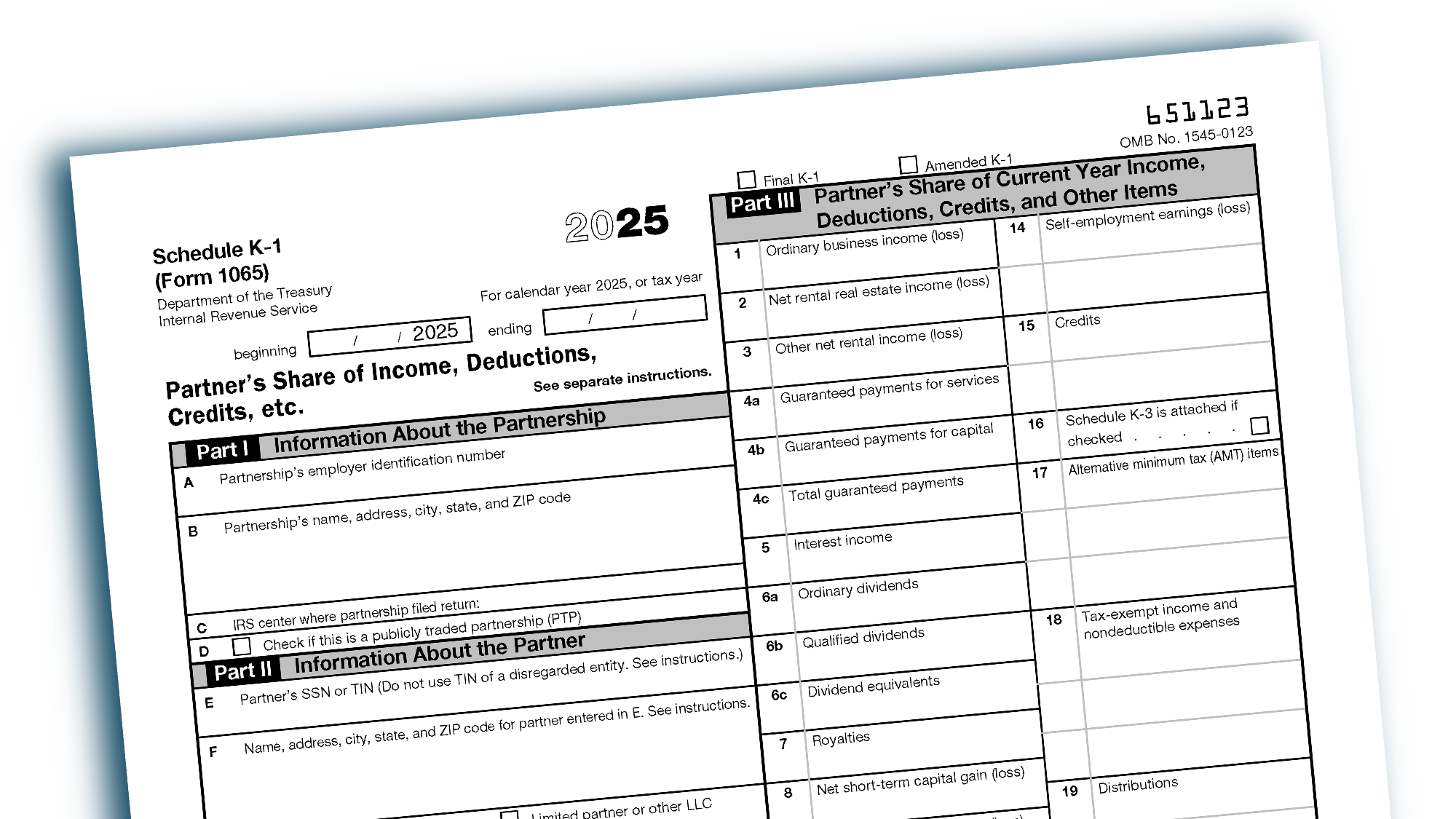
“It’s the taxpayer and preparer that get stung.”
By CPA Trendlines
CPA Trendlines Academy
Burnett


Bradley Burnett doesn’t start his 2025 Form 1065 program with a code section. He starts with a warning.

“Throwing rocks at a hornet’s nest,” says Burnett, JD, LLM, is what the IRS is doing to tax preparers. And then he delivers the line that drives the room quiet: “IRS has the bug spray, not us.”

2025 Forms 1065 and K-1s: IRS Throws Rocks at Hornet’s Nest with Bradley Burnett, J.D., LL.M
Full webinar on demand (any time, any device): Learn more | Buy now

The metaphor isn’t about audits. It’s about penalties. The practical risk of partnership returns has less to do with aggressive positions and more to do with incomplete disclosures, mismatched coding and mechanical errors. The danger is not interpretation. It’s the process.

“If the preparer does not do everything that IRS asks us to do,” Burnett warns, “it’s the taxpayer and preparer that get stung.”

And the sting is mathematical. For returns required to be filed in 2026, the failure-to-file penalty under IRC §6698 is $255 per partner per month, capped at 12 months

That means a two-partner firm that files a year late faces $6,120. A 20-partner investment group that files three months late faces $15,300. A 50-partner private equity structure could be staring at $153,000 if the delay stretches a year.

“It’s not just late,” Burnett emphasizes. “It’s also improper or incomplete.” Incomplete. That word now carries as much financial weight as incorrect.

The failure-to-file penalty is only the first layer. Sections 6721 and 6722 impose penalties for failing to file correct information returns with the IRS and for failing to furnish correct K-1s to partners

For returns required to be filed in 2026, the penalty can reach $340 per statement if not corrected before Aug. 1, and up to $680 per statement for intentional disregard.

Stack those penalties, and the math accelerates. A 40-partner firm with uncorrected K-1 errors could face $13,600 for filing errors and another $13,600 for furnishing failures. Add a late Form 1065, and the total can exceed $50,000 before anyone debates a single tax position.

Burnett recounts a real example from Washington State. A partnership return filed a year late. Two partners. The §6698 penalty alone: $6,120. Add K-1 failures, and the notice demanded another $8,000. “That taxpayer did not have a good excuse,” he says. “It just wasn’t pretty.”

The numbers are unforgiving because the system is unforgiving.

And it is increasingly automated.

Burnett notes that IRS staffing entering filing season dropped from roughly 105,000 employees to about 74,000—down about 26%

Fewer auditors do not mean fewer examinations. It means more algorithmic screening. “IRS says they’re going to employ more artificial intelligence to scout out who gets examined,” he warns. Artificial intelligence does not argue statutory interpretation. It looks for mismatches.

  • A missing TIN.
  • A liability decrease reported on one schedule but not reconciled elsewhere.
  • A capital account that doesn’t foot.
  • A distribution without corresponding basis tracking.

Machines do not care whether a taxpayer was reasonable. They care whether the fields reconcile.

Burnett’s hornet metaphor becomes sharper here. “We’re the ones agitated,” he says, “but IRS gets to sting us.”

That sting now travels through structured data.

The 2025 partnership return is less a narrative document and more a data engine. Every additional box is a cross-reference point. Every new disclosure is a matching trigger. “Disclosed info on 1065 and K-1 may lead to IRS exam,” he reminds practitioners

What has changed is not the statutory framework. It is the operational environment.

Under the old model, risk was substantive: Was the allocation defensible? Was the position aggressive? Would an auditor challenge it?

Under the new model, risk is mechanical: Was every required element completed? Were the schedules internally consistent? Was the K-1 furnished on time and coded properly?

The penalty regime is not new. But its leverage is.

When a return is incomplete, the IRS does not need to prove intent. The statute applies automatically. And with e-filed returns, incomplete may mean a missing data element rather than a missing attachment.

Burnett’s framing strips away the abstraction. “These penalties are worthy of our attention,” he says

The phrase is understated. They are existential for some firms.

A 25-partner real estate partnership that files three months late and fails to timely furnish K-1s could easily face $36,000 in stacked penalties. A larger professional services partnership could see six-figure exposure. None of that requires a tax shelter, an abusive transaction, or an aggressive interpretation. It requires only slippage.

The uncomfortable reality is that most penalty exposure in 2025 will not arise from bold tax strategy. It will arise from process breakdown.

  • Late delivery of source data.
  • Failure to reconcile liabilities.
  • Incomplete Schedule K disclosures.
  • Missed electronic furnishing deadlines.

Burnett’s metaphor works because it shifts the emotional lens. Preparers feel provoked by expanding reporting requirements. But the IRS controls the enforcement mechanism.

“IRS has the bug spray,” he says. And in 2025, the spray is automated.

The practical lesson for firms is not to retreat from complex clients. It is to harden internal controls.

  • Pre-filing checklists.
  • Liability reconciliation procedures.
  • Basis roll-forward documentation.
  • Verification that every K-1 field matches the partnership ledger.
  • Confirmation that information returns were both filed and furnished.

The most dangerous partnership return in 2025 is not the one that takes a position. It is the one that leaves a box blank.

In a data-driven enforcement environment, silence is not neutral. It is a signal. And signals are what artificial intelligence reads first.

Leave a Reply