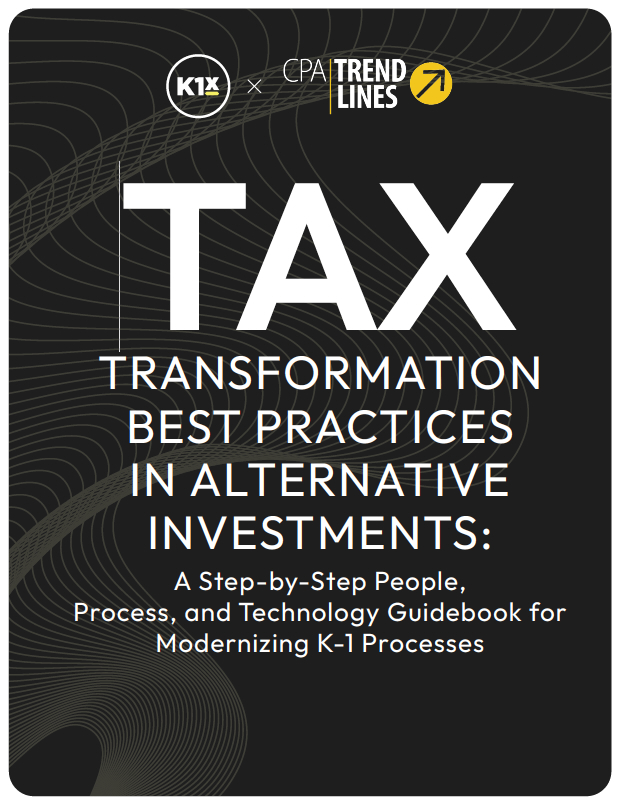
Schedule K-1 reporting has quietly become one of the most complex and resource-intensive areas of modern tax practice.
Rising alternative investment activity, expanding regulatory reporting requirements, and persistent staffing shortages are pushing tax teams to the breaking point. Meanwhile, delays across the K-1 ecosystem compress timelines and force professionals into last-minute fire drills.
New research
from CPA Trendlines and K1x explains why traditional K-1 workflows—manual collection, document extraction, fragmented analysis—are no longer sustainable.
The report introduces a practical roadmap for modernizing tax data operations using a structured framework built on three pillars:
- People – Align work with the right resources so highly trained professionals focus on analysis and planning instead of administrative tasks.
- Process – Standardize the K-1 workflow from data collection through extraction, validation, review, and integration.
- Technology – Deploy automation and AI-driven systems to reduce manual data entry, improve accuracy, and streamline tax reporting.
Key Findings From the Report
- 52.79% of K-1 aggregation work occurs in just three months, creating massive seasonal bottlenecks.
- 81% of K-1 work occurs within six months, expanding the traditional busy season deep into the summer and fall.
- Manual extraction averages 45 minutes per K-1, creating significant operational drag across large portfolios.
- 45 million K-1s are produced annually, and the alternatives industry is expected to grow significantly.
What You’ll Learn
Inside this guidebook, you’ll discover:
- Why K-1 workflows have become one of the most inefficient processes in tax operations
- The six-step standardized workflow used by leading firms
- Practical strategies for reducing busy-season bottlenecks
- How AI-driven automation reduces K-1 processing from 45 minutes to seconds
- How to build a scalable “Tax Data Operations” infrastructure
Download the Full Report Today

.