SURVEY RESULTS: Identifying and Developing Leadership Potential
SURVEY RESULTS
“Talent Strategies: How to Identify and Develop Professionals for Management and Leadership Responsibilities”
Join the survey; get the updates.
CURRENT FINDINGS
1. The single most important indicator of career potential is “They are always trying to improve.” Followed by:
– “Clients say good things about them.”
– “They increasingly handle the relationship with the client.”
– “They understand the importance of bringing in new business.”
– “People listen to them.”
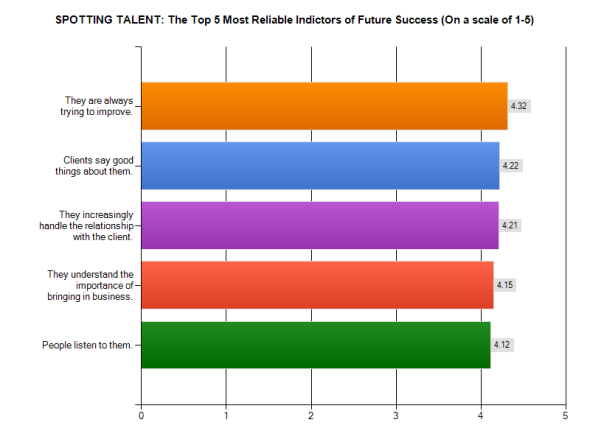
- Top 5 Talent Indicators
Sample comments on: “What’s the MOST IMPORTANT thing to look for in spotting staff with Partner or Top Executive potential?”
- Confidence and outstanding people skills, they make everyone around them feel great about being involved with this CPA firm
- Commitment to work, ability to understand and work with others and the technical knowledge of handling things right.
- Being able to translate the finance and accounting terminology and analysis into something that is understandable and useful to management.
- They are excellent role models and examples to others.
- They are great role models and examples to others. They provide excellent client services within time budgets. They are “self-starters” and make professional improvement on their own initiative.
- A positive attitude with common sense and an ability to get along with others
- A sense of integrity and responsibility to the profession, the firm and the client.
- Someone whose actions and achievements continuously affect the bottom line positively
- The ability to bring profitability to the firm.
- Good working attitude and leadership that seems to be progressive.
- Confidence and personality enable staff to garner the trust of our clients and the respect of partners and co-workers. This, coupled with technical skill and stellar work ethic, is the pathway to partnership in our firm.
- They are technically competent, they work (Exceedingly) well with clients and staff, they are dedicated, have a strong work ethic, and have at least good communication skills.
- Self initiative and vision
- The ability to think in terms that benefits the firm as a whole rather than just themselves or their cohort.
- Attitude and determination with the drive to succeed
- Competence, desire to grow professionally, positive attitude towards change, staff see them as “leaders”
- Energy and enthusiasm for what they do.
- People skills
- A willingness to address an issue with an attitude that “I can figure this out and I will do my research and present a solution based on my research, for discussion”. Too many today are looking for their partners/supervisors for the answer. Those with a passion will spend the necessary time to do their own research with will in turn assist in developing their proficiency in an area.
- The ability to spot and adapt to organizational cultures and still retain a results focus.
- Initiative and drive for excellence in all aspects of their life, not just work
- How they handle themselves with clients and networking.
- Good networking skills along with talent
- Ability to think and inspire clients and coworkers, which brings additional value.
- Discipline
- Leadership – help others, show the way, innovate, create opportunities
- Ability to get things done
- Client relationship management and growth.
- Outstanding attitude
- Understand that good service will bring satisfaction and referrals
- Client service orientation
- Someone who is willing to invest in their own career. Takes initiative. Listens.
- Human chemistry-ability to harmonize with staff
- Willingness to change. We have had several partners who started in one area and due to the needs of the firm were asked to completely switch gears and have willingly accepted the request!
- Attitude, curiosity, bringing value to firm
- Drive
- Initiative
- Desire to be partner & people skills
- Firm first attitude; not me first attitude
- Truly caring about coworkers and clients.
- Constant critical alert when instructed, when performing an engagement, when handling staff
- I think there is an over assessment on “exceptional” in todays marketplace. The trend seems to be putting the workload of
- 2-3 people on one person. This is a cause for failure, mistakes, burn out and frustration on all parties. I think the trending should be back to specialties and niche personnel, to achieve the best results and service to our clients. Looking for that all around “perfect” employee is looking for a needle in a haystack. Instead look to focus and pull the best abilities from your current talent and the rest will take care of itself.
- Ability to work with others, mentor and develop talent are important. Couple that with great technical skills and workpaper technique and you have a winner!
- An ownership mentality
- Drive and the desire to constantly improve and succeed.
- Attitude
- A person that is willing to work hard and constantly improve their own skill sets for the betterment of the firm as a whole, rather than just for personal gains.
- The ability to get and retain clients
- The ability to network and bring in business from that network.
- People who are team players and see job improvements from the whole team as the way to do better as an individual, as a team and as an organization.
- The ability to adapt and change with the times/ environment
- Someone who can see the big picture, and has an entrepreneurial attitude, not just a technician attitude.
- Their energy, enthusiasm, and passion to serve.
- An eagerness to learn and willingness to take on new challenges.
- The ability to be technical along with having people skills.
- Internally motivated to excel.
- Being able to related to the client. Subordinates employees and peers.
- Technical ability.
- Vision, Honesty and Responsibility
- They understand that the business isn’t just about cranking out tax returns. It’s about top quality client service in addition to top-notch work.
- They start acting like a partner before they are a partner.
- Initiative
- Brilliant mind
- Selflessness, looking for the win/win, never believing they have “arrived” but recognizing the need for continual improving, knowing when to take a break, brings out the best in others
- First, knowing what you want in an individual and then looking for it in the staff person.
- They treat the business as if they owned it and act accordingly to improve themselves and the business.
- Technical knowledge, commitments, diligence and respect.
- That they have the capability of thinking for himself and making decisions that benefit the firm.
- People skills are absolutely essential.
- Desire to work with new business and develop them.
- Willingness to accept responsibility and be a team player
- Those who can communicate well and at a casual setting, while also being technically excellent and able to think outside the box.
- The ability to over deliver on projects and manage client expectations
- Ability to network effectively
- The willingness to do what it takes to get a job done. An interest in career succession and always, always basing every decision on what is best for the company as opposed to doing what is best for them.
- Willingness to “own” projects
- Commitment and dedication to building up capital base by engaging old & new clients. One who takes time to assess risks and opportunity in handling client’s work
- Self awareness, strong interpersonal skills 1:1 and in groups, self managing, confident enough to have a point of view even if it differs from superiors, gets things done
- Positive attitude
- Sincerity, integrity & motivation to learn
- Attitude! We hire the top performers in school, so technical ability isn’t a question. The differentiator is their drive to succeed and willingness to do whatever is necessary without following blindly. They may question the career path, even while moving quickly along it.
- Honesty, has a working moral compass, have excellent ethics
- Humility in admitting mistakes and honestly learning from them. The ability to listen earnestly and take appropriate time with clients.
- Motivation to succeed.
- Capable and good listener
- Leadership skills
- A willingness to be responsible for their work.
- Being able to apply technical skills in real client situations in order to resolve issues.
- Good listeners, leaders and subject matter expert in at least some area.
- Good work ethic.
- Initiative
- Having not only the technical skills but also the people skills to manage client needs as well as staff.
- Dedication to servicing the client and continuing to grow professionally.
- Attitude and personal drive. They do not need constant validation that what they are doing above and beyond the requirement is a good thing. They are willing to take on more to make other’s jobs easier.
- A willingness to do whatever it takes to accomplish the task at hand.
- All around well balanced person with great technical skills as well as professional leadership qualities.
- The ability to be persistent and to find new opportunities for a firm to excel.
- Working hard but smart (not necessarily long hours). Work life balance while recognizing that clients are first in a service industry.
- High ethical values
- Bold
- Hard Worker
- Team Player
- Teacher
- Honest and open
- Take responsibility for work
- Take on additional work without being asked
- Well oriented to challenges.
- Critical thinking — technical, client engagements, marketing
- Social interest, Technical competent, Administrative compliant, Courteous and Honest.
- Experience that will allow that person to understand the work being done by subordinates.
- Honest, friendly and professionally thinking
- Willingness to learn; Good oral communication skills; Career a priority; Willingness to work long hours.
- Interested in growth of self and firm
- A solid work ethic with great people skills and a thrust for knowledge.
- The technical expertise and the ability to communicate with others.
- Leadership and the ability to make those around them better or more knowledgeable.
- One who Listens well before making conclusions
- A proactive attitude towards acquiring and maintaining clients. Desire to learn new skills and gain more expertise. Being a “doer” and not just a “talker”.
- Not always the smartest, but the person w/lots of ambition and the ability to communicate easily with others.
- Everyone wants to work with or for them
- Highly motivated, good technically and a keen eye for new business opportunities
- Go-getters who don’t need to be told what to do. They go above and beyond to excel, and recognize that bringing in business is of prime importance.
- Willingness to better the firm by their actions
- Problem solving skills
- Skill is important but mostly humility and perseverance and kindness
- DRIVE, DESIRE, DEDICATION, GOOD COMMUNICATION SKILLS
- Ability to work well with others to accomplish goals of the organization
- 1 Honesty, 2 Strong communication and interpersonal skills, 3 Dedication to quality
- Lead by example
- Commitment, intelligence, good technical background and consistent performance
- They bring something new to the firm.
- They want to succeed and not just work
- Ability to use networking to bring in new clients.
- Personality, knowledge, handling difficult situation, honest, and good leadership ability, Client oriented, good communication skill, think to grow the company.
- An understanding of what makes a firm work and always looking for ways to make that happen; whether it is personal development, business development or client development. They have a what is in the best interest of the firm attitude rather than what’s in my best interest and know that is what is best for the firm will ultimately be to their benefit.
- Commitment; adopting the company’s values and mission;
- Good work ethic, gets along well with others in the firm
- Diligence and teamwork. Networking is equally important
- Able to see the big picture.
- They are in love with their selected career and have high capability of development in term of technical skills and leadership.
- Goals and vision
- Being able to relate to other team players.
- Hard working professionals who understand the big picture about quality and growth
- Personal responsibility for career advancement. They are constantly asking the question “how can I get better, and can I try ______?
- Life long learner, keeps learning wisdom, and is honest.
- Ability to develop business by identifying clients’ unfilled needs.
- Confidence. Ability to articulate ideas and communicate with confidence. Ability to think independently and analyze information to identify root causes of issues. Ability to think out of the box.
- Ability to learn new concept quickly.
- Fire in the belly and a willingness to stretch themselves
- Initiative and resourcefulness
- They work well with clients and clients respect their input.
- Willing to constantly over achieve
- Desire to make partner and do whatever it takes to get there.
- Business sense while maintain a professional bearing
- Ability to work hard, learn and lead.
- Attitude, eager to improve and advance, work ethic, capacity and desire to learn skills and technical expertise
- Listening skills
- Hard worker, trustworthy, dedicated
- Confidence and Passion. They have confidence in themself and a passion to succeed.
- Drive, Initiative, insight into what makes the firm keep working and a need to want it to work smarter
- Critical thinking skills and communication skills of various types.
- They are always looking for ways to improve the firm.
- Ability to effectively communicate, which includes listening.
- Always willing to try new things
- Presence. How they handle themselves in various situations.
- Passion
- Good networking and work ethic
- They have developed a specialty and/or have developed contacts that are beneficial to the firm.
- Ambition moderated by sound judgment and maturity.
- Communication and leadership skills
- They are real intellectuals and updated with the General Market conditions.
- Someone who enjoys client contact. Someone who will make decisions and someone who understands that their paycheck comes from clients
- Thinking beyond the technical…almost anyone can learn the technical but how to run a practice, connect with clients, develop others and the list goes on is RARE even among current partners. Most miss the mark because they think that working harder solves makes up for everything when what public accounting needs is people that work smarter.
- Technical skills
- Works well with all levels
- An individual whom is confident, knowledgeable about the industry and has the leadership and drive to exceed no matter what issue is placed in front of them.
- Leadership, people look to them as trusted advisors
- Knowing how the business works in his/her own way.
- Motivated, socially skilled and a good working knowledge of the profession.
- Motivation to exceed, in competition with themselves, vision for themselves or an organization
- I look for an all around intelligent individual who makes few errors and sells as much work as possible.
- Character is the key determinant — honesty, sincerity, work ethic, integrity, professionalism, and communication skills, a teaching mentality.
- Challenging the status quo for quality service to clients – continuous improvement
- An attitude that includes consideration of the different personalities of the entire staff including different career goals.
- Maturity of character.
- The ability to communicate effectively.
- Ability to adapt and accept change
- Leadership ability
- Business sense
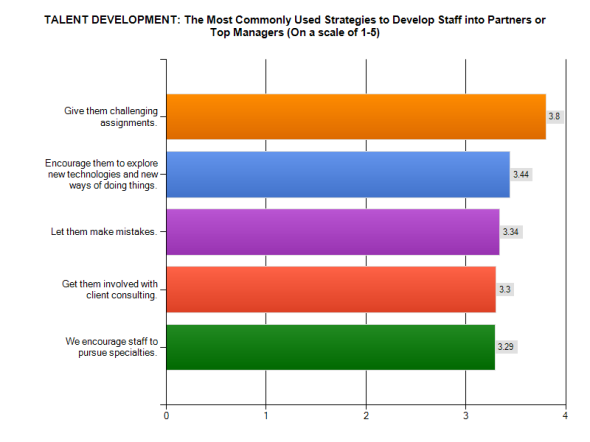
2. The single most often used strategy to develop talent is: “Give them challenging assignments.” Followed by:
– “Encourage them to explore new technologies and new ways of doing things.”
– “Let them make mistakes.”
– “Get them involved with client consulting.”
Sample comments on: “What’s THE BEST WAY to develop staff into Partners or Top Executives?“
- Give them interesting and challenging assignments
- Staff involvement.
- Get them involved with recruitment, client board meetings, and in the community
- Effective mentoring by top partners
- Lead by example and effective one on one mentoring
- Create a collaborative environment with defined goals and plans to reach those goals.
- Identify what areas interest that employee and coach/train him/her to achieve the goals set forth. Always challenge them to present new ideas on how to improve.
- They are born, not trained.
- His/her own strong will or ambition, mentoring or professional training
- Mentor them, give them the training and support they need to be successful, then let them get to work while accepting that there will be mistakes and that you will both learn from them.
- Expose them to a vast array of what we do; give them responsibility; encourage and give guidance on networking/marketing; oversee their technical development; inclusion in high level client and firm meetings/ events/planning, etc.
- All of the methods listed above are good ways. I’m a small firm with only part-year staff. We are mostly tax at this point in our growth. I have a staffer I’m trying to develop to meet directly with clients, but is resisting. She prepares all the drop off returns, but to grow, I really need her to handle meetings with the client. I’m currently building her corporate tax skills. As long as I can keep her busy in the drop off realm, it works out find, but when my desk starts piling up, well, then something’s gotta give.
- Keep them challenged and permit them to contribute to the firm at all levels (training, consulting, management of clients, etc.)
- Development plan in place; focus on strengths; challenge executives and assist them with leadership development
- Training and mentoring of staff
- Give them a road map of what is expected is a must with today’s staffers and don’t expect that they will put as much effort into getting there as those who came before them.
- Involved in early client relationships
- Create/capitalize on existing opportunities after having a discussion to determine individual’s interest in moving up
- As the owner I will provide the staff with the resources but they must have the self-motivation to develop themselves.
- Have a formal mentoring program that is consistent and fair to all staff and helps the staff realize their goals and potential
- Dedication
- Hands on experience
- With gen x and y, you have to figure out whether they are committed to doing what needs to be done to be a partner. They seem to just expect it.
- Give them wings
- Provide more client interaction for consulting/planning, overall client management, and sales advice.
- Give them a lot of rope to hang themselves
- Exposure to dealing in person with clients
- Partner mentoring
- Determine firm’s expectations, identify candidates, communicate with them, develop individual development plans and put development plan in action, actively monitor progress on plan, take action as necessary based on progress or lack of progress.
- Get them engaged in higher-level projects
- Establishing an outline of benchmarks. Some people are “superstars” and need very little coaching – but the rest of us could use some help. Understanding that to make partner you need “x” dollars in billing and you need to have accomplished a series of goals should be made clear.
- Mentoring, challenge opportunities, ongoing coaching
- Consistent mentoring
- Encourage growth
- Give them work beyond their comfort zone and challenge them
- Mentoring
- Model the behavior that is expected
- Train how to network and bring in business.
- Exposing to different challenges and technical issues
- Provide challenge and encouragement
- Mentoring, coaching, specific goal setting and regular follow-up and specific, honest feedback.
- Give them a flex schedule and see how they handle it. Give them as much string as they will take and monitor their ability to learn and perform at higher than expected levels
- Provide meaningful training that is of interest to the individual and the firm as well. Give as much mentoring time to the individual as possible, providing as much “real” experience as possible on how to become a practice leader.
- Motivate them
- By giving them the proper training and the opportunities to implement that.
- Standby a life-saving float and let him/her swims on his/her own.
- Experience and training development
- Communicate expectations, needed skills. Give additional responsibilities similar to those of a partner, e.g. Handling client p.r., billing matters, etc.
- Show them what is expected, and give them the tools to empower them.
- Allowing them to perform challenging work and do not engage in harsh criticism.
- Provide them with challenging projects that provide “stretch” in their abilities.
- A combination of CPE and client experience.
- Give the opportunity to grow
- Model the proper behavior to them.
- Groom through doing and observation and practice
- Coaching and critiquing
- Mentor training
- Get involved with the staff, matching personalities for good mentor relationships, even if informal. My eighth grade math teacher used to say, “to teach means to show how.”
- Develop competency tables for each position in the firm and don’t promote until individual excels in all or most of the key competencies.
- Encouragement
- Have them take on more responsibilities and to give them a sense of ownership.
- Hire the right people in the first place
- Encourage continuing education and show staff how to improve in areas where they are week
- Give them client responsibility early on and let them run with it. But you also have to coach them and be open about the potential future. Top talent could be leaving not evening knowing they were the top.
- You can’t build a book of business from nothing. And you can’t expect them to be expert networkers and build anything quickly if you don’t have a marketing person/dept. or at least a marketing plan.
- Valuing input, asking staff to truly be part of the team
- To shadow partners in handling meetings to deal with issues important to clients
- Mentoring and identifying the standouts early on so that we can nurture them as well as help them progress in their personal an professional goals. Lead by example.
- Give them challenges and learn how to develop relations with top clients. On the job training.
- Provide opportunities and allow them to take charge to learn
- To involve the staff in all areas of management from grassroots to top level. This will be accompanied with offering the employee with management skills by ensuring he or she attends to various workshop / seminars etc.
- Frequent reviews of recently completed assignments
- Formal talent review program driven by senior partners including identifying required competencies, gaining a shared view on who is top talent, creating development plans and holding their leaders accountable for implementing the plan.
- Involve them in the day-to-day activities
- Identify early, clearly define their path, and confirm their desire & buy-in and monitor progress continually with frequent communication and feedback.
- Organically
- Give them test projects, observe and make evaluations and suggestions and follow their progress.
- Discuss their career plan and goals with them early on in their career.
- Provide mentor(s)
- Education and mentoring
- Informal mentoring, encouragement to pursue knowledge and providing support when mistakes are made.
- Mentoring programs that address all aspects of ownership.
- Let them get involved with senior members and view them in action. Mentoring is the best way. Start with small clients and progress from there.
- Informal mentoring
- Experience is very valuable to make this transition. I like to include them in real life situations either solving problems (internal or external) or trying to land new business. My experience is if they see it in action and are a part of the success it teaches them many things in the process.
- Tough section to answer, as we’re currently a small firm. I have worked in larger firms in my 41+-year career and some of comments above reflect that experience.
- Make them a part of the process. To make a staff feel that the firm values them enough to invest in them to develop them into future leadership, continually show them that you are invested instead of just telling them.
- Give them ever-increasing responsibility, proportionate to their ambition and set them free, with permission to make mistakes along the way.
- Provide progressively greater responsibility on engagements
- Create a profile of the qualities and attributes required for partnership – not just technical – relationship skills, vision, ideas and creativity are also important
- tie it to recruitment pipeline
- have a discernable track for staff that want to be partners and have the potential to be partners
- managing partner mentorship + in-depth client experience
- if firm too small – external mentorship
- set specific timeline and challenges
- expect and tolerate mistakes en route
- Involvement and opportunities to develop in new areas.
- Let them in participating meeting with clients.
- Do with no. 1 the above-described actions
- Rounded experience, leadership opportunities, exposure to strategic problems/decisions.
- Continuing support and encouragement. Recognize the job well done and understand the pressure when mistakes occur.
- Spending time training and communicating with them to ensure their understanding of processes and they’re comfortable asking questions.
- Let them make mistakes and see if they learn from them
- One on one time with strong partners.
- I think it is seeing if they have the ambition to want to do it, and not have to be spoon fed or dragged through a program. If they show that they want to be a partner or owner, you look for the spark that shows they want to do the extra work and put in the extra time to be an owner. Once you know that, then you invest the time to move them up the organization by providing opportunities and training.
- Get them involved and let the staffer figure out them what do to with coaching from the mentor
- Train them in the areas that you need for them to be proficient in and measure the way the respond to a challenge
- Get the staff to emulate the habits of successful partners or executives
- Intensive training and mentoring
- Lead, don’t manage. Give them responsibility. Let them be creative and bring value to the firm.
- Have a formal plan and follow it.
- Frequent feedback, regular performance meetings, and feedback from not just above but peers and below (and they have to respond to this well, for it to work; which goes back to humility, kindness, sincerity)
- Take top talent, train them, at each step of the way let them take the next step & continue to build their growth.
- Continue to give them higher-level contact with clients and their workload.
- Explain the logic behind the decisions you take.
- On the job training: accompany an existing high potential partner and learn off them
- On-the-job training, hands on experience and involvement in various assignments
- Make them responsible for a group of clients and let them develop the business.
- Giving them room to prove themselves and not hover over them
- Keep staff directly involved with clients.
- Educate them early on how a firm works and what items individuals are measured on. Have them shadow as many successful firm members as possibleThe best way to develop staff is to work with them to identify what motivates them and use that information to develop a performance program for them.
- Train-train-train. I don’t think we have done a very good job of it.
- Develop a mentor relationship.
- To provide continual mentor program to them at each level of promotion.
- Train
- Allow staff to excel on their own and once
- you can see the potential, provide them with the tools to reach their goal.
- Invite them to client meetings and networking events
- Trust them and let them fail occasionally.
- Pursuit top profession, lessons learned, and how to prepare to do better next time.
- Challenge them. Help them succeed.
- Provide the opportunities to take on more responsibility and give them guidance on how to take control of situations and issues. See if the staff understands that they need to take responsibility.
- Stretch assignments and strong immediate feedback
- Take an interest in them and invest in them.
- Let them occasionally take the lead on jobs and work with clients
- Keep them informed and motivated through engagement
- Mentor them and show them how to lead by example.
- Set the example bring them along work closely eighth them once you have identified potential
- Mentor them
- Challenge them, provide opportunity, and don’t burn them out
- Set realistic expectations
- Mentoring
- By giving them leadership classes and including them in our process. Also, shadowing current partners.
- Not sure we know the best way. I’d say invest in their strengths and allow them to be in control of some things be it client engagements, a firm process, etc.
- Give them exposure to situations/meetings/etc. Where issues are discussed with senior mgmt.; get them rotating among areas for broad experience.
- Get them involved in higher-level thinking?
- Get them involve and allow them space to grow.
- Real life experiences.
- Give them challenging assignments
- Open communication and encourage them to seek out opportunities on the team
- When I worked at Arthur Andersen, we had the “pull” philosophy. Very simple really. In order for me to get promoted, my successor had to be trained by me to my current job better than me. My supervisor had the same criteria in place for him or her. It works.
- Hands on work
- By giving them opportunities and encouragement to develop their skills into positioning themselves for the highest level in the firm they desire.
- Involve them in all aspects of client development, service, and retention.
- To involve them in meetings and train them appropriately within and outside the organization.
- Communicate, communicate, and communicate. Vision, vision, vision. Most of the time we are far too caught up in getting through the next week or deadline that we fail to address the most pressing issue – who is next that needs development. Your best performers will be easy to bring along but too often those that bring other very unique and valuable skill sets are passed over because they don’t pick everything up as quickly or don’t fit the typical accountant mold. That means they will take a little more effort perhaps to coach and develop – who has time for that, right – and so we end up with a lot of the same types of practice styles and personalities which ultimately leads to a far less diverse leadership as those people progress.
- More responsibility & client contact
- Challenge and let them get all the credit/criticism based on the outcome
- The best way to develop a staff accountant into a partner is to have the partner mentor them and “mirror” the partner within their field of expertise.
- Your comment let them make mistakes and see how they correct the situation.
- Give them confidence to accomplish tasks that are difficult to handle
- The firm does not have staff at this time.
- Give them direct client responsibility, require technical expertise, train and participate in marketing and business development efforts
- Simply: pick top talent and properly develop and mentor them.
- Mentorship. Provide experience in non-technical areas, including marketing, client development, business management, and profitability analysis.
- Find the right staff to begin with. Then, listen to them, guide them and support their efforts.
- Mentorship/involvement with partners and giving them responsibility
- Allow them to grow at their own pace keeping in mind that mistakes will occur and serve as a learning opportunity.
- Personal development plan with coaching.
- Mentor them in all areas,
- Train them and provide leadership
- Training and positive encouragement
- Mentoring
- Training.
- Give people a clear set of goals, and let them know their work is appreciated!
- Provide new and interesting challenges.
- Keep teaching and sharing knowledge with every conversation.
- Experience and match job with personality and natural abilities
- Mentor – get them involved in the areas they will be expected to perform.
- Find what they are good at and allow them the opportunity to developed that area of the practice.
- Their attitude
- Provide them with opportunities and challenges and see how they respond. Then determine if the potential is there.
- Experience and effort
- Mentor, mentor, mentor!
- Hands-on training, walking them through management-type activities until they are comfortable doing those tasks on their own
- Give feedback, challenging work
- Mentoring, setting expectations and professional training
- Encourage them to stand their ground without compromising their integrity. Far too often, people in current leadership positions are willing to “sell their souls” for a short-term gain (either personally or for the firm). The end result is their careers are trashed and end in disgrace & the firm’s reputation suffers accordingly.
- I’m hoping for some answers.
- Give them minimum guidance and maximum follow up. If you have to tell them how to do the job every time, you don’t allow them to develop their own style and methods.
- Give them increasingly complex work, increasing authority to communicate with clients and resolve problems, make time for feedback on their performance
- Thru open discussions of issues and give the opportunity to improve skills and expertise
- Look for the “willing and hungry”, and let them have the opportunities to grow and advance. They will show themselves as capable of being the leaders we see in them
- Experience, involvement, coaching.
- Be willing to spend personal time to train them.
- Let them challenge themselves, while making sure it a sign of maturity to ask for help when you need it.
- Tell them point blank that they have the ability; listen to their ideas and accede to them; make them part of the processes and not just observers; let them run certain things as they demonstrate the capacity. The analogy I use is: here is an important project for you to tackle on your own. Ask for help if you need it, but I am going to let you stub your toe, and maybe even stumble, but I won’t let you fall on your face because that doesn’t help any of us. But there is no greater exhilaration than coming out on the far side of a project as a success when you knew there was a very real chance that you would fail.
- By example
- Give them challenging work and communicate with them continuously with regards to the goals at hand
- Let them make mistakes as long as they learn from them. In billable work as well as in “networking”.
- Take them with you and have them participate in things that you do internally and externally with clients and others.
- We rely on outside training with some guidance from existing partners. We find ourselves with not a lot of time to spend mentoring (unfortunately) as we need to find some of that type of talent to bring in – can’t find anyone with the foundation traits that we can then work with / work on
- Work all levels of an engagement from start to finish through exposure with different clients and differing issues.
- Have a direct relationship with the staff member and always be teaching them something.
- Get them involved in all levels of the business so they can fully understand how the different levels/areas fit in?
- Challenge them
- Challenge them with increasing responsibilities and provide timely positive and constructive negative feedback.
- One way is get them involved w/ local organization & see how they perform.
- Encouragement and honest reviews. Provide necessary training.
- Let them work with them.
- Motivating higher performers and let them know what the produced is what is used to compensate them
- Let them participate in what partners are doing on a daily basis; let them know that they are a candidate
- Direct mentoring from a current partner or top executive; providing opportunity
- Once you see that this is a staff member’s goal by their actions, guide them and encourage them so that they see a way to accomplish partner or top executive
- Keep them challenged, show them appreciation and respect, and always keep the lines of communication open.
- Coaching and mentoring
- Communication of goals
- Give them opportunities to try new things and fair feedback on their performance
- Once the potential has been identified, then jot – on the job training – in various areas. Allowing staffers to fail (make mistakes) provides for good training points.
- Always keep the discussion open about progress toward partnership.
- Give the opportunity and resources to improve client service and watch them go.
- Give them exposure to the decision makers within the firm, and at the clients.
- Training first until “light bulb goes on” then expand into projects requiring application of concepts – not just technical expertise – then development of networking skills
- The fish stinks from the head down. Staff emulates what the partners do. If you have weak partners who are not setting the example, your staff with copies their work style.
- Close relationship with partners
- give them responsibility
- development of important skills
- Hands-on, side by side by every means possible to teach, mentor, and allow person to develop to full potential.
- Responsibility
- Exposure to leadership inside and outside of the organization (formal education, training, workshops, working with outside firms)