How AI Accounting Went From Pioneering to Inevitable in 1 Month and 11 Years.
By CPA Trendlines Research
In a matter of days, AI in accounting produced its most celebrated funding round and its most instructive collapse. Both developments were years in the making. Neither was a surprise to anyone paying close attention.
The leap from Botkeeper’s machine learning to Basis.ai’s agentic AI didn’t just change the technology. It changed which companies survive.
MORE AI | Outlook 2026: Agentic AI Reaches the Tipping Point in Tax and Accounting Firms | Gen AI in Accounting: Epic Transformation, or Overheated Hype? | AI Tax App Crashes Financial Stocks on Wall Street | The $125 Billion Challenge: Intuit’s AI Platform Redraws the Accounting Map | Bot Wars: Wolters Kluwer, Intuit, Thomson Reuters Battle for AI Dominance in CPA Firms | How TaxDome and Juno Just Changed the Tax Tech Game | Meet Basis, the New AI Bookkeeper on the Block
The juxtaposition is not just ironic. It is clarifying.
What happened in February 2026 was not a story about whether AI works in accounting. The research says it does.
It was a story about which business models survive the moment when AI actually arrives — and which ones get caught between the old world and the new one, having spent years and tens of millions of dollars building toward a future that materialized faster, and harder, than anyone expected.
RADICAL BEGINNINGS
On the morning of Feb. 24, 2026, a three-year-old New York startup called Basis.ai sent a press release to financial journalists announcing that it had raised $100 million at a valuation of $1.15 billion. The round was led by Accel, one of Silicon Valley’s most storied venture firms. Google’s investment arm, GV, joined in, along with Lloyd Blankfein, the former chief executive of Goldman Sachs. Vinod Khosla, who had backed Basis in its Series A just 14 months earlier, doubled down. So did Keith Rabois, Adam D’Angelo of Quora, Amjad Masad of Replit and Clem Delangue of Hugging Face. The investor list read like a roll call of the people who tend to be right about where technology is going.
The company had just demonstrated something that would have seemed far-fetched not long ago: an artificial intelligence agent completing a Form 1065 partnership tax return — one of the most labor-intensive filings in the U.S. tax code, one that can take a junior associate 10 to 15 hours — from start to finish, without a human touch, and ready for partner review. In one demonstration, the machine did the grunt work. The human signed off.
Seventeen days earlier and 1,200 miles to the north, a very different message had appeared on the internet. On the morning of Feb. 7 — a Saturday — Enrico Palmerino posted a statement on the website of Botkeeper, the AI bookkeeping platform he had founded in 2015. The message was addressed to his community. It began with gratitude and ended with a eulogy.
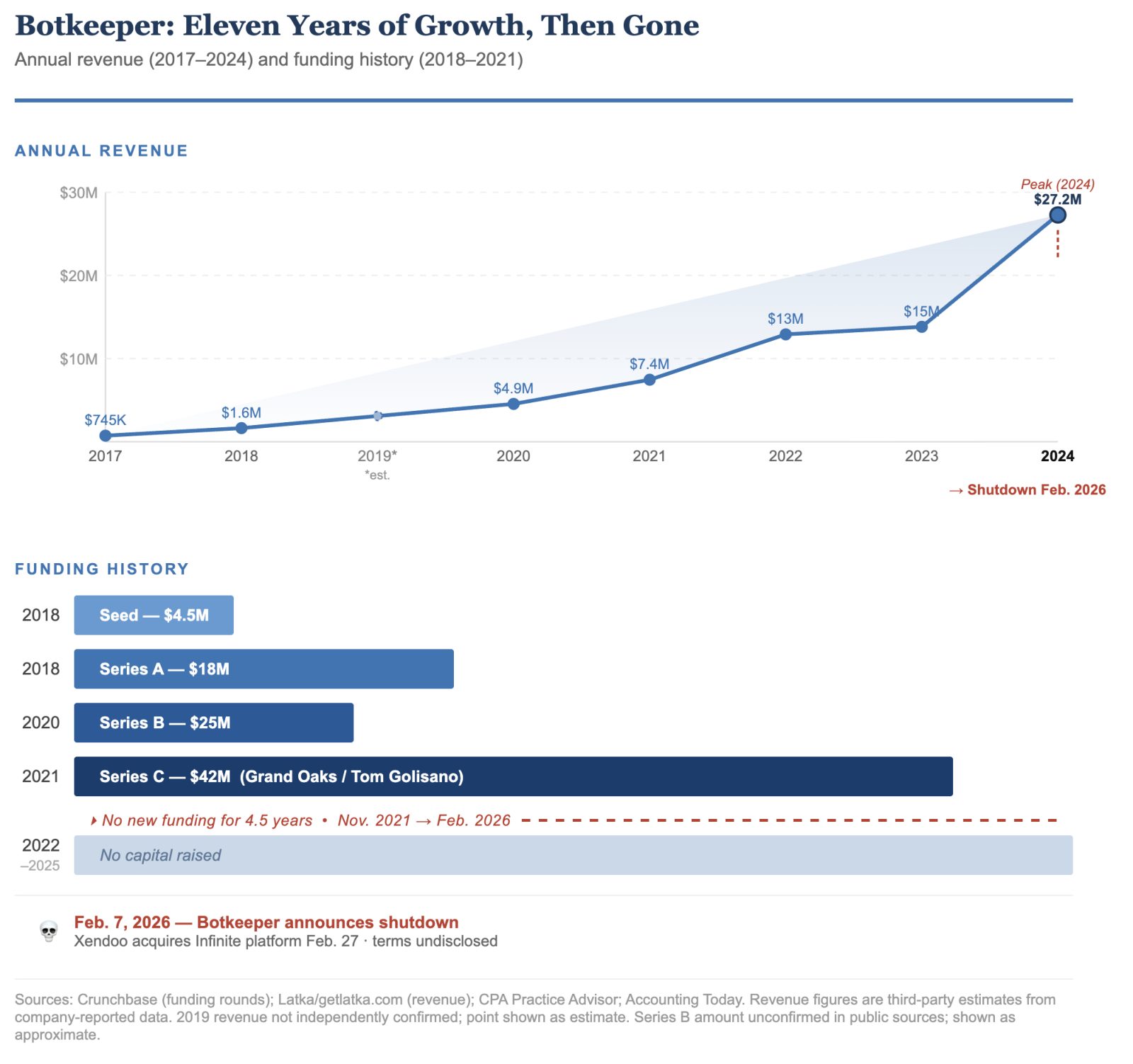
The message was addressed to his community. Palmerino wrote that Botkeeper had started with a radical premise — that AI could handle the nuance of a general ledger, that machines could do the work accountants found most tedious, that the profession could be transformed from the back office outward. “Today, it is with the heaviest of hearts, and also a profound sense of gratitude for the journey,” he wrote, “that I announce the closure of Botkeeper.” The platform — which had raised nearly $90 million over 11 years, served hundreds of accounting firms, and, by its founder’s own account, was within weeks of launching its most sophisticated product yet — was shutting down. The technology had never been more capable. The company could not survive.

THE UNICORN: BASIS.AI
Basis was founded in 2023 by Matthew Harpe and Mitchell Troyanovsky with a simple yet difficult-to-execute thesis: accounting is structured, high-stakes, and essential to every business on earth, and it is one of the most underserved areas in technology. The founders believed that AI agents — not chatbots, not autocomplete tools, not rule-based automation, but genuine multi-step agents capable of independent action across a complex workflow — were about to change that.
The timing was deliberate. The company launched after large language models had demonstrated enough capability to be trusted with structured financial data — after the false dawns of earlier AI eras, and before the window of first-mover advantage closed. “Accounting is structured, high-stakes, and essential to every business on earth,” the founders wrote on the company’s blog at the time of the Series B announcement. “It’s also one of the most underbuilt areas in technology.”
The product Basis built is designed to function like a tireless junior associate. Its agents ingest client documents, accounting system data and enterprise resource planning records. They analyze financial records, extract relevant fields, perform calculations, identify anomalies and produce review-ready output. They do reconciliations. They draft workpapers. They complete tax returns. They do this continuously, in the background, over many hours, returning finished deliverables to a human professional for review and sign-off.
The Form 1065 demonstration was the company’s most pointed statement of intent. A partnership return involves allocating income, deductions, credits and other items across multiple partners, reconciling Schedule K-1s, navigating complex passive activity rules and producing a multi-schedule filing that requires both technical precision and contextual judgment. For a human associate, it is a full day or more of careful, error-prone work. Basis has completed one end-to-end. The human reviewed it.
“In 2026, we expect Basis to drive the same step-change in accounting that software engineering saw in 2025.”
— Vinod Khosla, founder, Khosla Ventures
The comparison to software engineering is not accidental. Over the past two years, AI coding tools — GitHub Copilot, Cursor, and various agents built on large language models — have demonstrably increased software developers’ productivity. Lines of code written per engineer per day have climbed. Time-to-feature has compressed. Junior developers have been able to produce work that previously required more senior oversight. The industry did not collapse; the bottleneck shifted from writing code to reviewing, debugging, and making architectural decisions about it.
Basis is betting that the same shift is coming for accounting. If the bottleneck moves from preparing returns to reviewing them, from executing reconciliations to evaluating them, from drafting procedures to exercising judgment about them, then the firms that adopted these tools earliest will carry a structural cost advantage and a capacity multiplier that firms operating manually cannot match.
The market appears to be betting on it. By the time of the Series B close, Basis’s platform was in use at approximately 30 percent of the top 25 U.S. accounting firms, the company says, and at roughly 20 percent of the top 150. Named clients include Boulay PLLP, Clark Nuber PS, MarksNelson LLC, Pinion LLC and UHY LLC. Miles Clements of Accel, who will join the board alongside Rabois of Khosla Ventures, describes Basis as “years ahead in accounting AI” and says the company “has what it takes to define this category as it matures.”
Prashant Mital, applied AI lead at OpenAI, offers a more technical endorsement. “Basis is on the frontier of building production-grade, long-horizon agents,” he says. “They’ve pushed the limits of what we thought our models could do on real-world, economically valuable, complex accounting tasks.” The implication was notable: OpenAI’s own team has been watching what Basis does with its models.
The $138 million Basis has raised in total — a $3.6 million seed, a $34 million Series A in December 2024 and now the $100 million Series B — is earmarked for expanding engineering and machine learning teams and deepening platform capabilities in tax and audit. The company is also pursuing what it calls an “agent-native” internal culture, deploying its own AI tools across operations rather than asking engineers to build products while doing administrative work the old way.
Basis — By the Numbers
-
-
Founded: 2023, New York City
-
Founders: Matthew Harpe (CEO) and Mitchell Troyanovsky
-
Series B: $100 million at $1.15 billion valuation (Feb. 24, 2026)
-
Total raised: $138 million
-
Lead investors: Accel, GV (Google Ventures)
-
Notable co-investors: Lloyd Blankfein, Khosla Ventures, Adam D’Angelo, Amjad Masad, Clem Delangue
-
Customer reach: ~30% of Top 25 U.S. firms; ~20% of Top 150
-
Key milestone: First AI agent to complete end-to-end Form 1065 partnership return
-
Efficiency gains reported: 20% to 50% across practices (per Khosla Ventures)
-

THE FEBRUARY THAT CHANGED THE CONVERSATION
Basis was not alone. February 2026 saw a concentration of AI-in-accounting investment activity without precedent in the profession’s history.
On Feb. 2 — three weeks before the Basis announcement — Fieldguide, a San Francisco-based platform that embeds agentic AI directly into audit and advisory engagements, announced a $75 million Series C led by the growth equity group at Goldman Sachs Alternatives. The round valued Fieldguide at $700 million. Total funding reached $125 million. Existing investors Bessemer Venture Partners, 8VC and Thomson Reuters participated alongside new backer Geodesic Capital.
Fieldguide was founded in 2020 by Jin Chang, a former CPA who had spent years watching talented auditors burn out on work he believed machines could do. His platform is now used by half of the top 100 U.S. accounting firms, including KPMG, RSM, Baker Tilly, BDO, Grant Thornton, Forvis Mazars, CLA and CohnReznick, among others. Goldman’s due diligence found that clients were achieving 30-40% efficiency improvements.
On the same day as the Fieldguide announcement, a second startup emerged from stealth. Accrual, incubated inside General Catalyst’s $1.5 billion Creation fund — which builds companies from scratch rather than backing founders who pitch — launched with $75 million, including $65 million from General Catalyst itself. The company, led by CEO Cosmin Nicolaescu and co-founder Siddarth Chandrasekaran, both veterans of Stripe and Brex, is focused on the preparation and review bottleneck for individual and partnership tax returns. Early clients include H&R Block, Armanino and Creative Planning.
Add it together, and February 2026 delivered $250 million in new venture capital into AI platforms built specifically for accounting firms. That is not a trend line. That is a signal.
“The future of audit and advisory depends on how effectively firms combine human judgment with AI-driven execution.”
— Harris Pollack, VP, Growth Equity, Goldman Sachs Alternatives
Harris Pollack, vice president with Goldman Sachs Alternatives’ growth equity group, describes the investment thesis for Fieldguide in terms that apply equally to the whole cohort. “Fieldguide embeds AI and agentic workflows directly into how engagements are delivered — helping firms move faster while maintaining the standards that the profession depends on,” Pollack says. “This establishes a new foundation for how the audit and advisory industry will operate.”
For CPA firms, this concentration of capital is not just a technology story. It is a market structure story. When Goldman Sachs’ alternatives arm leads a $75 million round, when Accel — whose portfolio includes Meta, Slack, Dropbox and Atlassian — leads a $100 million round in an accounting software company, these are not bets on a niche. They are bets on a category. The firms that adopt these platforms earliest are, in the view of those investors, building durable competitive advantages. The firms that do not are, implicitly, falling behind.
THE FUNERAL: BOTKEEPER.COM
In 2015, Enrico Palmerino started a company in Boston with a premise strikingly similar to the one Basis would articulate in 2023. AI could transform accounting. The profession was ripe for it. No one had done it right yet.
Palmerino was not wrong. He was early.
“In 2015, we weren’t just a startup; we were pioneers in a landscape that didn’t yet understand nor trust that AI could handle the nuance of a general ledger,” he wrote in his Feb. 7 statement. By the time Botkeeper shut its doors, the platform’s Infinite product could clean up years of messy books in minutes, autonomously reconcile accounts, and code more than 80 percent of transactions with 98 percent accuracy. The company was two months from launching a voice-activated assistant called Cassie and an autonomous check-scanning feature. By its founder’s own account, it had become what he had always imagined it would be.
It could not survive.
The proximate cause, Palmerino told Accounting Today in a detailed interview published March 3 — the same day Basis was still celebrating its unicorn announcement — was customer concentration colliding with an M&A wave he never saw coming. Between 30 and 40 percent of Botkeeper’s revenues, he says, came from approximately 10 clients. Those clients were large accounting firms. And in the second half of 2025, the private equity-driven consolidation that has been reshaping the accounting profession for years accelerated suddenly and violently through exactly that tier of the market.
When firms merge, they consolidate their vendor relationships. A Botkeeper client that becomes part of a larger PE-backed platform may already have a technology stack. The contract does not survive the merger. Palmerino says a first wave of cancellations arrived at the end of the third quarter of 2025. Troubling, but manageable. A second wave hit at the end of the fourth quarter. That one was existential.
“You just would never expect to have the vast majority of those clients all leave at the exact same time with basically no advance warning,” he says.
From the moment Palmerino realized the company faced an existential threat to the moment he concluded there was no path forward was eight days. The 72 hours of acute crisis he describes — exploring every acquisition possibility, negotiating with lenders, seeking bridge capital, bound by confidentiality on all of it — would become the template for every postmortem that followed. The company did not fail slowly, then all at once. It failed all at once.
“Pioneers don’t always get to be incumbents. But they do change the terrain.”
— Enrico Palmerino, founder and CEO, Botkeeper
The closure announcement landed in a profession that had known and respected Botkeeper for years.
“Botkeeper blazed a lot of new trails,” says David Cieslak, a CPA and chief cloud officer at RKL eSolutions who tracks accounting software closely.
Jody Padar, who served as Botkeeper’s vice president of partner development and strategy from 2018 to 2023, offered a harder-edged assessment of the structural risk the company had carried. She compared its situation to an accounting firm whose client base “comes mainly from a small number of large” clients — a concentration risk that is well understood in professional services and one that proved fatal here.
Botkeeper had also gone nearly four and a half years without a new funding round. Its most recent raise — a $42 million Series C led by Grand Oaks Capital, the investment firm founded by Paychex founder and chairman Tom Golisano — had closed in November 2021.
Ellen Choi, CEO of the AI-focused accounting consultancy Edgefield Group, noted what that gap implied. “Four years without raising in an era when AI companies were raising constantly,” she says. “That means you’re either profitable or in a precarious capital situation. The suddenness was partly manufactured. Many tech companies fold seemingly overnight, but internally they’ve been trying to dig themselves out of a hole for a long time.”
The technology question is more complicated.
Botkeeper was built on machine learning — pattern recognition, reinforcement learning, models trained on accounting data by a team of human accountants who fed the AI better and better examples over the years. That was the right approach in 2015, when generative AI did not exist. Palmerino defended it in his March 3 interview, arguing that generative AI still hallucinates too much to be trusted with consistent, accurate, continuously improving accounting work.
Byron Patrick, a CPA who worked at Botkeeper from 2019 to 2022 and is now at Karbon, offered a different read. “Using pure machine learning in an accounting environment is just not as complete a solution as we now have with generative AI,” Patrick tells CFO Brew. “Compared to the AI that we’re using today, that was kind of a butter knife to a steak knife.”
Choi’s framing is perhaps the most precise: “Botkeeper was early — 2015, before most people were talking about AI in accounting. Being early gave them attention, but also meant they built before AI was truly ready. Timing is everything — being too early or too late will lead many startups to death.”
Botkeeper’s technology assets — the Infinite platform — were acquired by Xendoo, a Fort Lauderdale bookkeeping and accounting services provider, on undisclosed terms. Xendoo announced Feb. 27 that Infinite “remains fully operational” and intends to continue developing the platform for the accounting firms that use it. Whether those firms stay or migrate to the new generation of agentic platforms is now their decision.
Botkeeper — By the Numbers
-
-
Founded: 2015, Boston, by Enrico Palmerino
-
Shutdown announced: Feb. 7, 2026
-
Total raised: Nearly $90 million over 11 years
-
Last funding round: Nov. 2021 — $42 million Series C, Grand Oaks Capital
-
Years without new capital: ~4.5 years
-
Revenue concentration: 30–40% from approximately 10 clients
-
Trigger: Two waves of client cancellations in Q3–Q4 2025, driven by PE-led M&A consolidation
-
Crisis timeline: 8 days from awareness to wind-down decision; 72 hours of acute crisis
-
Platform at shutdown: Botkeeper Infinite: 80%+ transaction coding at 98% accuracy
-
Technology: Machine learning (pre-generative AI architecture)
-
Acquirer: Xendoo (Fort Lauderdale, FL); acquired Infinite platform; terms undisclosed
-
THE PRELUDE: BENCH
Botkeeper was not the first to issue this kind of warning.
Six weeks earlier, on Dec. 27, 2024, a Vancouver-based startup called Bench Accounting posted a shutdown notice on its homepage. The timing — the Friday after Christmas, with tax season two weeks away — left 12,000 small-business clients locked out of their financial records at the worst possible moment.
Bench had described itself as North America’s largest bookkeeping service for small businesses. It had raised more than $113 million over 13 years. Its final funding round, a $60 million Series C in 2021, had drawn strategic investors including Sage and Shopify. It employed more than 600 people. Its co-founder, Ian Crosby, who had left the company in December 2021 after a dispute with the board over strategy, describes on LinkedIn the same day as the shutdown what he believed had gone wrong. The board had wanted to take the company in a direction he opposed. He left. The direction they chose did not work.
The trigger, according to reporting, was a venture debt recall by Bench’s bank. The company’s CEO, Jesse Tinsley — of the acquiring company Employer.com — reportedly finalized an acquisition in under 72 hours. Bench was back online Dec. 30. Customers were given the choice to stay with the platform under new ownership or download their data and leave. The acquisition price was not disclosed. Employer.com is an HR and payroll technology company. It had no previous experience in accounting.
The Bench episode established a pattern that Botkeeper would repeat six weeks later: a service-model company — one that pairs technology with human labor to deliver accounting work — runs out of runway suddenly, leaves clients exposed, and is acquired for undisclosed terms by a buyer who may or may not have the expertise to operate what they have purchased. For CPA firms relying on either platform, the lesson was unambiguous: vendor stability is a risk that belongs on the technology evaluation checklist.

WHAT THE RESEARCH SAYS
The timing of these failures does not suggest that AI in accounting does not work. The research, to the contrary, suggests that it works quite well—and that the firms most at risk are those that have not adopted it yet.
In August 2025, researchers at the MIT Sloan School of Management and the Stanford Graduate School of Business published a study that has become a touchstone in the profession’s AI conversation. Bingxin Choi of MIT and Jie Xie of Stanford analyzed hundreds of thousands of transactions from 79 small and mid-sized companies and surveyed 277 accountants about their experience with generative AI tools. The findings were striking.
Accountants using AI supported 55% more clients per week than non-users. They shifted 8.5 percent of their time away from routine back-office processing toward analytical work, quality assurance and client communication — the higher-value work that commands premium fees and builds relationships. Monthly close cycles shortened by approximately 7.5 days. The level of detail in financial reports improved by 12 percent. And notably, the researchers found that more experienced accountants tended to reap larger gains: they knew how to interpret the AI’s confidence signals and intervene strategically when the system was uncertain.
“Generative AI can substantially augment accounting work without displacing the professionals who perform it,” Choi and Xie concluded. The bottleneck shifts. It does not disappear.
Fieldguide’s Goldman Sachs due diligence produced a compatible data point on the audit side: clients of the platform were reporting 30 to 40 percent efficiency improvements in audit engagements. Basis’s investors cite 20 to 50 percent efficiency gains across practices at the firms using its agents. These are not controlled studies, and they are not independent. But they are consistent with the academic research in that direction.
“Generative AI can substantially augment accounting work without displacing the professionals who perform it.”
— Bingxin Choi and Jie Xie, MIT Sloan and Stanford GSB (Aug. 2025)
The demand side of the equation reinforces the urgency.
The AICPA’s 2025 report on the supply and demand for new accounting graduates found that U.S. schools awarded 55,152 accounting bachelor’s and master’s degrees in the 2023-24 academic year — a drop of 6.6 percent from the prior year. It was the third consecutive annual decline. Master’s degrees fell 15 percent. Jan Taylor, the AICPA’s academic-in-residence, offered cautious optimism: enrollment in accounting programs rose 12 percent in the 2024-25 school year, suggesting that pipeline initiatives may be gaining traction. But enrollment gains take four to five years to translate into working professionals. The shortage is here now.
Fieldguide’s Series C materials quantified the gap in terms that made the investment case concrete: an existing capacity shortfall of approximately 125 million hours, worth more than $25 billion in unmet demand, projected to reach 600 million hours and more than $230 billion annually by 2030.
Eva Mrazikova, senior director of product marketing at IRIS Software, put the structural reality plainly. “With over 300,000 accountants having left the profession since 2020 and three-quarters of CPAs approaching retirement age,” she tells Accounting Today, “this isn’t a temporary squeeze — it’s a structural shift that demands new thinking.”
That structural shift is precisely what the venture capital flowing into Basis, Fieldguide and Accrual is betting on. AI agents are not being positioned as optional productivity tools. They are being positioned as capacity infrastructure — the mechanism by which a shrinking profession serves a growing client base.

WHY THE ARCHITECTURE MATTERS
The most important distinction between companies that attract capital and those that close is not the quality of their technology at the moment of their peak. Botkeeper’s Infinite platform was, by any reasonable measure, technically impressive when it shut down. The distinction is architectural and structural: what kind of company were they building, and what kind of risk did that structure carry?
Botkeeper was a service business with a technology layer. In its early years, it used human accountants to train its machine learning models and fill gaps the AI could not yet handle. That was a sound approach in 2016 and 2017 — the only viable approach, given what the technology could do. But it meant the company’s economics were tied to both a labor force and a software product. As generative AI entered the market after 2022, the competitive landscape shifted. Startups without legacy labor costs could build on foundation models that were dramatically more capable than the machine learning algorithms Botkeeper had spent years training. The company that had been the innovator was suddenly the incumbent, trying to catch up.
Basis, Fieldguide and Accrual are software businesses. They do not deliver accounting services. They sell infrastructure — platforms that accounting firms embed into their own workflows, under their own professional supervision, with their own liability. This distinction matters for competitive dynamics, regulatory exposure, and, most critically, the economics of scaling. Software margins are not labor margins. A software platform that adds a new accounting firm client does not need to hire a new accounting team to serve it.
The current generation also benefits from a design philosophy that was not available to the pioneers. All three funded platforms emphasize what their materials call “human-in-the-loop” architecture: AI agents execute, human professionals review, and the audit trail documents both. This is not merely a liability hedge. It is a product feature.
Accounting firms operate in a regulated environment where professional sign-off is legally required, errors carry financial and reputational consequences, and clients expect a named CPA to stand behind the work. A platform that produces AI-generated output and routes it to a licensed professional for review is not undermining the profession. It is restructuring how the profession allocates its time.
Jin Chang of Fieldguide, who spent years watching talented auditors quit the profession over the tedium of first-pass testing, describes the intended outcome: a traditional 10-person audit team, he told Fortune in February, may be able to perform an audit with three people within the next few years. “We will see less burnout in the industry,” he says, “because the work does get interesting at the more senior levels.”
Carl Mayes, vice president for CPA candidate quality and competency at the AICPA, describes the directional destination in similar terms. “If you can train an agent to leverage the AICPA’s entire professional standards suite,” he says, “then you’ve got something much more valuable.” The caveat he attached: “Even then, a knowledgeable human must evaluate its output.” The agent does the work. The CPA remains responsible for it.

WHAT THIS MEANS FOR CPA FIRMS
For a CPA firm evaluating technology strategy, the events of the past three months offer some concrete lessons.
First, the vendor landscape is not stable.
Botkeeper and Bench were both well-regarded platforms with substantial funding histories, active client bases and credible technology. Both shut down within six weeks of each other, in both cases with little advance warning and no graceful transition period for clients. Firms that had built operational dependencies on either platform were left scrambling. The lesson is not that AI platforms are unreliable. It is that service-model platforms — those that deliver accounting work, rather than enabling firms to deliver their own — carry concentration and capital risks that are difficult to assess from the outside. A vendor’s last funding round, its customer concentration and the architecture of its business model are now due diligence questions, not footnotes.
The second lesson is about the speed of the shift.
Basis was founded in 2023 and is already deployed at roughly a third of the top 25 firms. Fieldguide, founded in 2020, is used by half the top 100. The adoption curve for this generation of AI tools is steeper than most firm leaders anticipated.
John Higgins, a strategic technology advisor who tracks the accounting software market, says, “There will be a fierce battle between legacy solution providers trying to hold on to their customer base by integrating the power of AI into their applications versus the new startups that build innovative applications using state-of-the-art technology without the burden of integrating into a legacy application.”
That battle is already underway. The funded startups are winning the early rounds.
The third lesson involves the talent crisis.
The staffing problem that firm leaders describe as existential — and which the AICPA’s graduation data and Fieldguide’s capacity estimates confirm as severe — is not going to be solved by hiring alone. The pipeline is constrained for structural reasons, and even optimistic enrollment trends take years to produce licensed professionals. Firms that are not using AI to extend the capacity of their existing staff are not holding steady. They are falling behind.
Avani Desai, CEO of Schellman, sees the profession bifurcating into two lanes: one automated and fast, the other advisory and judgment-driven. The firms that thrive will be those that master both. “The value of the CPA goes up, not down,” Desai says, “because when AI handles the routine, what’s left is the part clients need humans for: judgment, ethics, and confidence.”
The fourth lesson is about the PE connection.
The private equity consolidation wave that CPA Trendlines has tracked through nearly 350 transactions since 2016 — and which produced the client cancellations that ultimately killed Botkeeper — and the AI investment wave visible in February’s funding announcements are not separate phenomena. They are expressions of the same underlying theory that accounting workflows can be automated at scale, that the firms capable of deploying that automation will carry structurally higher margins than those that cannot, and that those margin differences make accounting firms worth acquiring and aggregating. PE buyers are acquiring firms in part because they expect AI to change the value of those firms. The firms being acquired are often acquiring AI tools as part of the same transformation.
What that convergence means for the profession’s long-term structure — for pricing, for staffing, for the economics of partnership — is a question the industry has not yet fully answered. February’s funding announcements are the loudest signal yet that the answer is coming faster than anyone planned for.
THE TERRAIN HAS CHANGED
In his shutdown statement, Enrico Palmerino wrote something that deserves to stand alongside the unicorn headlines.
“It mattered because it forced an old profession to confront a hard truth,” he says of Botkeeper’s run. “AI wasn’t coming someday. It was already here. And it wasn’t theoretical. It could do real work. Messy work. Accounting work.”
He was right about that in 2015, and he is right about it in 2026. The difference is that in 2026, the firms that spent those 11 years figuring out how to build the right business model around that truth are worth more than a billion dollars and are being deployed inside half the top 100 accounting firms in the country. And the firms that spent those years building the wrong model, however good their technology became, are writing eulogies.
The accounting profession is not facing a choice about whether AI will arrive. It has arrived. The choice facing CPA firms now is narrower and more practical: which platforms to trust, which architectures to build on, what to do when a vendor closes without warning, and how to prepare a workforce for work that looks different from what it did two years ago.
Those are not abstract questions. February 2026 made them urgent.