The test is whether practitioners can learn to run AI before AI outruns the practice.
By CPA Trendlines Research
With artificial intelligence now firmly embedded in the daily life of tax and accounting firms, the profession’s next test is whether practitioners can learn to run AI before AI outruns the practice.
A new crop of research studies and benchmarking surveys suggests firms have yet to fully govern the tools, price the work, train the staff and protect client trust under AI regimes. Reports from the AICPA, Karbon, CPA.com, Blue J, Intuit Firm of the Future, KPMG, Personiv, the ACCA, Rightworks, Business.com and Citrin Cooperman show AI adoption is no longer in doubt. Coping with it is.
MORE Artificial intelligence | Supkis Cheek: Most Accountants Are Missing This AI Shift | |Private Equity’s Big Bet Faces an AI Shake-Up | Doug Slaybaugh: How to Define “Values in Motion” | At ENGAGE 2026, a Profession Richer and Less Certain Than Ever. | Jen Cryder: From Membership Model to Market Maker | Big 4 Transparency | Three Tech Priorities with Rapid ROI | The Google Playbook for Young Accountants | AI Can Fix Your Workflow—or Break It in Seconds |
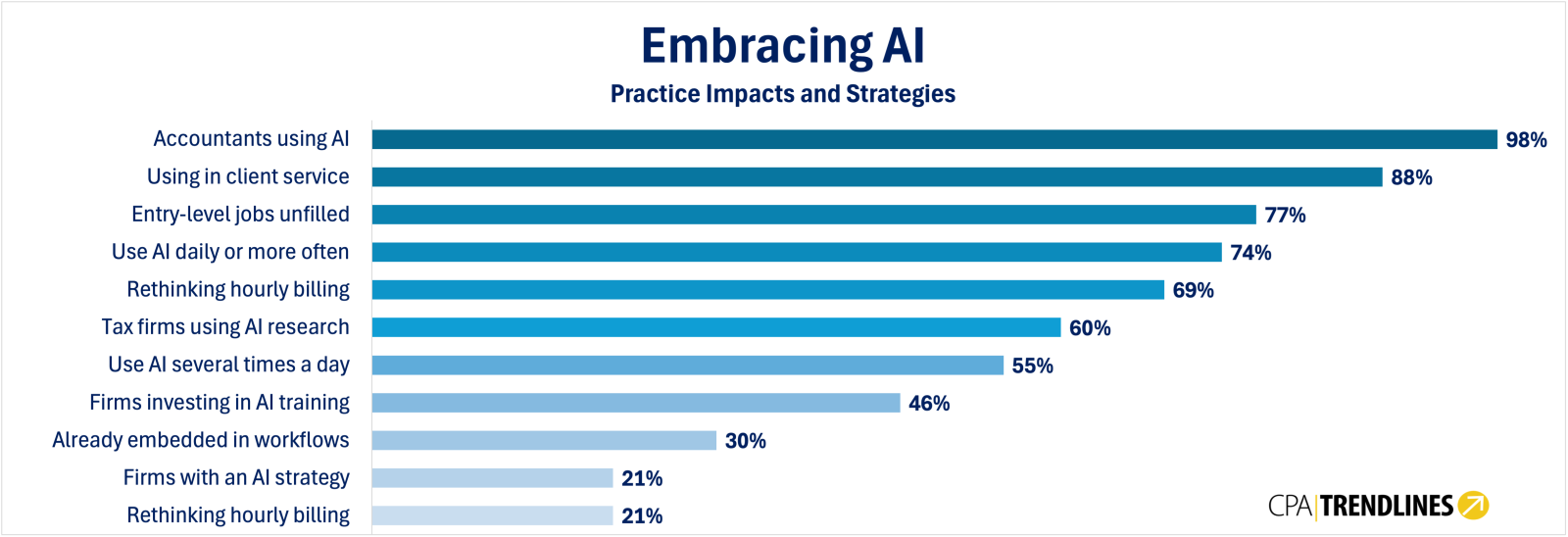
Karbon says 98% of accounting professionals use AI, up 15 percentage points from last year, with 55% using it several times a day and 74% using it daily or more often.
Intuit says 88% of accounting professionals used AI for at least one client service in the last 12 months, and 86% used AI for at least one firm operation. Some 46% of firms are investing in AI training, 21% have an AI policy, and 21% have an AI strategy. Intuit says 30% describe AI as embedded by default in daily work, while 54% use it only when it seems useful.
Overwhelimng tech change
AICPA puts the gap at the top of the profession’s five-year agenda, ranking change management related to technology, including AI, as the No. 1 long-term issue across firms.
“The top issues for firms tie into the transformation we’re seeing in technology, people skills and operating models,” says Lisa Simpson, AICPA vice president of firm services. “Regardless of technology capabilities, accounting is still a people business.”
KPMG and the University of Texas at Austin find a similar split inside KPMG’s own workforce. The study of more than 1.4 million workplace AI prompts and responses from about 2,500 employees over eight months finds that nearly 90% of employees used AI regularly. Still, only about 5% showed the most sophisticated usage patterns.
KPMG says the findings show that high-impact AI use is observable and teachable.
The study also warns against equating activity with skill, saying many organizations rely on usage frequency, hours logged, prompt counts, tokens or self-assessed skills even though those measures do not show sophistication or impact.
More time to work
CPA.com and Blue J say adoption of AI-powered tax research nearly doubled in the last year, to 60%, while the share of firms planning adoption rose from 20% to 32%.
The same report says 80% of respondents use either general-purpose AI or tax-specific AI on a weekly or monthly basis, suggesting individual use is running ahead of formal firm-wide adoption.
Among AI adopters in the Blue J/CPA.com survey, 69% are considering alternatives to traditional hourly billing.
The report says 37% are moving toward value-based billing, 30% are adopting a hybrid model, 28% are maintaining hourly billing while increasing realization, and 3% are making no change.
“Clients aren’t paying for the time it takes to do something right now. They’re paying for the sum of experiences over your career,” says Brandon Allfrey, senior director of tax transformation at CPA.com, framing the issue as value rather than time.
AI in audit
Blue J/CPA.com says 77% of AI-powered tax research adopters report that the tools give them more time for work that better uses professional judgment, while 2% say AI reduces the value of their professional judgment.
“One of the worst things firms could do when looking at AI-driven time savings is try to just do more work,” says Allfrey, warning against using the saved time merely to pile on more work.
In audit, there will be “next to no human beings” performing routine audit testing in two or three years, according to Thomas Mackenzie, KPMG’s audit chief technology officer, quoted by Bloomberg.
Citrin Cooperman’s analysis of AI audit risk describes the control gap from the internal audit side.
“The challenge is not awareness of AI risk, but clarity around what to audit, how to assess it, and what good looks like,” Citrin says.
Intuit says firms increasingly value judgment, modern-tool fluency and client-facing ability, not only technical proficiency.
But 77% of respondents report at least one hiring struggle in the last 12 months, and 56% say a new entry-level hire would need at least six months to become fully productive.
Job openings explode
A Personiv personnel survey shows a parallel shift in corporate finance and accounting, noting the average number of job openings has tripled since last year and exploded eightfold since 2024.
But 63% of leaders now use AI and automation to reduce the need to fill roles, up from 23% in early 2025.
And 94% use outsourcing to fill open accounting positions and manage expanding workloads.
“The time for doubling down on recruiting has passed,” Matt Wood, Personiv’s global head of finance and accounting outsourcing, says.
ACCA reports 82% of respondents feel confident in their ability to learn and apply AI capabilities, 52% regularly use AI tools, and 43% say their employer provides AI-related upskilling, up from 32% in 2025. Yet 51% remain worried about AI’s effect on jobs.
Randstad finds the same unease in the broader labor market, reporting 47% of workers fear AI will benefit the company more than employees. In contrast, one in five workers believes their tasks are immune to AI efficiencies.
Clients want proof
Randstad also says job postings requiring “AI Agent” skills have jumped 1,587%, and demand for “AI Trainers” is up 247%.
Intuit says 60% of accountants report clients are asking for proof of AI data protection.
Rightworks reports that 91% of small and midsize businesses acknowledge AI benefits, while 93% have concerns.
Time savings rank as the top benefit at 60%, and data privacy ranks as the top concern at 57%.
Business.com says 57% of U.S. small businesses are investing in AI, up from 36% in 2023, and 30% of employees now use AI daily.
The survey also says 45% of small-business workers worry that too much AI could harm their company’s reputation, and 12% of small businesses are very likely to reduce staff because of AI in the next 12 months.
Bob Hutchins, CEO of Human Voice Media, tells Business.com that “AI anxiety is often linked to trust.” He adds: “We tend to trust what we can see, shape, and understand.”