Outlook 2026: Tax Prep Prices Surge and Diverge

Experience, complexity, and scarcity redefine the market
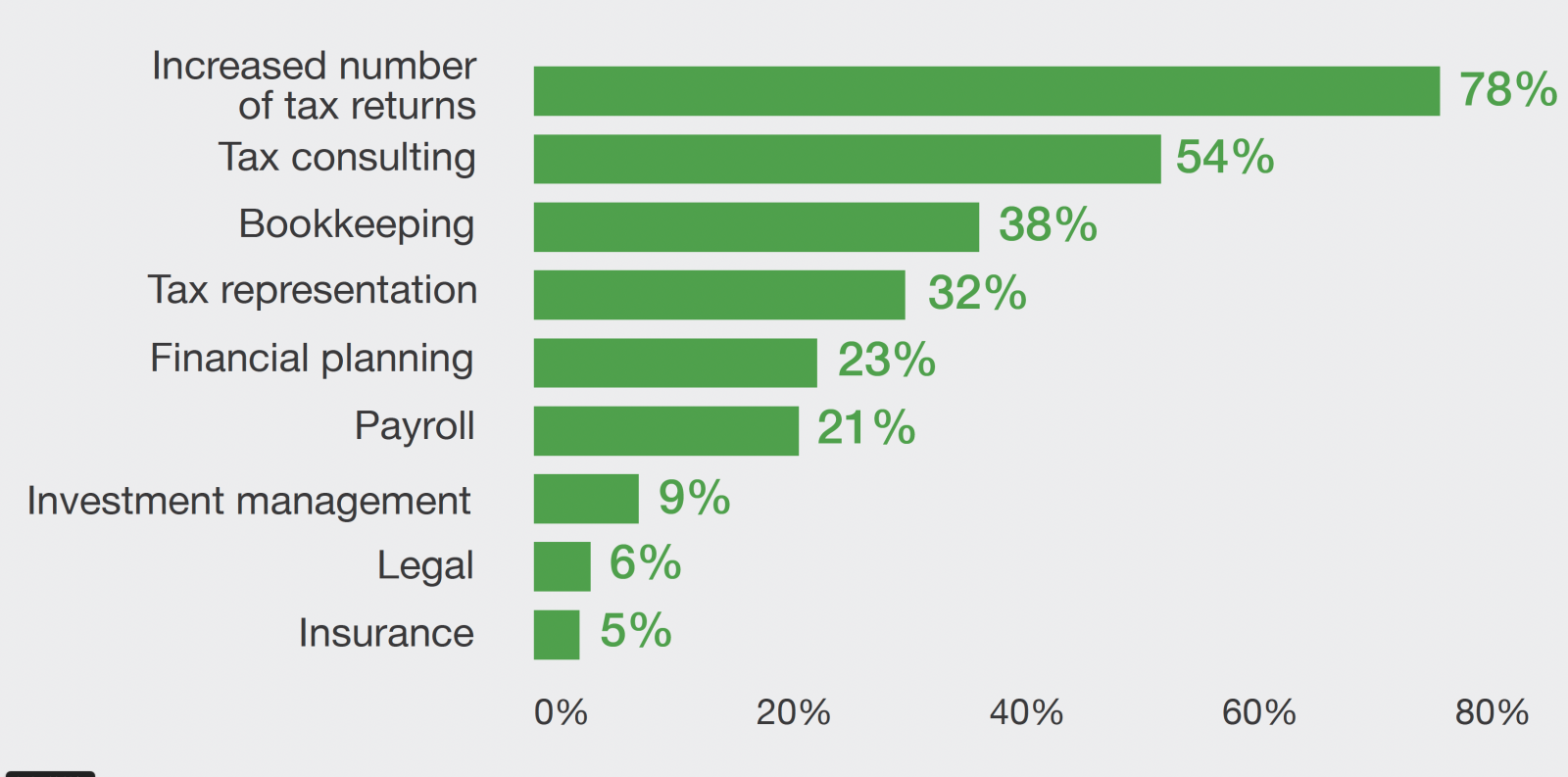
Volume and consulting drive growth: Of the 48% of firms reporting advances, 78% credit more business and 54% credit higher-grade services. Source: NATP

By CPA Trendlines

Tax preparation is getting markedly more expensive in 2026, and not in the slow, incremental way many firms have long assumed they can explain away.

In a widely used pricing model, the National Association of Tax Professionals reports the average base charge for a Form 1040 with Schedules is $236, up from a 2024 average of $162 reported in the same study series. That’s a 45.7% nominal increase in two years for the profession’s signature product, before a single schedule, state filing, or complexity premium is added.

JOIN the Busy Season Barometer survey. Get the results.

MORE TAX and PRICING

The U.S. tax preparation market is not merely more expensive.  It is increasingly stratified, with pricing that clearly distinguishes between complex professional work and the lower tiers of retail and do-it-yourself alternatives.

Across multiple independent pricing measures, certified public accountants and credentialed tax professionals command fees that are substantially higher than the base costs advertised by major retail chains, software platforms, and dwindling government-sponsored free filing options. The result is a world of tax preparation pricing that reflects not only the complexity of engagement but also client expectations, risk management, service delivery models, and clear segmentation of value.

At the high end of the market

Tax preparation services by credentialed professionals, such as CPAs and enrolled agents, regularly sell for hundreds to thousands of dollars per engagement. According to surveys and pricing compilations from Bluegrass Professional Associates, national averages for CPA preparation services in 2025 are approximately $300 overall, with individual returns ranging from about $200 for simple forms to $600 or more for moderate complexity, and business returns often exceeding $2,500 for entities with multiple schedules, multi-state issues, or significant deductions. Hourly billing among CPAs and similar professionals typically ranges from $200 to $400 per hour, depending on the geographic location and firm reputation.

These professional pricing norms for 2025 build upon historical trends of fee escalation indexed to both complexity and expertise. Independent pricing guides document that tax preparation fees have “been steadily increasing,” with nearly 90% of accounting firms planning to raise their rates for individual tax returns in 2025. Firms in New York state, for example, reported average baseline charges of $200–$300 for simple individual returns and that roughly 49% of firms charge between $400 and $799 even for basic individual services.

Minimum fee plus: Total price equals 1040 base, plus additional schedules and forms. Source: NATP

The spread between professional and retail pricing is stark.

Major national retail tax preparation chains offer lower entry price points for basic filers, but those prices rise steeply with complexity and additional services. At H&R Block, published up-front pricing shows base preparation starting at around $89 for federal returns, plus additional state fees that often begin at about $75 per state, with additional per-form fees for credits or deductions as the client’s tax picture becomes more complex.

Jackson Hewitt’s published 2024–25 retail pricing guidance explains how packages are structured by complexity level, with basic federal and state filing bundled at a lower tier and more complex packages charging for each additional form such as Schedule C (business income), Schedule D (capital gains), or Schedule E (rental income), pushing the total retail cost higher with each added unit of complexity.

Cost HQ’s analysis places typical in-store Jackson Hewitt costs for basic tax preparation in 2025 in the ballpark of $120 to $230 for simple federal plus state returns, rising to $250 to $450 or more for Schedule C filings and $500 to $900 for returns with multiple complexities or add-ons.

Retail chains vs. DIY software 

Retail chains are also competing with a growing array of software and government-affiliated free file programs. The IRS Free File Program, part of the Free File Alliance, enables eligible taxpayers—typically those with adjusted gross income below a set threshold—to prepare and electronically file their federal returns at no cost, though some providers may charge nominal state fees of $10 to $30.

Tens of millions of taxpayers have used this or related free, fillable forms options since the early 2000s, collectively saving an estimated nearly $2 billion in avoided professional fees, based on conservative per-return savings estimates. Similarly, the government’s short-lived IRS Direct File initiative aimed to provide guided, free federal filing for all taxpayers, with early data suggesting hypothetical per-taxpayer savings of around $160; however, the program’s operational status remains in flux.

The professional pricing data underscores how different the market now is compared with consumer expectations. Even for competent DIY filers using commercial software such as TurboTax, TaxSlayer, or H&R Block’s own online platforms, pricing can quickly approach or exceed hundreds of dollars when multiple forms, schedules, or state returns are required. A recent Investopedia guide noted that professional tax preparation costs “can range from about $220 to more than $1,200 depending on the complexity of a taxpayer’s return and their location.” At the same time, software alternatives rarely exceed low to mid triple digits for basic federal and state filing combined.


Service / Channel Typical Range Notes / Examples
Professional CPA / Credentialed Preparer (National) $200 – $600+ Individual returns; complexity raises price
Professional – Moderate Complexity $400 – $800 Itemized, investments, self-employment
Professional – High Complexity $1,200 – $2,500+ Multi-entity business, rental portfolios, foreign income
Professional – Business Returns (CPA) $1,200 – $2,500+ S-Corp, C-Corp, multi-state
CPA Hourly Billing $200 – $400/hr Geographic / firm reputation variation
 

Retail – H&R Block Base


about $89 + State Fees


Base federal; state often ~$75 each

Retail – Jackson Hewitt (In-store) $120 – $230 Simple federal + state
Retail – Jackson Hewitt with Complexity $250 – $900 Schedule C / multiple add-ons
Retail – Jackson Hewitt Online about $25 Basic online federal filing
 

Software DIY Tiered Pricing


Free – $100+


Basic federal + state (varies by provider)

Government – IRS Free File (eligible) $0 (state fees may apply) Income-based eligibility
Government – IRS Free Fillable $0 Federal only; advanced DIY
Tax preparation pricing, 2026, across professional, retail, software, and government filing channels.
Ranges represent typical market observations. Actual fees vary by complexity, geography, and service model.

Divergence explained

At the macro level, professional rates reflect the confluence of increased tax code complexity, labor scarcity in accounting and tax preparation, and the value placed on reducing risk and leveraging expertise. Multiple independent guides note that location matters, with CPAs in major metropolitan centers charging 25% to 40% more than their counterparts in rural markets, consistent with broader pricing dynamics in professional services. Complexity and form count also drive the pricing structure: returns involving self-employment income, rental real estate, multi-state reporting, or business ownership incur higher fees because they require more time, deeper technical expertise, and increased exposure to compliance risk.

This differentiation becomes more evident when analyzing ranges beyond simple averages. According to independent sources, basic individual returns prepared by a CPA may be reasonably expected to run $200–$300, but moderately complex returns involving itemized deductions, investments, and business income commonly fall in the $400–$800 range, and the highest echelons of complexity—multi-entity business returns, extensive rental portfolios, or foreign income reporting—often exceed $1,200 to $2,500 or more for the most sophisticated engagements.

Retail pricing, by contrast, emphasizes volume and accessibility, while still reflecting incremental cost add-ons for added complexity. For instance, although Jackson Hewitt’s flat $25 online filing is among the lowest advertised rates for basic electronic submissions, in-store services tailored to complex situations such as business income or multiple schedules can push the total bill into the mid-hundreds, aligning in part with low-tier professional pricing while still differing in service scope and expertise level. H&R Block’s approach combines software and professional assistance, offering free basic filing for simple returns, tiered fees for expanded support, and expert professional preparation starting at $89, plus state fees, for more complex filings.

The pro shift

The evolution of pricing models highlights how professionals are increasingly shifting from traditional hourly billing to flat or project-based fees that explicitly price complexity. Independent price guides note three common billing structures: flat fees for predictable engagements, hourly rates for engagements with uncertain scope, and per-form pricing where each additional schedule or entity form adds to the total cost. Flat fees prevail for simple and moderately complex returns, offering clients predictability, while hourly billing remains the primary approach for bespoke, high-complexity, or advisory services, where time and judgment vary significantly.

From the practitioner’s perspective, these structures reflect market realities. Rising operational costs, including wages for credentialed staff and investments in technology and regulatory training, have pressured firms to adopt pricing strategies that sustain profitability. Small accounting practices report that their minimum acceptable fee for individual filings has increased as they balance workload and overhead. Surveys show that roughly 90% of firms planned to raise their rates in 2025, responding not only to inflation but also to the competitive need to differentiate their professional expertise from commoditized alternatives.

This environment of pricing stratification has important implications for taxpayers, firms, and the broader accounting profession. For taxpayers with straightforward tax situations—such as W-2 income, standard deductions, and no complex credits—low-cost or free filing options remain viable and financially rational. Software platforms, including TurboTax, TaxAct, and FreeTaxUSA, offer tiered pricing that often keeps basic filing costs under $100 or at zero for qualifying filers, with add-ons for state returns and advanced forms. Government programs such as IRS Free File further expand access to no-cost, compliant filing for eligible taxpayers, preserving affordability for the majority who do not require professional advisory services.

For taxpayers with complex financial situations—such as multi-state income, significant investment activity, business ownership, rental properties, or fiduciary responsibilities—the higher end of professional pricing correlates with deeper expertise, compliance risk mitigation, and advisory value that cannot be automated away by software alone. The ability of professionals to interpret evolving tax law, optimize deductions and credits, and represent clients in audit or controversy situations distinguishes premium service from routine filing and commands commensurate value in the marketplace.

The view from the practice level

CPAs and tax specialists are also responding to the challenge of articulating and justifying these value differentials. Pricing experts advise firms to adopt evidence-based pricing strategies that reflect the true cost, complexity, and risk of engagements rather than relying solely on competitive price matching or legacy hourly rates that can erode margins. Such strategies include value pricing, tiered service packages, and transparent scope definitions that help clients understand where professional fees align with outcomes and expert support.

As the 2026 tax season unfolds, it is clear that pricing is becoming an increasingly strategic lever in both client acquisition and practice sustainability. Professionals who adopt structured pricing, invest in client education about fee drivers, and differentiate their services based on expertise and advisory outcomes are better positioned to thrive. Conversely, taxpayers who choose lower-cost or free options must be mindful of the limitations of those paths when faced with complexity beyond standard forms.

In this differentiated ecosystem, tax preparation pricing in 2026 reflects not just economic cost but also the evolving nature of tax compliance itself. It’s an arena where clarity, expertise, and risk management increasingly command premium value, and where the market’s pricing signals are separating basic filing needs from professional solutions that warrant higher fees.


Leave a Reply
