21 Hard-Earned Lessons from Tax Season 2026

And What 20 Years of Data Say Comes Next

By CPA Trendlines Research

There is a ritual to tax season. It begins with anticipation dressed as control.

Practitioners tally the risks — the IRS, the law, the clients who will not deliver on time — and tell themselves this year will be different. Then the season starts. And it isn’t.

MORE Busy Season BarometerJoin the survey. Get the results

The CPA Trendlines Busy Season Barometer tracks that ritual across waves of surveys from September 2025 through April 2026 with more than 300 respondents.

The data show not a profession in crisis, but a profession under stress. Where pressures no longer arrive one at a time but stack up on each other. Where external shocks have been absorbed, and internal limits have come into view.

Tax season is full of noise, chaos and confusion. But a close look at the Busy Season Barometer from this year – and going back more than 20 years – can cut through the fog for the patterns, trends, insights and, most of all, the tough lessons learned.

Tax season 2026 gives us at least 21 essential takeaways.

1. The season opened at a record high.

In December 2025, net sentiment reached a positive 29.8 — the highest pre-season reading in the Barometer’s history. Practitioners had, for once, clarity. The One Big Beautiful Bill, passed July 4, 2025, resolved years of TCJA uncertainty. Rates were permanent. Deductions were defined. The rules were known. That certainty registered as confidence. And confidence registered as optimism.

Join the survey. Get the results.

2. Then it fell — farther and faster than any prior season.

By April 2026, net sentiment had fallen to negative 2. The 32-point swing from December to April is the largest in-season reversal recorded in the history of the Barometer.COVID’s 2020 collapse was faster. The 2013 federal sequester’s trough was deeper. But those were events imposed from outside. This reversal was internal. The system didn’t break. Firms broke.

3. The final reading was negative — for the first time.

The April 2026 close of minus 2 is the first negative end-of-season reading in this Barometer cycle. For historical perspective, the sequester season of 2013 reached minus 47.9. The COVID crash of May 2020 hit minus 35.5. The IRS backlog peak of April 2021 reached negative 45.2. By those standards, 2026 was not the worst season practitioners ever navigated. It was the worst they had navigated since they last had reason to believe it wouldn’t be.

4. One-third of the profession was unmoved.

A consistent 37% to 38% of respondents reported conditions “about the same” in every wave. They did not spike in December. They did not crash in April. That stability is not statistical noise. It is structural. A segment of the profession has built systems — pricing, workflow, client selection — that buffer seasonal volatility. Others have not. The gap between them is widening.

5. IRS dysfunction peaked early — then faded as a top concern.

In January 2026, IRS operations ranked as the top concern at 62.3%, up from 52.1% in September. The IRS had shed roughly 19,000 employees over the prior year. Its paper-return backlog had surged from 52,000 in December 2024 to 294,000 a year later. By April, that figure had fallen to 30.2% — not because the IRS improved, but because practitioners had absorbed it and moved on.

6. Tax law complexity followed the same arc.

Tax law concerns fell from the mid-50s in early waves to just over 20% in April. The rules did not get simpler. The One Big Beautiful Bill introduced real complexity. But practitioners had processed it. What they could not absorb was what came next.

7. Workload was the concern hiding in plain sight.

When “too much work, not enough time” appeared as a formal category in the April survey, 46.2% of respondents selected it immediately — tying for the top concern. It had been there all along, expressed in open-ended responses across prior waves. It simply had not been named. The profession is no longer strained by complexity alone. It is strained by volume.

8. Client behavior became the single biggest friction point.

“Clients late or unprepared” rose to 56.6% in April — the highest reading in the dataset. It is not a technical problem. It is a coordination problem. Practitioners are responding with structural changes like earlier deadlines, enforcement, client culling, and waitlists. The adaptation is visible. Firms are choosing their workload rather than absorbing it.

“Giving deadlines to have the paperwork turned in so I’m not doing everything at the last second. If it’s not turned in, I won’t guarantee it will get done.” – CPA firm founder-owner, New Castle, Pa.

9. Extensions were redefined — from failure to strategy.

In January, 47% of respondents expected extension volume to increase, up sharply from December. By April, 40.4% confirmed it. Extensions are no longer a signal that work cannot be done. They are deciding when it should be done. Busy season is stretching, by design, into summer.

10. Revenue held. Profit didn’t.

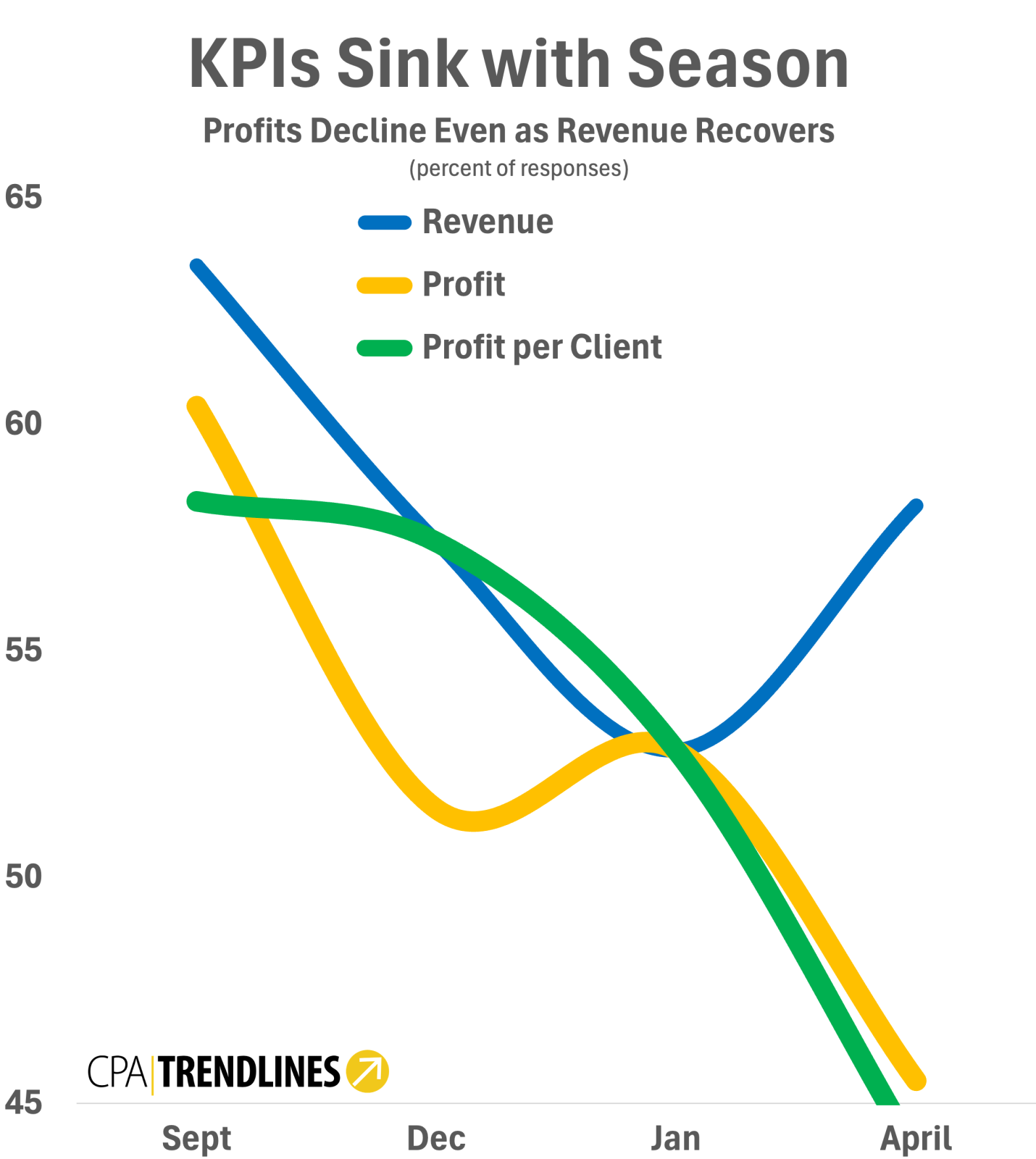
A majority of April respondents — 58.2% — report increases in total revenue, consistent with recent years. But only 43.9% report higher net profit. Profit per client fell the most sharply, dropping roughly 15 percentage points across the season. Practitioners worked more. They billed more. They kept less.

11. The fee distribution is bimodal — and the gap determines outcomes.

The April wave reveals a market split nearly in half. 31% of respondents serve clients who pay under $1,000 annually. Another 31% serve clients paying $5,000 or more. The middle is narrowing. Firms reporting profit growth had median fees of $3,413. Firms reporting flat profit had median fees of $825. The difference is not efficiency. It is structure.

“There is a shortage of accountants and we no longer need to compete for clients. Raising fees without worry.” – James Sosinski, The Koenig Group CPAs, Scotch Plains, N.J.

12. Three cost pressures aligned simultaneously.

Rising labor costs, complexity overhead from new tax provisions, and accelerating technology investment arrive together. In prior cycles, one or two of these might dominate. In 2026, they converge. The result is not a collapse, but a steady narrowing of margins — a quieter, more persistent form of strain than the profession is accustomed to measuring.

“Clients are going away in droves due to price increases necessary to keep up with steeply rising staff salaries.”
– Wendi Hall, DBHW CPAs, South Milwaukee, Wisc.

13. Pricing power for some, not everyone.

The median typical-client annual fee rose from $1,262 in September to $2,000 in April — a 58% increase that reflects real fee discipline, not panel composition change. But the distribution matters. Firms anchored in the under-$1,000 tier cannot meaningfully raise prices without losing clients. Firms operating at $5,000 or more have pricing power — and are using it.

14. AI adoption accelerates — dramatically.

At the start of the season, 42.7% of firms planned no changes to their technology stack. By April, that figure had fallen to 12.6%. Artificial intelligence, absent as a structured category in September, became the top planned investment at 52.6% by April. In the span of one season, AI moved from the periphery to the center.

15. AI impact did not follow adoption.

Only 15.3% of respondents say AI had reduced their work hours. The technology is advancing faster than its demonstrated value. The promise of productivity remains, for most, unrealized — not because the tools are failing, but because adoption without commitment produces negligible results.

16. Full AI commitment is the dividing line.

Among firms fully committed to AI integration, 75% reported time savings. Among those taking a minimal or wait-and-see approach, the figure was in the single digits. The technology is not failing uniformly. It is succeeding selectively — and the selection criterion is how seriously a firm treats implementation, not which tool it chose.

17. AI works for research and communication. Not for preparation.

Practitioners consistently report value in research, drafting, and client communication. They do not report it in tax preparation or review. The bottleneck has not moved. Where practitioners try to use AI as a substitute for preparation rather than as a research and communication accelerant, they report more problems, not fewer.

“Every AI program I use, other than for research, has caused more headaches and increased the time needed at higher billing levels to resolve the issues it created.” – CPA, Olney, Md.

18. AI has made client management harder, not easier.

More than a third of respondents — 37.8% — agree that “AI makes clients think they’re experts.” For the first time, a major technology shift has increased the difficulty of managing client expectations while promising to reduce internal workload. The practitioner is now mediating between what AI tells clients and what the tax code actually requires.

“Clients think AI is correct every time.” 
– CPA, Bonita Springs, Fla.

19. Nearly half the profession is firmly opposed to private equity — and they’re the ones under the most strain.

Forty-six percent of respondents describe themselves as firmly opposed to PE. They are not interested in selling and define their independence as identity. And yet, those same respondents report worse season outcomes than their more PE-open peers. This is not enthusiasm versus resistance. It is capacity versus exhaustion. The firms under the greatest strain are also the least inclined to consider structural change. The tension is not ideological. It is practical.

“Why work and invest in a firm as a young employee if you know a PE firm is going to make an offer you can’t come close to matching?”
– CPA

20. The real issue is succession — and it is not being solved.

The Barometer repeatedly surfaces the succession problem: concerns about the talent pipeline, retirement and the long-term viability of the partnership model. PE is not the cause of these concerns. It is a response to them — one option among few in a system where internal solutions are increasingly difficult to execute. The unanswered question is not whether PE is good or bad for the profession. It is what happens when there is no succession plan at all.

“What happens when the investors want out?”
– CPA, Crestwood, Ky.

21. Twenty years of data offer one consistent lesson: busy season doesn’t get easier. It changes.

In 2013, the force was policy. In 2020, a pandemic. In 2021, a backlog. In 2026, it is internal capacity — the ability of firms to manage their own systems under sustained, compounding pressure. Next season will not be defined by whether conditions improve. It will be defined by whether firms adapt.

The tools are visible: pricing discipline, client selection, workflow systems, targeted AI use, structural options including — for some — private equity. But adoption is uneven. And uneven adoption produces divergence.

Some firms will continue to operate in that stable middle — the 37% who report ‘about the same’ regardless of conditions. Others will continue to cycle through optimism and overload. The difference is no longer external.

“Managing the practice, not the practice managing us.”
– EA, Lewisville, Texas

That, more than any single statistic, is what Tax Season 2026 made clear.

Leave a Reply
