CPA PE Deal Tracker™: 57% Say PE Threatens the CPA Brand.

But They’ll Take the Money.
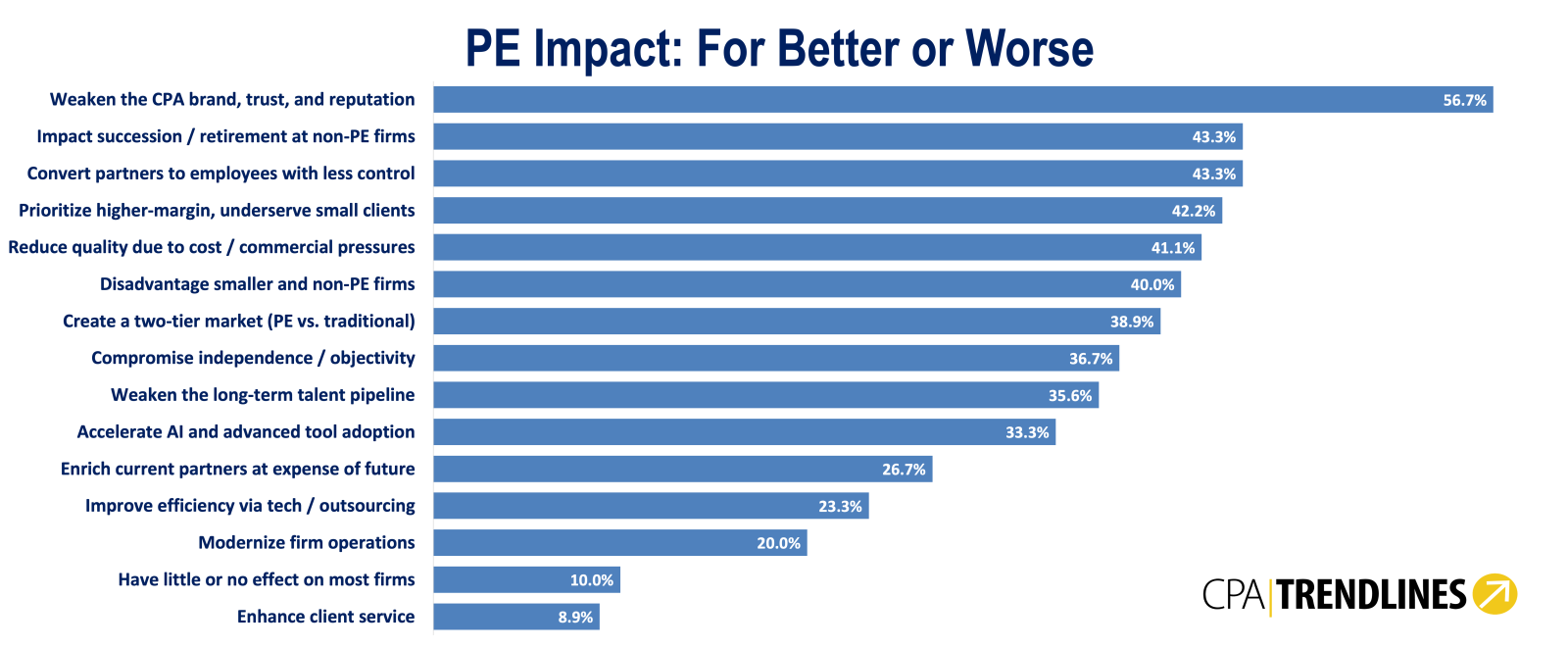
Most CPAs are concerned that private equity is undermining the CPA profession’s reputation for independence and objectivity. Only 10% say PE will have little or no impact. Fewer still can say PE will improve client service. (CPA Trendlines)

By CPA Trendlines

It’s a toss-up between CPAs opposed to PE and those unopposed. (CPA Trendlines)

As the CPA Trendlines CPA PE Deal Tracker™ adds 13 more closings for the month of May, a new survey shows accountants worrying about PE tarnishing the image and reputation of the profession. But half say they might take the money anyway.

MORE Private Equity | MORE All 500-plus Headline Deals for the Last 10 Years

The CPA PE Deal Tracker™ now contains more than 500 headline deals and developments. Through May 31, the tracker shows 91 headline 2026 events, including 83 M&A deals. Full-year 2025 finished with 190 significant events, including 178 M&A deals. The last three consecutive months have produced the first sustained plateau in 12-month trailing M&A activity since the acceleration phase that began in 2023.

Meanwhile, nearly half of the professionals in the new CPA Trendlines survey — 49.5 percent — describe themselves as decidedly opposed to private equity investment: fiercely independent, not interested, never ever.

The rest, a bare but discernible majority, are not. They would do a deal for the right price. Or they are already in play. Or have already done a deal.

“It only makes sense to keep our options open,” says Michael Royer of Royer Advisors and Accountants in Falmouth, Maine. He is not opposed, and he is not sold, adding “it’s still a personal business — and we don’t know the full impact of AI.”

91 deals so far in 2026

May 2026 is what the unopposed look like when they do a deal. Monthly activity remained healthy, even as growth slowed. May produced 13 verified institutional-capital M&A transactions in accounting firms and related advisory businesses, up from seven M&A deals and 10 meaningful tracker events in April, and on par with the year-ago May.

The CPA Trendlines PE Deal Tracker now contains 472 verified tracker rows. Through May 31, the tracker shows 91 meaningful 2026 events, including 83 M&A deals. Full-year 2025 finished with 190 meaningful events, including 178 M&A deals. The last three consecutive months have produced the first sustained plateau in 12-month trailing M&A activity since the acceleration phase that began in 2023.

Ascend opens the month on May 1 with the marquee deal, Alabama’s Jackson Thornton — founded in 1919, a Gulf Coast regional leader with six offices, roughly $41 million in revenue and 30 partners.

Three days later, Frazier & Deeter – backed by General Atlantic, PSP Capital Partners and Aksia – picks up Copeland Buhl in Minneapolis.

On May 6, Aprio adds Phoenix’s Price Kong and a cannabis-industry client base. Two days after, Doeren Mayhew takes South Miami’s Parlade Schaefer Schortz, with about 25 professionals. Mid-month brings a cluster: Nichols Cauley — the Madison Dearborn platform, barely a year old — buys Miami’s Molieri Group. Citrin Cooperman adds Coral Gables firm Sharff, Wittmer, Kurtz, Jackson & Diaz, and Sorren absorbs the $23 million Gorfine Schiller & Gardyn. The next day, Cohen & Co. crosses into Michigan for Gordon Advisors.

Don’t be fooled by a lull

The back half of the month widens the map: Springline Advisory goes to Norman, Okla., for GBC Advisory. Windsor Path, backed by a family office, buys the non-attest book of ASO Advisors. Grant Thornton Advisors agrees to acquire MCA Connect, a Denver Microsoft consultancy of some 350 people. Platform Accounting Group enters Massachusetts through Shoreline Advisors. And Ascend closes the month as it opened it, adding Ohio’s William Vaughan Company, its second deal of May and the only platform to buy twice.

The pace reads as a lull and a record at once. May’s 13 deals — all of them M&A, the first such month since February — sit below January’s peak of 30, and the three-month M&A average has fallen to 10.3 from 23.3 in February. But the rolling total remains near its high: the 12-month M&A count hit 190 in March, then held at 188 in both April and May. May is also a rebound from April’s seven-M&A, 10-event trough, the slowest month of the year. The monthly count and the cumulative line measure different things: how hard the buyers are pushing now, and how far the profession has already moved. The survey explains the second number. The deal count is the open half transacting, one firm at a time.

The Exhaustion Hypothesis

The survey data suggests that the most burned-out practitioners are the most open to a deal. CPAs who describe themselves as decidedly opposed to PE report they had a particularly difficult, busy season. Exhaustion, not greed, may be what moves a practitioner from “never” to “maybe.” “They inject capital that you desperately need,” notes a CPA in the survey.

The specific fears that animate the opposition go well beyond the commonly cited concerns about professional independence or service quality. Practitioners are worried about the architecture of the profession itself, the succession pathway for junior staff, the economics of firms that don’t take PE money, and the long-term talent pipeline. Among the top concerns: Converting partners to employees drew 43.3 percent. Impacting succession strategies at non-PE firms drew the same.“Why work and invest in a firm as a young employee if you know a PE firm is going to make an offer you can’t come close to matching?” says a partner in a local firm generally opposed to PE.

But even at a firm in play, the CEO is concerned about “the impact of non-CPA ownership and its long-term impact on the profession.”

The Most Overlooked Aspects

The open-ended question asking for the most overlooked aspect of PE generated some of the most substantive responses in the survey. The answers ranged from structural observations about exit risk to granular concerns about professional standards to historical perspective.“I remember roll-ups in the ’90s and maybe early 2000s, that fizzled out,” recalls Jonathan Kaplow at his Houston firm. “PE may be kind of the same thing with more money.”

Bill Brown in Irving, Texas, might agree. Citing “the impact on independence and quality over net profit,” Brown says, “it’s possibly a repeat of the background found in Enron.”

In Crestwood, Ky, the owner-operator of a small firm wonders, “What happens when the investors want out?”

“Clients and top quality accountants go home at night,” says Robert Davidson at Arundel Consulting, with offices in New York and London. “PE does not have a good track record in running businesses where those assets are not nailed to the floor.”

In rural Illinois, a partner in a regional firm worries about “cultural erosion and staff turnover.”

In Oklahoma City, a CPA says, “PE is about the current bottom line and potentially flipping an investment after a few years, rather than focusing on an ongoing profession built on client trust and relationships for the long haul.”

The PE debate in accounting is not fundamentally about capital or efficiency or even independence. It is about succession. The wave of retirements among boomer-generation practitioners — evident in the verbatims across all four waves, with multiple respondents mentioning transitions, retiring partners and mergers as their primary operational challenge — has created a structural problem that PE offers to solve, for a price.

For many small firms, especially solo practitioners facing the mathematics of a one-person practice with no obvious buyer, the choice is not between PE and an ideal transition. It is between PE and nothing. The 44 percent who are open to the right offer are not necessarily enthusiasts for the private equity model. They are practitioners who have run the numbers on their alternatives. One respondent captures the posture exactly: the firm is “mostly opposed, but if no other option presents itself, might consider it as a last option.”

The Succession Subtext

From Toronto, Daren Chalupiak at Accountancy Insurance, mentions “Lack of allegiance” and says, PE “would just sell tomorrow and then it’s a new owner with new rules or ideas.”

In Bonita Springs, Fla., Debra Reno sees a “conflict of interest when firms take on auditing clients and give tax advice.” She foresees PE-backed firms “underserving the backbone of the country” and “pricing out small clients who will not be properly served.”

The concerns that track most tightly with opposition are the identity and legitimacy ones — independence, brand, talent pipeline and two-tier market. The concerns that the PE-curious hold just as readily, or more, are the operational and succession ones — succession/personnel, higher-margin client focus, partner-to-employee conversion. In other words, the opposed and the open largely agree that PE changes the mechanics of a firm; where they part company is whether it damages what the CPA designation means.

But no single concern is unique to the opposed camp. Even the harshest items are endorsed by sizable minorities of owners still weighing an offer. People aren’t sorting into “for” and “against” based on what they fear PE will do — they’re sorting on whether those effects are disqualifying.

The other side of every May transaction is a buyer, and that pool is widening too.

Platform moves

Ryan LLC and EisnerAmper, first and fifth all-time, sit the month out, coasting on positions built earlier.

The work falls to Ascend and to the middle and the newcomers, and to capital that is no longer uniformly private equity. Two of May’s 13 run on family-office money, in Windsor Path and in Platform Accounting Group through The Cynosure Group. The targets stretch the category as well, from a Microsoft consultancy to a non-attest practice.

The two-tier market that the opposition fears is forming in plain view, and it is being built with more kinds of money than the survey question assumes.

The drumbeat continues because the conditions that manufacture sellers are still in place — the exhaustion, the missing successor, the brand worry that troubles a practitioner without disqualifying the deal. The opposed and the open largely agree on what private equity does to a firm. Where they part is whether those effects are disqualifying, and May records 13 owners who decided they were not. That is the number to watch as the year runs on. The deal count is not enthusiasm spreading through the profession. It is resolve, giving way, one firm at a time.

Ryan moves into first place in the CPA Trendlines PE Deal Tracker while the largest platforms continue to capture a growing share of all transactions. Ryan leads the CPA Trendlines PE Deal Tracker with 43 verified transactions, followed by Ascend with 37. Aprio and Crete Professionals Alliance each have 24. EisnerAmper and Platform Accounting Group each have 23.

Leaderboard leaders

The leaderboard measures cumulative verified institutional-capital transactions through May 31, 2026. The ranking reflects a market increasingly controlled by a small number of large consolidators.

The top six platforms account for 174 of 472 verified tracker rows. The top six control 36.9% of all activity recorded in the tracker. The top 10 platforms account for 251 transactions. The top 10 control 53.2% of all verified activity.

More than half of every verified deal in the tracker belongs to one of 10 organizations. Scale remains the defining competitive advantage in the PE-backed accounting market.

Larger platforms benefit from broader capital access, larger recruiting networks, stronger technology investment capacity and greater acquisition experience. Independent firms evaluating succession options increasingly face a buyer universe dominated by a relatively small number of organizations.

CPA Trendlines CPA-PE Deal Tracker™

Selected Deals and Analysis

May 2026

  • Jackson Thornton (Montgomery, Ala.) joins Ascend (Alpine Investors). Announced May 1, 2026. The Gulf Coast regional firm, founded in 1919, has six offices across Alabama and about $41 million in revenue.
  • Copeland Buhl (Wayzata, Minn.) acquired by Frazier & Deeter (General Atlantic; PSP Capital Partners; Aksia). Announced May 4, 2026.
  • Price Kong (Phoenix) acquired by Aprio (Charlesbank Capital Partners). Announced May 6, 2026.
  • Parlade Schaefer Schortz CPAs P.A. (South Miami, Fla.) acquired by Doeren Mayhew (Audax). Announced May 8, 2026.
  • The Molieri Group (Miami) acquired by Nichols Cauley (Madison Dearborn Partners). Announced May 12, 2026.
  • Sharff, Wittmer, Kurtz, Jackson & Diaz PC (Coral Gables, Fla.) acquired by Citrin Cooperman (Blackstone). Announced May 12, 2026.
  • Gorfine Schiller & Gardyn (Owings Mills, Md.) joins Sorren (DFW Capital Partners). Announced May 12, 2026. IPA reports the firm at $23.4 million in FY24 net revenue.
  • Gordon Advisors (Troy, Mich.) acquired by Cohen & Co. (Lovell Minnick Partners). Announced May 13, 2026; close expected June 1, 2026.
  • GBC Advisory (Norman, Okla.) joins Springline Advisory (Trinity Hunt Partners). Announced May 19, 2026.
  • ASO Advisors, the non-attest tax and advisory business of Agresta, Storms & O’Leary (Indianapolis) acquired by Windsor Path, a family office-backed platform. Announced May 19, 2026.
  • MCA Connect (Denver) acquired by Grant Thornton Advisors (New Mountain Capital). Announced May 20, 2026. The Microsoft consulting and technology firm has about 350 professionals.
  • Shoreline Advisors / BA Inc., formerly Burke & Associates (Rockland, Mass.) joins Platform Accounting Group (The Cynosure Group). Announced May 26, 2026.
  • William Vaughan Company (Maumee, Ohio) joins Ascend (Alpine Investors). Announced May 28, 2026. The IPA 100 firm reports $24.7 million in FY24 net revenue, more than 115 professionals and 15 partners.

What the Month Shows

Every one of May’s 13 tracked deals is a simple acquisition. There are no platform-formation financings, recapitalizations, continuation vehicles, sponsor-to-sponsor flips or carve-outs in the May data. After the first-quarter capital activity, May is consolidation in its plainest form: one firm folding another in.

Twelve platforms account for the 13 May deals, with only Ascend booking two. Two deals point beyond conventional private equity: Windsor Path is family office-backed, and Platform Accounting Group is backed by The Cynosure Group. The targets also stretch the category, from a Microsoft consultancy to a non-attest practice.

2 Responses to “CPA PE Deal Tracker™: 57% Say PE Threatens the CPA Brand.”

  1. ROGER ROTOLANTE

    the end of excellence, the end of ethics, and the end of the CPA as a trusted advisor.

    Reply
  2. Frank Stitely

    The CPA brand was already on life support with rules largely written in the 20th century. The barriers to entry shrank the pool of people becoming CPAs and allowed other types of firms to become substitutes for CPA firms.

    Reply

Leave a Reply
