Rillet’s Raise: Betting $100 Million on Fewer Accountants

$1 Billion Valuation Puts AI at the Center of Accounting’s Next Software War
By CPA Trendlines Research

Kopp: Accounting for ‘what happens next.’

Rillet’s new financing round values the accounting software company at $1 billion as AI-native ledgers, accounting agents and incumbent ERP vendors compete for control of the accounting workflow — and investors fund competing answers to the profession’s labor problem.

MORE A.I. and Tech

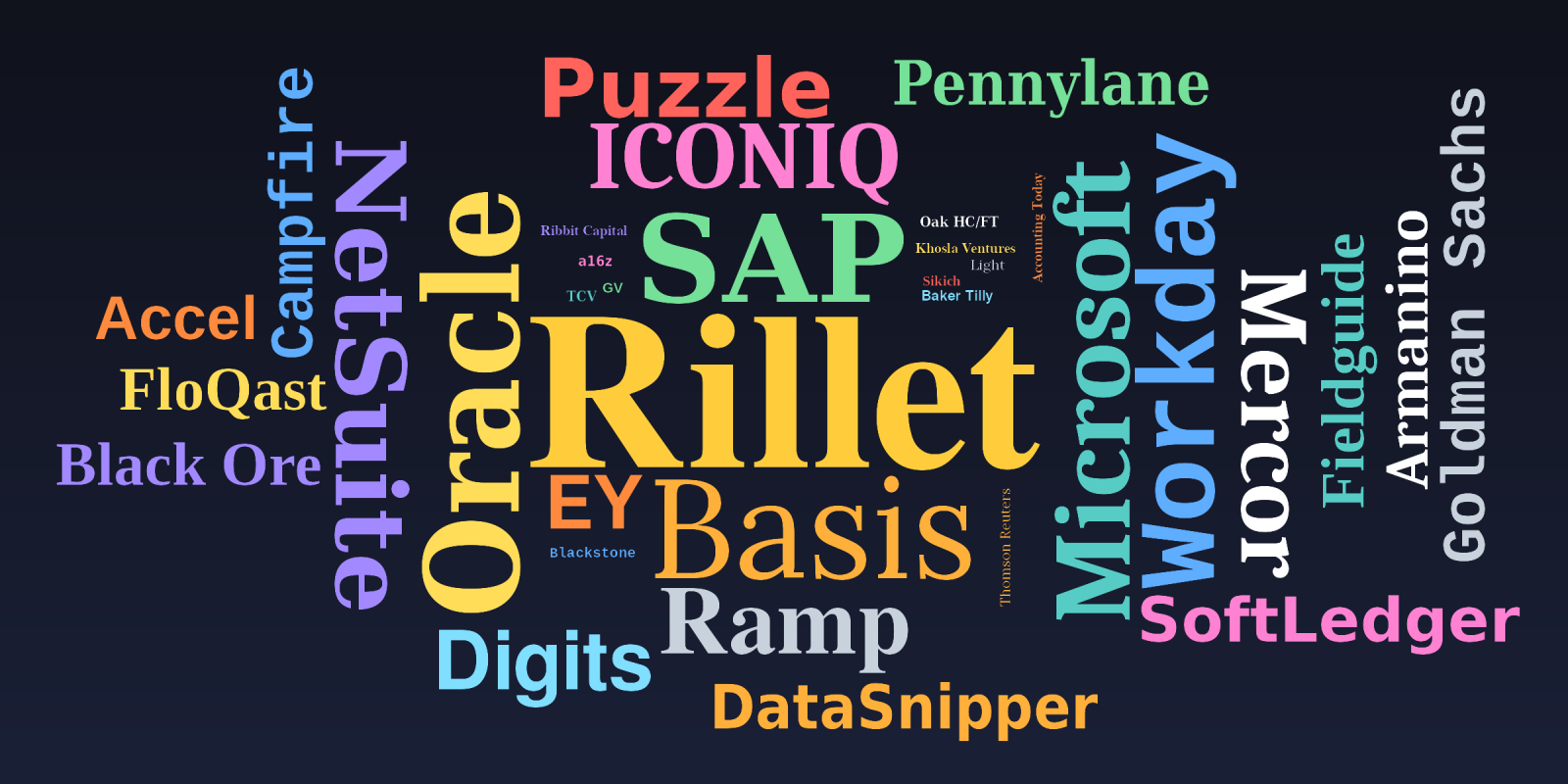
Rillet’s $100 million Series C gives the market another heavily financed challenger just six months after Basis raised $100 million at a $1.15 billion valuation. Around them, Ramp, Digits, Puzzle, Light and SoftLedger are pushing into different layers of the finance stack while Oracle, SAP, Microsoft, Workday and NetSuite defend systems already embedded in corporate accounting.

The fight is over where artificial intelligence belongs in accounting software – inside the system of record, in agents operating across existing systems or in a new layer that sits around the ERP and performs the work.

“What stands out to us is how customers actually run on it — multi-billion-dollar businesses operating with finance teams a tenth the traditional size, closing their books continuously,” says Seth Pierrepont, an ICONIQ general partner and Rillet board member.

The billion-dollar bet.

Instead of selling merely faster bookkeeping, Rillet is trying to move AI into the accounting system itself, with software agents working inside the ledger, close and reporting process rather than alongside them.

Pierrepont: ICONIQ backs both Rillet and Ramp

The financing is Rillet’s third raise in 14 months, bringing total funding past $200 million. The company emerged from stealth in 2024 and now reports more than 600 customers.

Basis is the nearest billion-dollar counterexample. The New York company reached a $1.15 billion valuation in February 2026 on a $100 million Series B led by Accel, with GV and other investors participating. Basis builds agents for accounting work rather than an ERP replacement. Its own examples include journal entries, difficult reconciliations and technical accounting memos, and its announced firm partnerships place the agents inside existing accounting delivery models.

Baker Tilly unveiled a Basis collaboration in April 2026 inside its managed accounting and finance services practice. Sikich followed in July, saying Basis would be incorporated into its client accounting services delivery model. Basis co-founder Matt Harpe said in July that the platform is deployed in about 40% of the top 25 firms and more than 25% of the top 150, up from roughly 30% of the top 25 at the time of the February round. Those adoption figures, like Rillet’s firm-partnership claims, are company-reported.

Attacking from another direction

Ramp has launched Stack, which it calls an AI operating system for accounting firms. Stack is designed to run reconciliations, schedules, journal entries and monthly reporting while connecting to the systems firms and their clients already use. Ramp says it partners with more than 4,500 accounting firms and that 92 of the top 100 CPA firms already have clients on its platform.

One day after the Stack launch in June, Ramp announced a $750 million financing at a $44 billion valuation. ICONIQ was among the lead investors, putting the same investment organization behind both a $1 billion AI-native ERP and a much larger finance platform pushing agents into accounting-firm workflows.

Some vendors want to become the system of record. Some want agents to perform work across the existing stack. Others are building a surrounding operating layer. All are competing for the same scarce resource: accounting attention.

Smaller challengers fill out the battlefield without occupying the same weight class. Digits markets what it calls its Agentic General Ledger and publishes comparisons with Rillet, Puzzle and SoftLedger. Puzzle operates its own general ledger and subledgers. Light positions itself as an AI-native finance platform for multinational and high-growth companies. SoftLedger, founded well before the current AI wave, sells an API-first general ledger for complex, multi-entity accounting.

The Bet Is on the Ledger

Traditional accounting systems record transactions while much of the work surrounding those transactions still passes through accountants, spreadsheets and adjoining applications. Reconciliations, journal entries, close management, reporting and exception handling frequently sit on top of the ledger rather than inside it. But Rillet is embedding those functions into the accounting system.

Its AI agents operate against live general ledger data while finance teams retain approval authority, visibility and an audit trail. The company says humans and agents work from the same accounting policies and financial records rather than through an AI layer placed over older software.

“For the last two decades, the ERP has been treated as a system of record, a place to store what already happened,” CEO and co-founder Nicolas Kopp says. “In the AI era, it has to become the operating layer for what happens next.”

Rillet is taking that proposition into a market dominated by deeply embedded systems from Oracle, SAP, Microsoft, Workday and other enterprise software companies.

Investors See a Large Target

Rillet says customers are nevertheless replacing Oracle Fusion, SAP, Microsoft Great Plains, Workday and other incumbent systems with its software.

The company reports more than 600 customers, up from more than 200 when it announced its Series B in August 2025. Rillet says new annual recurring revenue doubled in the preceding three months. Kopp separately writes that usage of Rillet’s AI agents is growing 70% each month.

Rillet says a three-person Mercor finance team uses its AI agents as Mercor scales past $2 billion. Mercor’s chief executive describes the milestone as an annualized revenue run rate, and reporting on it characterizes the figure as gross revenue booked before contractor payouts, while Rillet calls it annual recurring revenue. Pierrepont says other customers are operating multibillion-dollar businesses with finance staffs one-tenth the traditional size.

Rillet says it is an official partner with more than half of the top 20 CPA firms. It has announced relationships with Armanino and EY, among others.

EY’s alliance with Rillet combines the software with EY’s finance transformation, technology consulting, and risk and controls work, with the two firms describing controls and audit readiness as part of the transformation rather than a separate workstream. EY’s Americas technology consulting and risk consulting leaders have joined Rillet’s advisory board.

The opportunity for accounting firms sits beside an obvious exposure.

Firms can help clients implement AI-native systems, redesign controls and manage finance transformation. The same systems are being built to reduce the human labor required to perform accounting work that firms have historically sold by the hour or delivered with large teams.

Kopp addresses the staffing question directly.

“There’s no getting around the point that we believe in lean, impactful finance teams,” Kopp writes in his Series C post.

Controllers and accountants, in Rillet’s version of the future, spend less time reconciling transactions and more time reviewing exceptions, applying judgment and interpreting results.

Basis and Ramp approach the same labor problem from the accounting firm’s side. Their pitch is not that less work reaches the firm, but that agents let firms perform more of it with the people they already have.

The paradox is now inside the profession: firms can gain a new market by implementing and governing AI systems, at the same time, those systems reduce the labor required to produce accounting output.

Fewer Hands, More Accounting

Continuous reconciliations reduce the amount of work concentrated at month-end. Automated journal-entry preparation removes part of the processing burden. Exception-based review directs people toward transactions that require judgment. A continuously updated ledger reduces the separation between recording, closing and reporting.

Month-end close begins to look less like a periodic labor event and more like an ongoing software process.

The accountant remains in the system, but the labor equation changes.

For CPA firms already operating with persistent recruiting constraints, the relevant question may become how much revenue, reporting and compliance work each accountant can support rather than how many accounting jobs AI removes.

Two Software Models Emerge

Accounting technology is beginning to divide between companies building new systems around AI agents and established vendors embedding agents into products already in use.

Oracle and Microsoft, among others, are moving agents into core finance workflows within existing platforms, controls and data models. Incumbents retain advantages that include installed bases, mature controls, large integration networks and years of accumulated financial data.

The newer companies start from another premise. They are designing products on the assumption that software agents will participate directly in the work. Rillet pushes that premise into the ERP itself; Basis and Ramp demonstrate that agents can also be deployed without replacing the underlying system of record.

“We spent three years building Rillet before anyone outside the company saw the product,” Kopp writes.

The company launched publicly in August 2024 and ended the year with 100 customers, according to Kopp. It raised its Series A and Series B 10 weeks apart in 2025. The new Series C gives it another $100 million to push into larger enterprises.

Rillet Is Not Alone at $1 Billion

Using a narrow definition that excludes payments, spend management and tech-enabled bookkeeping services, at least five privately held accounting, audit or tax software companies have reached billion-dollar valuations: Rillet, Basis, DataSnipper, FloQast and Pennylane. The category boundary is editorial rather than standardized, and the five companies do not share the same architecture or customer base.

Basis is the nearest 2026 analog and the mirror image. Where Rillet is trying to reduce the human labor required inside corporate finance, Basis sells agents to accounting firms to automate work across the systems those firms already run. Its valuation arrives on a round of the same size as Rillet’s, six months earlier, from the opposite side of the ledger.

DataSnipper joins the group in February 2024, when the Amsterdam company raises $100 million from Index Ventures at a $1 billion valuation. Its Excel-native audit automation reports more than 600,000 audit and finance professionals in 175 countries, including all Big Four firms. At the time of the 2024 financing, the company also said it was profitable.

FloQast reaches unicorn status earlier, at a $1.2 billion valuation in July 2021, then rises to $1.6 billion with an April 2024 Series E led by ICONIQ Growth. That puts ICONIQ in FloQast, Rillet and Ramp, three companies attacking different layers of finance and accounting software.

Pennylane tops the group by valuation. The French accounting and financial platform reaches a reported $4.25 billion valuation in January 2026 after a €175 million round led by TCV, with Blackstone Growth participating. Pennylane reports serving 6,000 accounting firms and 800,000 small and midsized businesses across Europe.

The waiting room is thinner than the headlines suggest. Fieldguide comes closest, reaching a $700 million valuation in February 2026 on a $75 million round led by Goldman Sachs’ growth equity group. Campfire sits further back: it raised $35 million in a Series A led by Accel and another $65 million in a Series B co-led by Accel and Ribbit Capital, two 2025 rounds the company describes as $100 million raised in 12 weeks, at a valuation reported at roughly $375 million. Black Ore says its Tax Autopilot is used by 40% of the top 20 accounting firms and has disclosed roughly $60 million of funding.

Both Sides of the Labor Equation

The 2026 financings expose the deeper pattern. Rillet and Basis raise identical $100 million rounds six months apart, but at different valuations and from different positions in the accounting stack.

Rillet is trying to reduce the human labor required inside the finance function by moving more accounting work into the system of record. Basis is trying to increase the amount of work accounting firms can perform with existing staff by deploying agents across the work those firms already do. Ramp is building another version of that firm-side model around an operating layer connected to client systems.

Taken together, the investments point to a common conviction: the labor structure of accounting is changing. The disagreement is over where the change hits first — inside corporate finance departments, inside accounting firms or inside the software layer connecting the two.

Leave a Reply
