How fast (or slow) are accountants adopting AI? Depends on whom you ask.
Six Surveys. Eleven Answers.
By CPA Trendlines Research
Hourly billing is fading. Advisory is spreading. Artificial intelligence is freeing accountants to do more valuable work.
But agreement may end there.
The meanings of adoption, advisory and the AI dividend are leaving firm leaders with sometimes clashing pictures of how far the change is going.
MORE AI: Gen AI in Accounting: Epic Transformation, or Overheated Hype? | Intuit, Thomson, Wolters Kluwer: Accountants Question AI Promises | Caseware’s David Marquis: AI Can Do More Work but Auditors Must Make the Call | AI Accountants Cut Costs per Task to 21 cents from $10.35 | Your Next Hire Might Not Be an Accountant | It’s Not Just the Numbers
The problem surfaces again in a fresh series of surveys that tell different, even confusing, versions of the same story. One study finds advisory in 57 percent of surveyed U.S. practices. Another puts advisory or consulting at 94 percent in its U.S. sample. A pricing-platform survey finds little hourly billing for particular services. A broader practice-management benchmark finds most responding firms still use hourly billing.
Firm leaders are being shown evidence of progress, but the evidence does not consistently measure the same progress.
Adoption has many meanings
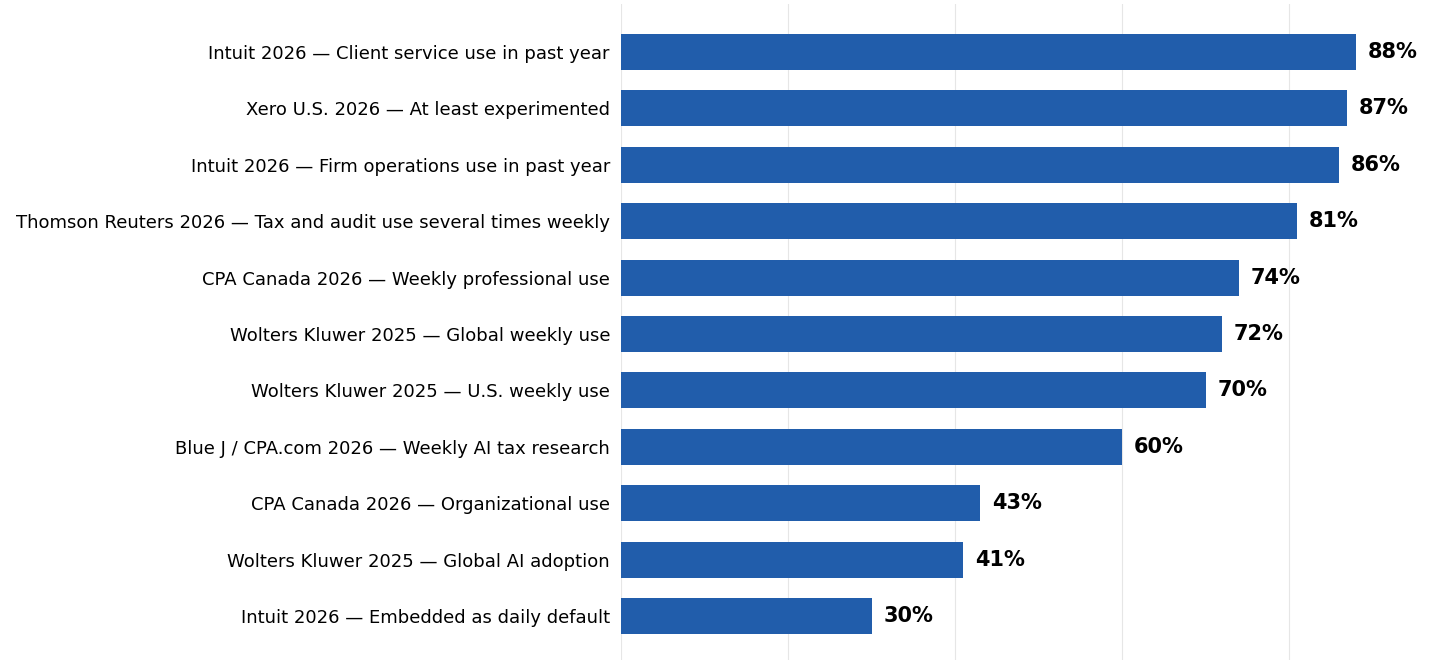
Intuit’s 2026 Accountant Technology Survey finds that 88 percent of respondents used AI for at least one client service in the preceding 12 months, and 86 percent used it for at least one firm operation.
Yet only 30 percent say AI is embedded as the default in day-to-day work. The largest group, 54 percent, uses it situationally. All of those findings come from the same survey of 725 U.S. accounting professionals. The first two measure participation; the others describe depth.
Xero’s U.S. Modern Practice Playbook draws a similar line within a single sample. Eighty-seven percent of surveyed practices have at least experimented with AI, but 56 percent use it in day-to-day workflows. The gap widens by practice type, with 70 percent of accountants reporting active daily use, compared with 17 percent of bookkeepers.
Pick your number. Pick your survey.
Other studies set other thresholds. In a joint project, Blue J and CPA.com report that 60 percent of surveyed U.S. tax professionals use AI for tax research at least weekly.
Thomson Reuters says 81 percent of tax and audit firm professionals use AI tools at least several times a week, based on a survey of 538 professionals across 40 countries.
These figures describe different activities, frequencies and respondent groups. They don’t yet establish the better strategies.
High use. Low control.
Figures can resist comparison even within the same research project.
For instance, Wolters Kluwer’s 2025 Future Ready Accountant release reports that AI adoption rose from 9 percent in 2024 to 41 percent in 2025. The same release says 72 percent of firms use AI at least weekly. The release does not explain what separates its adoption measure from weekly use.
CPA Canada adds another distinction. Its 2026 AI in Accounting Study, released in October and based on responses from 5,000 Canadian CPAs, reports weekly professional use of 74 percent but organizational AI use of 43 percent. Personal use and workplace adoption are separate measures.
Thomson Reuters finds that 35 percent of tax and audit firm professionals use AI tools their firm has not authorized in their day-to-day work. In the CPA Canada study, 67 percent have access to approved AI tools and 45 percent report a formal AI policy. Apparently, substantial use can coexist with incomplete organizational control.
Advisory depends on the definition
The 37-percentage-point gap between Xero’s advisory finding and Wolters Kluwer’s U.S. advisory-or-consulting finding is especially striking. Both address U.S. practices, but they describe differently assembled groups.
Xero surveys 561 senior accountants and bookkeepers. Wolters Kluwer’s global study covers 2,768 tax and accounting professionals in 14 countries; its reviewed U.S. summary does not state the U.S. respondent count.
Xero also gives each of four practice-size groups 25 percent of the total weight. That provides equal representation across size groups. It does not establish the distribution of firms in the U.S. market. The weighting changes the influence of each size group: 55 sole practitioners carry the same collective weight as 259 respondents from practices with 11 to 50 employees. The mix also includes bookkeeping-led practices, and 39 percent of bookkeepers offer advisory, compared with 60 percent of accountants.
Advisory ad hoc
Definitions add another layer. Xero describes advisory as forward-looking guidance, including cash flow forecasting, advanced tax planning and virtual CFO advice. Wolters Kluwer combines advisory and consulting. Without aligned questions and comparable samples, the figures cannot settle how much of the profession has built a paid advisory business, let alone how to define advisory.
Xero also finds that 78 percent of practices offering advisory bundle it with broader accounting and bookkeeping services, complicating the distinction between advice delivered and advisory revenue separately identified
For an owner, an informal client conversation, a separately priced planning engagement and a recurring CFO relationship carry different staffing and revenue implications. A broad service label does not identify how much clients pay, how regularly they buy or how much of the firm’s revenue the work produces.
Hourly billing survives
Ignition calls its 2025 pricing-benchmark release “The end of hourly billing.” The underlying survey covers 219 U.S. firms using Ignition. Only 3 percent report hourly pricing for tax preparation; 17 percent report it for tax planning and advisory, down from 21 percent a year earlier.
The 2025 AICPA PCPS and CPA.com National MAP Survey finds that 63 percent of responding firms use hourly billing. Value billing reaches 30 percent and fixed pricing 29 percent. Those approaches can coexist within a practice.
Xero measures a third thing: the share of engagements. Practices bill an average of 78 percent of client engagements on nonhourly terms and 22 percent by the hour. Among practices using value-based or fixed-fee pricing, 52 percent turn to a hybrid model. The report illustrates a hybrid model with fixed fees for tax returns, hourly bookkeeping and advisory priced on value.
The studies ask different questions of different groups. Ignition measures pricing for particular services among its customers. MAP describes approaches used by firms across their practices, with financial information primarily covering fiscal 2024. Xero averages across engagements.
The evidence supports a market in which pricing models overlap. It does not establish that an entire profession is abandoning time-based billing. Nor does a fixed price, by itself, show that a firm prices according to the value of the result to its client.
Saved time is not yet measured profit
Xero reports average AI savings of 7.6 hours per practice per week across all staff and an estimated annual monetary value of $231,000. Both measures come from self-reported response bands.
The calculation uses band midpoints and annualizes the weekly monetary estimate. It measures respondents’ estimated value of time released but does not establish that $231,000 reaches the bottom line.
Avoiding a future hire, producing more work, reducing overtime and shortening an owner’s week have different financial consequences.
Define success
MAP shows how differently firms intend to use the time. Among the roughly two-thirds of firms with plans for freed-up capacity, 45 percent intend to reduce hours to improve work-life balance, 40 percent to provide more advisory or consulting services and 39 percent to expand their client load without adding staff. Those are plans rather than results, and each leads to a different financial outcome.
MAP also exposes the measurement difficulty directly: 40 percent of responding firms have not figured out how to track efficiencies from technological advances.
ICAEW finds another assessment gap among U.K. mid-tier firms. Eighty-six percent say their technology strategy explicitly includes AI adoption, but only 17 percent agree they can assess AI’s effect on their workforce. The ICAEW survey covers 35 firms. The two studies identify different assessment gaps: MAP asks about tracking technological efficiencies, while ICAEW asks about understanding AI’s workforce effects. Neither establishes how much reported capacity becomes profit.
Even the definition of success varies. Xero identifies top performers by net profit margin; MAP by net remaining per partner before partner compensation. The 2024 CAS benchmark from CPA.com and AICPA PCPS uses a third measure, advisory-practice fees per professional.
A high margin, a high income per partner and high revenue per professional are different measures. Associations between technology and those outcomes do not establish whether technology precedes financial results or financial results precede technology.
The survey creator helps frame the question
To be sure, the studies serve different purposes.
Ignition examines pricing and collections; Blue J and CPA.com examine tax research; Intuit examines technology and workflows; MAP benchmarks practice operations.
Their subjects are relevant to their publishers’ commercial or institutional interests. Those relationships do not invalidate the findings, but they help explain why the questionnaires illuminate different parts of firm life.
The unresolved issue is the connection between those parts.
An adoption percentage does not show whether review consumes the time saved in preparation. An advisory percentage does not show whether advice produces separate revenue. A pricing percentage does not show whether faster delivery improves margins or expands the work included in the fee.
In the end, practitioners decide what it all means and how to define success: a shorter workweek, more clients, a different service mix or a stronger financial return.