Intuit, Sage, Xero grapple with ‘bubblelicios’ AI spending strategies.
Surging AI costs are making managing profit margins a new challenge at many of the same companies seeking to generate new revenue in the technology.
By CPA Trendlines Research
Zoho is freezing its usual annual pay increases for its 19,000 employees worldwide and cutting marketing spending as rising server prices and AI usage are driving up costs.

“AI has raised costs dramatically,” Sridhar Vembu, Zoho’s co-founder and chief scientist, says. Server prices have risen fourfold, and the company is working to avoid mass layoffs.
MORE AI in Tech
Meanwhile, Zoho’s peers and competitors report surging A.I. costs that make managing margins a new challenge. Intuit, for example, says it spent $110 million last year alone.
AI costs are rising fast enough at Zoho to stop raises, yet the company is adding capabilities to Analytics and Campaigns without increasing the base subscription prices. For now, the response includes payroll restraint and metered usage charges.
For accounting firms using Zoho products, the news shows why base subscription prices may not capture the full cost of AI. Zoho’s Analytics documentation also says some features share data with external vendors and some built-in agents support only OpenAI, determining which providers receive business data.
Zoho links pay restraint to its price pledge
Mani Vembu, chief executive of the Zoho.com division and Sridhar’s younger brother, says Zoho is skipping raises and appraisals to avoid layoffs and customer price increases. “Cutting jobs could affect both employees and customers,” he says.
Mani Vembu says the business is still growing and describes research and development to make products and infrastructure more efficient as part of the response. Sridhar Vembu says Zoho has not been growing its employee count for 18 months.
Kashyap Kompella, founder of AI consultancy RPA2AI Research, says cheaper automation could weaken Zoho’s low-price advantage and force it to “compromise margins to retain clients.” Abhisek Mukherjee, managing partner at consulting and investment firm YCP India, notes customer data can make software migration difficult, although smaller clients with less customized data may switch more readily.
AI charges extend beyond the subscription

Zoho Analytics is rolling out a multi-agent version of Ask Zia that coordinates tasks including data preparation, analysis, visualization, coding and SQL generation. Zoho says a semantic layer supplies shared business definitions and an ontology maps entities such as customers, orders and vendors and their relationships.
The Analytics Basic plan remains $24 a month when billed annually, covering two users, 500,000 rows and 10,000 Zoho LLM credits monthly. Preview versions of pixel-perfect reporting, the ontology and the semantic model are scheduled to roll out globally within four to eight weeks, with on-premises updates due in the first quarter of 2027.
Zoho distinguishes monthly Zoho LLM credits from a one-time credit pool for supported external models, with paid add-ons for heavier use. Customers bringing their own API key receive usage bills directly from the external model provider; that spending does not consume their Zoho Analytics AI credits.
Some built-in agents support only OpenAI, while others support both OpenAI and Zoho models. Availability depends on the agent, subscription plan and data center. Some features send row-level data to external vendors, and others send metadata, such as table and column names.
In Campaigns, the updates combine email, SMS and native WhatsApp marketing with workflows available to compatible AI agents, through Model Context Protocol support. Paid plans still start at $4 a month, while SMS and WhatsApp require purchased message credits; the free plan covers 500 contacts and 2,000 emails a month.
The disclosed credit limits, add-ons and billing through customers’ own API keys can put some AI costs outside the base subscription.
Analysts question the work behind the agents
Mike Ni, an analyst at Constellation Research, says Zoho’s opportunity lies in combining analytics, business context and automation within its established application ecosystem. “My question is whether it can turn that into simpler deployment and better economics for customers,” he says.
Mike Leone, an analyst at Moor Strategy & Insights, says that the integrated approach matters to smaller companies without a data warehouse or dedicated data team, but Zoho still must show how much work customers need to model their businesses. “The agents’ answers are only as good as that model,” Leone says.
Accounting software peers grapple with costs
Intuit, the maker of QuickBooks, reports substantial AI spending alongside operating savings. “We spent about $110 million on tokens this past year,” CFO Sandeep Aujla says, adding model optimization and improvements in delivery costs should help offset rising AI usage and support gross-margin expansion. Aujla attributes more than $135 million in customer-success savings to AI and automation. Intuit’s fiscal 2026 results show revenue rising 14 percent to $21.4 billion and GAAP operating income rising 20 percent to $5.9 billion.
Sage reports organic revenue growth of 10 percent for the nine months ended June 30, and reiterates its expectation that operating margins will rise in fiscal 2026 and beyond. “Demand from new and existing customers remains strong,” CFO Jacqui Cartin says.
Xero’s fiscal 2026 annual report shows platform costs before capitalization rising to 144.3 million New Zealand dollars from 105.1 million, an increase of about 37 percent. Gross margin falls to 83.9 percent from 89 percent, but Xero attributes the decline largely to incorporating Melio’s payments business and says gross margin excluding that effect remains 89 percent.
Costs to outpace revenue
NetSuite’s parent, Oracle, reports cloud applications revenue rising 10 percent and cloud infrastructure revenue rising 121 percent in its first quarter of fiscal 2027. Oracle also reports 57 percent growth in GAAP operating income and a $20 billion equity raise under its capital investment program, without supplying a separate NetSuite AI-cost breakdown.
Salesforce deputy CFO and head of finance Mike Spencer links internal Claude usage in research and development to the decision to hold margin guidance steady. “It is part of the reason we did not raise margin guidance on the year,” he says.
HubSpot CFO Kate Bueker similarly forecasts that AI usage will put pressure on delivery costs. “We expect that COGS growth will outpace revenue growth in 2027,” she says.
“Buying memory costs us six times more today than it did a year ago,” says OVHcloud founder Octave Klaba. He links the shortage to manufacturers shifting production toward AI memory and says separately billing local storage and public IP addresses raises affected cloud bills by 1.4 percent to 21.9 percent, with compute rates unchanged.
‘Bubblelicious’ times
Zoho is pursuing its own infrastructure efficiencies through Nathu La, an internally designed server platform developed with Intel. The company says the platform delivers equivalent performance with 20 percent to 30 percent lower total ownership costs and 12 percent to 18 percent lower power consumption.
Sridhar Vembu also advocates caution on large AI infrastructure bets, saying Zoho will continue foundational research while waiting for a “less bubblicious time” to invest in infrastructure.
An assistant and a grim jobs outlook
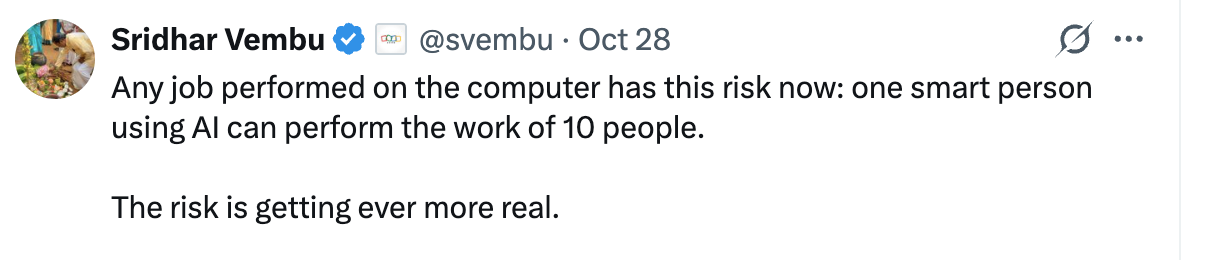
Ananda Raman Krishnan, Zoho’s senior vice president for marketing applications, describes Campaigns’ AI as “a marketer’s assistant, not a replacement.” Sridhar Vembu’s warning and later claim that one person can do the work of 10 describe a broader threat to employment.
“The outlook for software jobs in general is grim,” Vembu says in the post on X.com.
The employment warnings have drawn criticism on X, with educator and AI mentor Sandeep Manudhane questioning Vembu’s appeals for overseas Indians to return home while Zoho faces staffing pressure.
Vembu rejects treating the productivity forecast as a prediction of 90 percent unemployment among computer workers. He argues that cheaper software engineering and digital marketing can reach businesses that previously could not afford them, creating new demand even as workers endure a painful economic adjustment.