 A decade of private equity in accounting: From a handful of deals to hundreds a year
By CPA Trendlines Research
For most of the teh 21st century, private equity in accounting had been a rumor, a distant memory. Today it is the market.
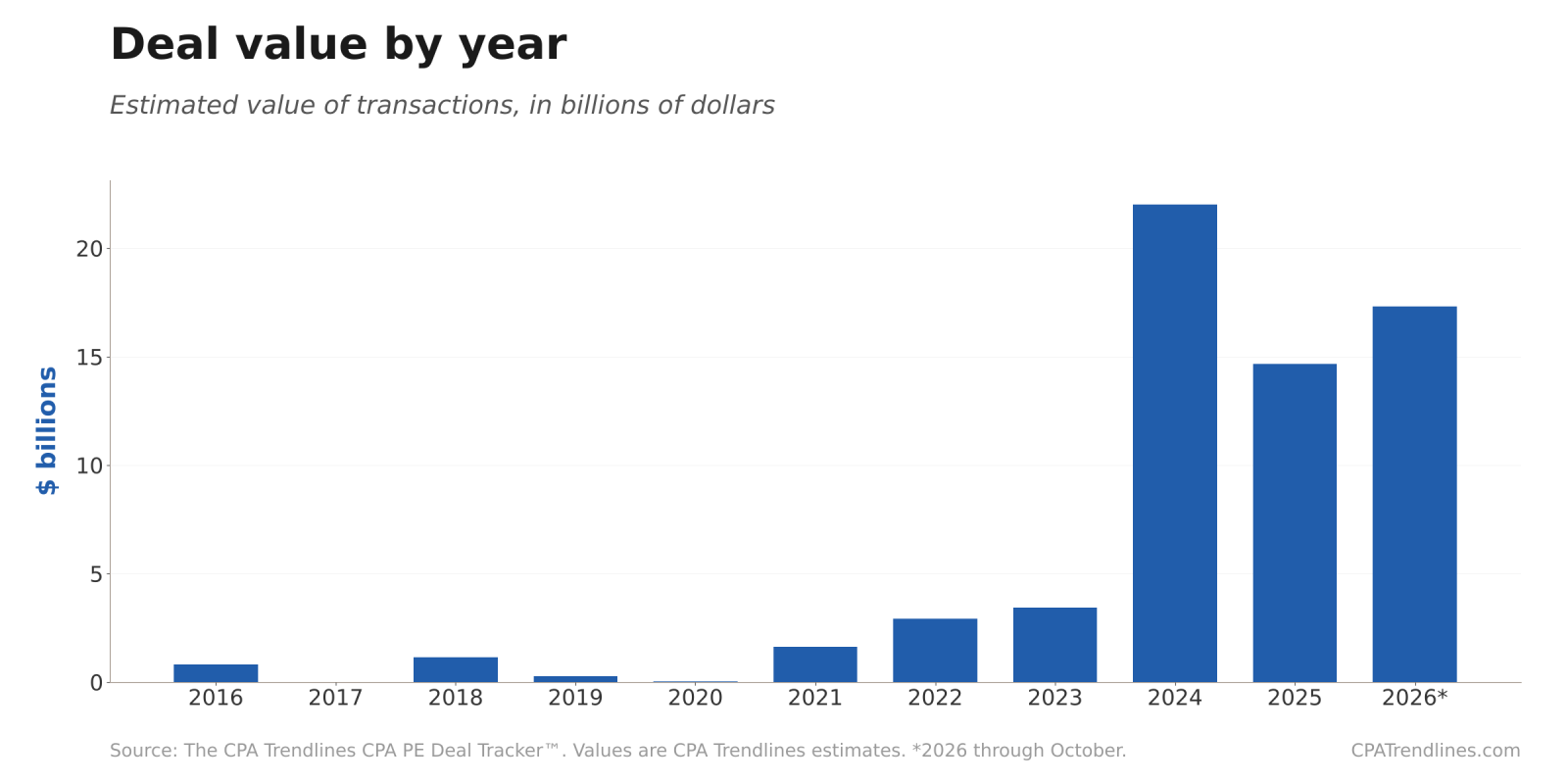
The CPA Trendlines CPA PE Deal Tracker™ now lists 621 transactions involving accounting, tax and related-service firms from January 2016 through October 2026. The pace is uneven at first and then relentless. But today CPA Trendlines Research estimates that investors have pumped up the valuations of the acquired firms to a total of more than $55 billion.
SEARCH, SORT AND FILTER ALL THE DEALS – By firm acquired, private equity investor, CPA firm platform, and date. Plus exclusive insights and notes on the biggest deals, in the CPA Trendlines CPA PE Deal Tracker™ PRO here.
Exclusively for PRO Members. To join CPA Trendlines as a PRO Member, click here.
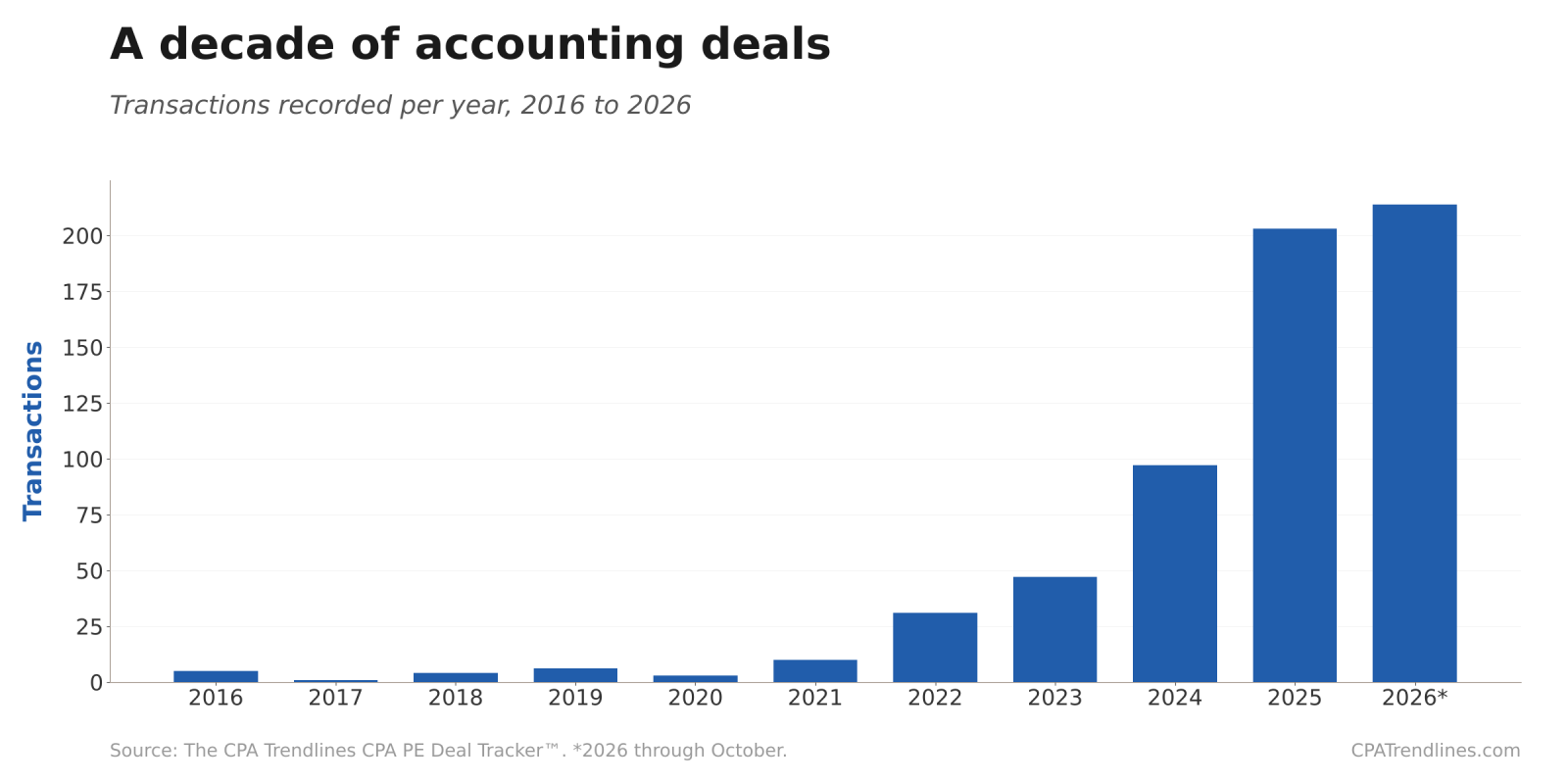
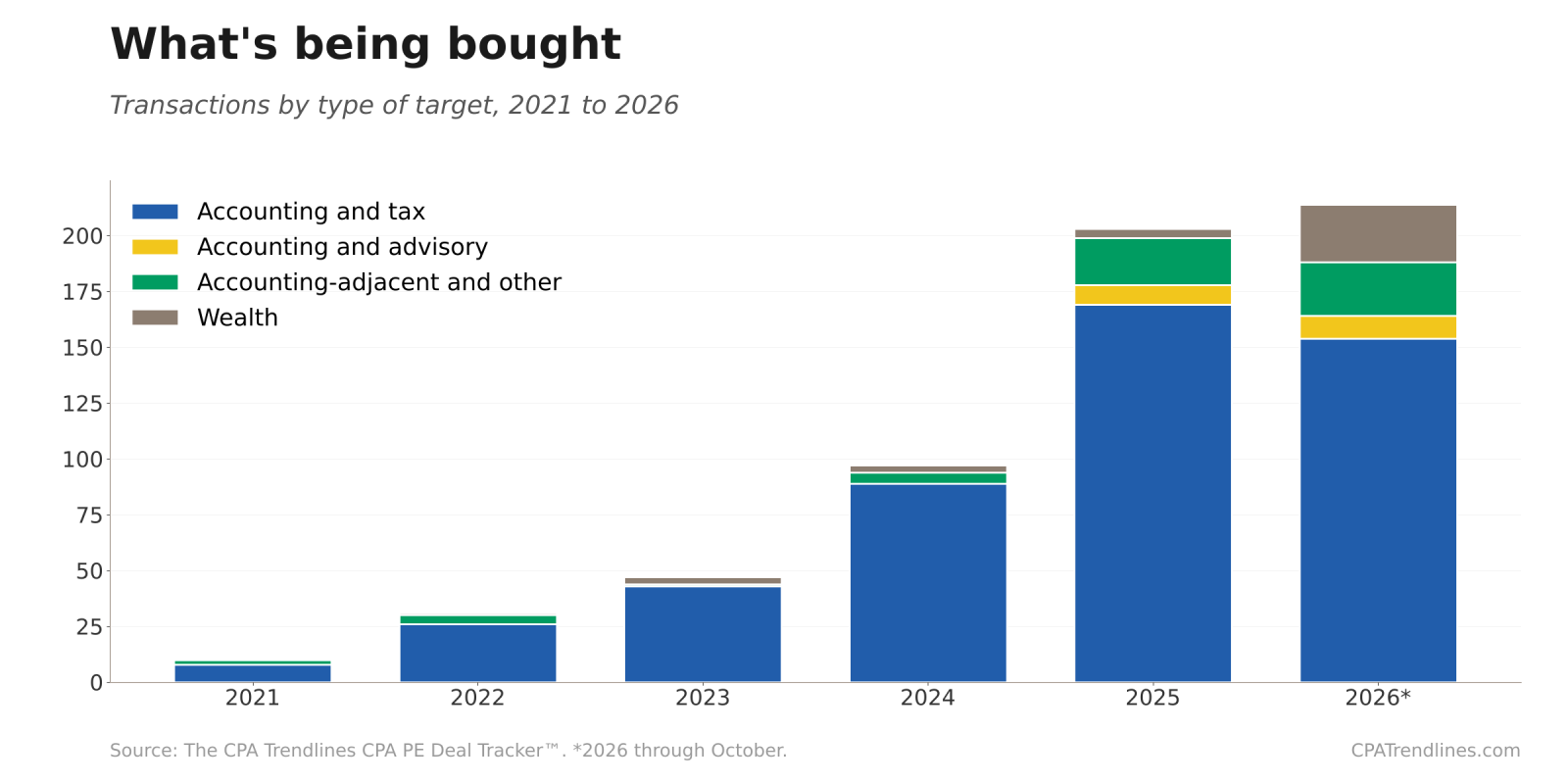
Fewer than 70 transactions are recorded in the seven years from 2016 through 2022. In 2016, five entries appear. Activity in 2020 and 2021 stays in the single and low double digits, at three and 10 entries.
The turn comes in 2023, with 47 entries. The count roughly doubles in 2024, to 97, and doubles again in 2025, to 203. Through October, 2026 already logs 214 transactions, more than any full year before it, with two months still to go.
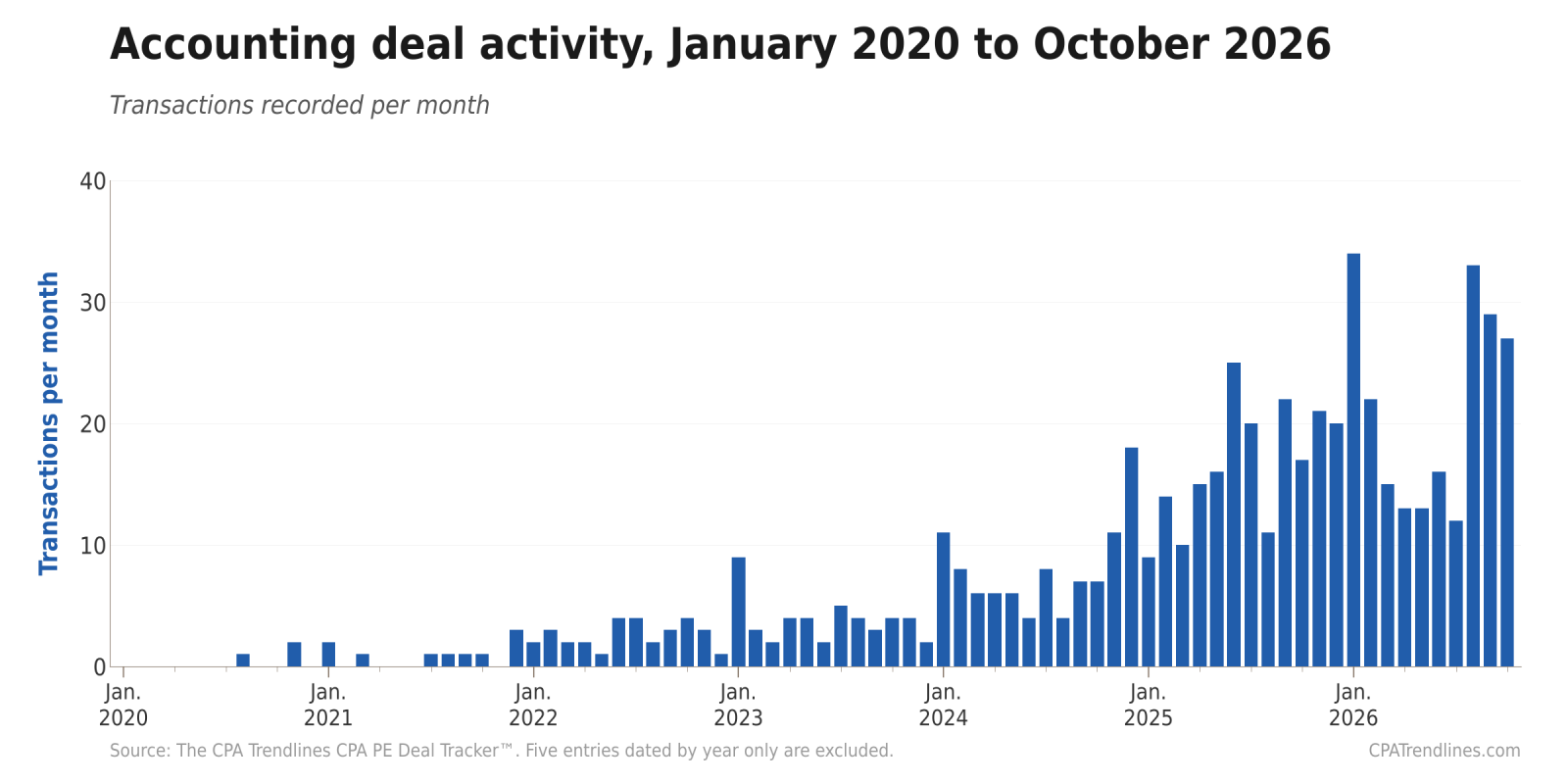
The monthly rhythm tells a similar story. January 2026 is the busiest month on record, with 34 transactions, and August 2026 follows with 33. Between those peaks, activity cools to 12 to 16 deals a month from March through July. It is a pause rather than a retreat, and the rebound is immediate.
Who is buying
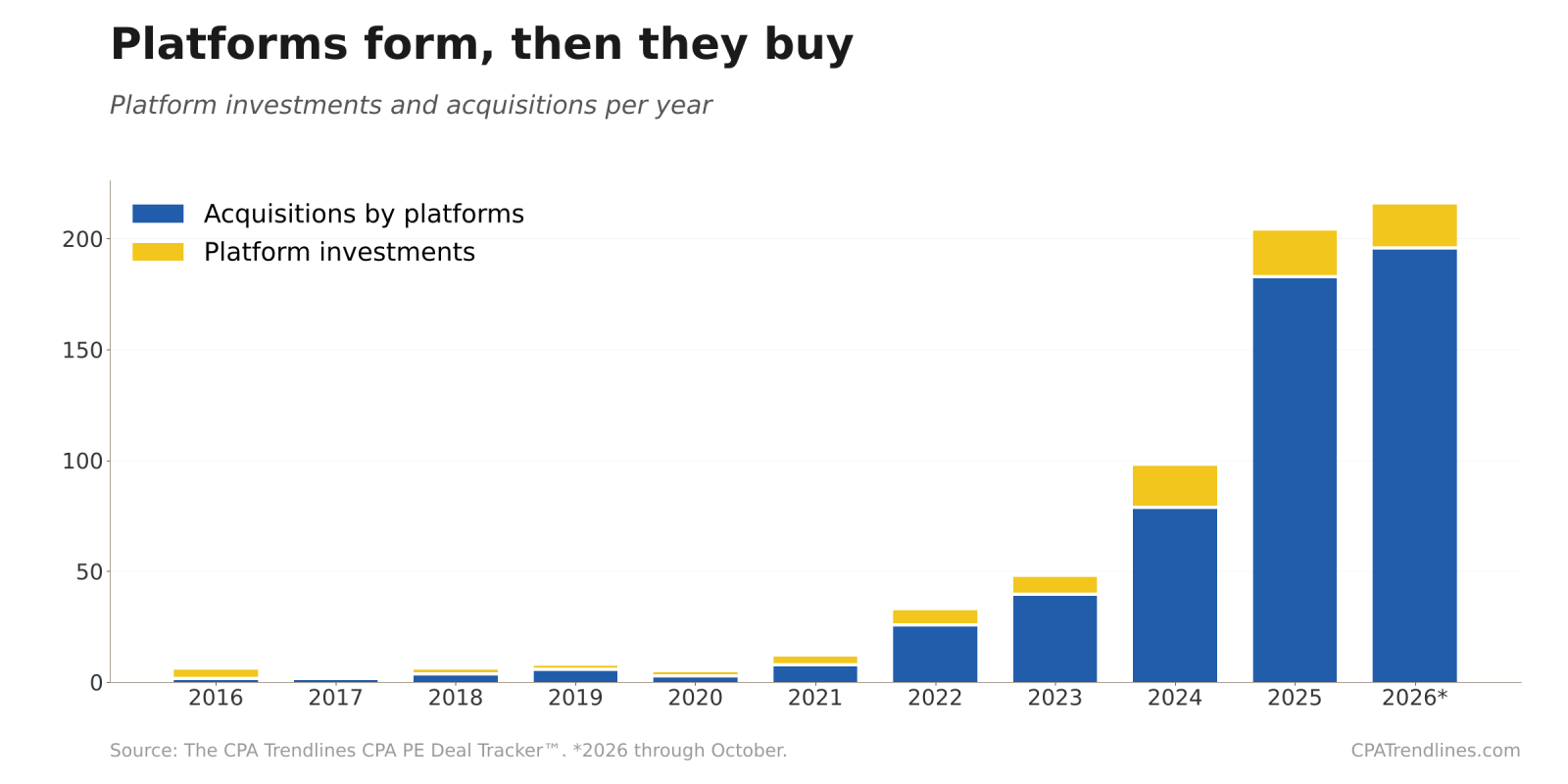
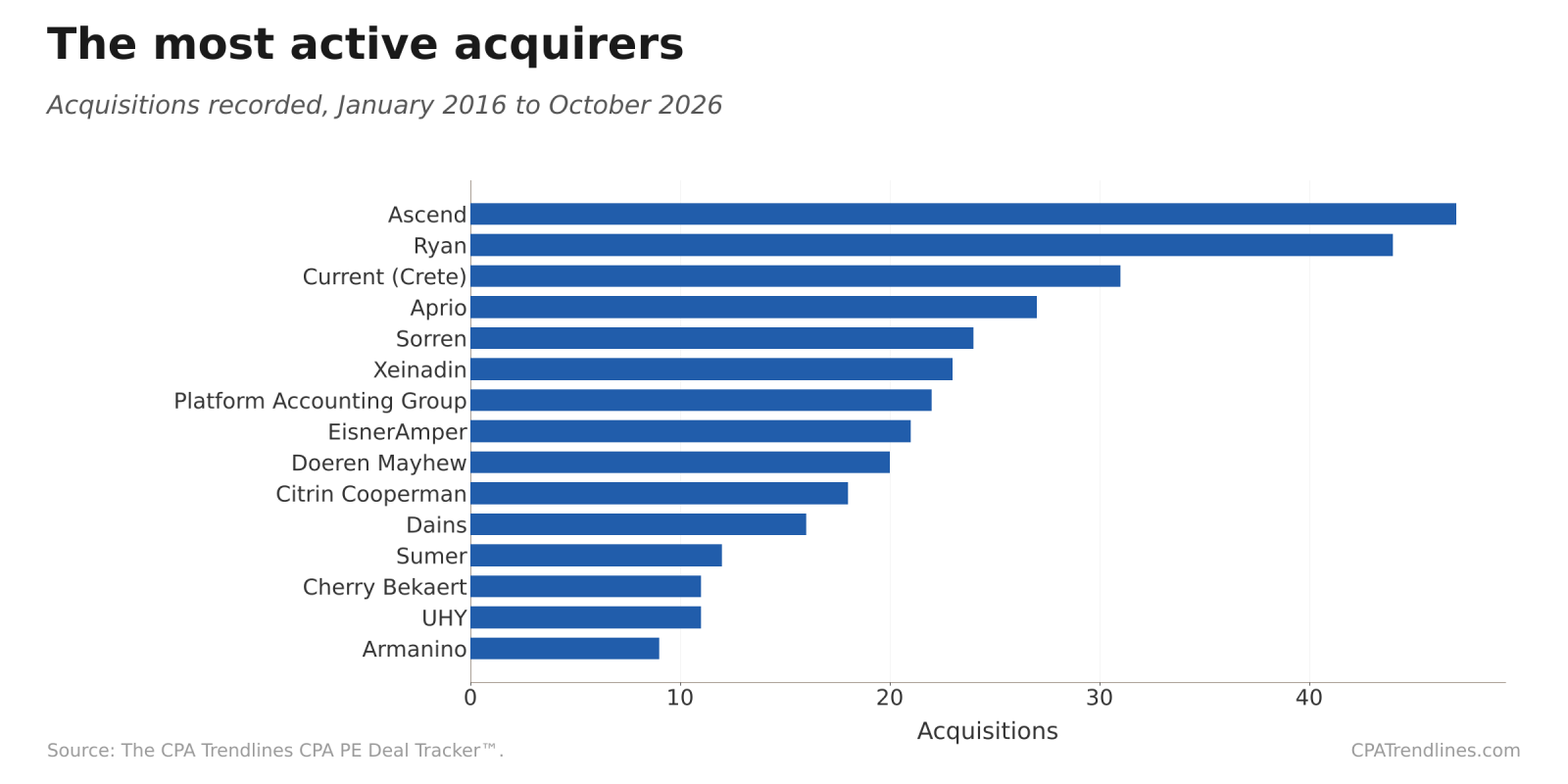
A small group of investor-backed platforms accounts for a large share of the activity. Ryan appears as the acquirer or combining firm in 44 entries, Ascend in 37 and Aprio in 28. Sorren and Xeinadin each have 25.
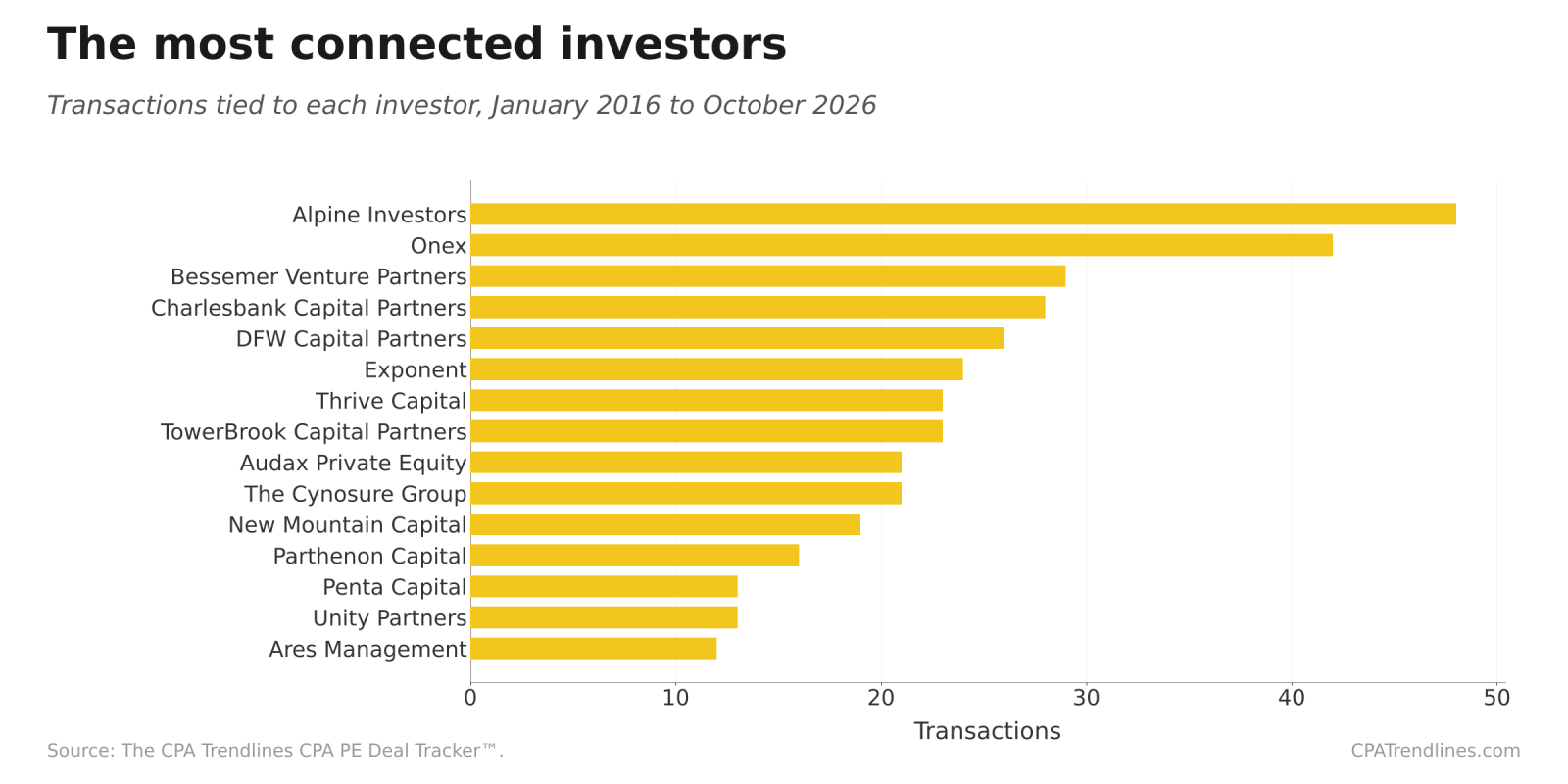
Behind the platforms sits a familiar roster of investors. Alpine Investors is connected to 48 transactions and Onex to 30. Charlesbank Capital Partners, DFW Capital Partners and Exponent each follow with 24 to 27.
The market is not limited to private equity. It includes publicly traded consolidators, family offices and venture-backed newcomers. It is also not limited to the United States. About 82% of entries involve accounting and tax firms, including a growing set of international deals. The rest reach into wealth management, valuation, technology and consulting.
The paradox of a maturing market
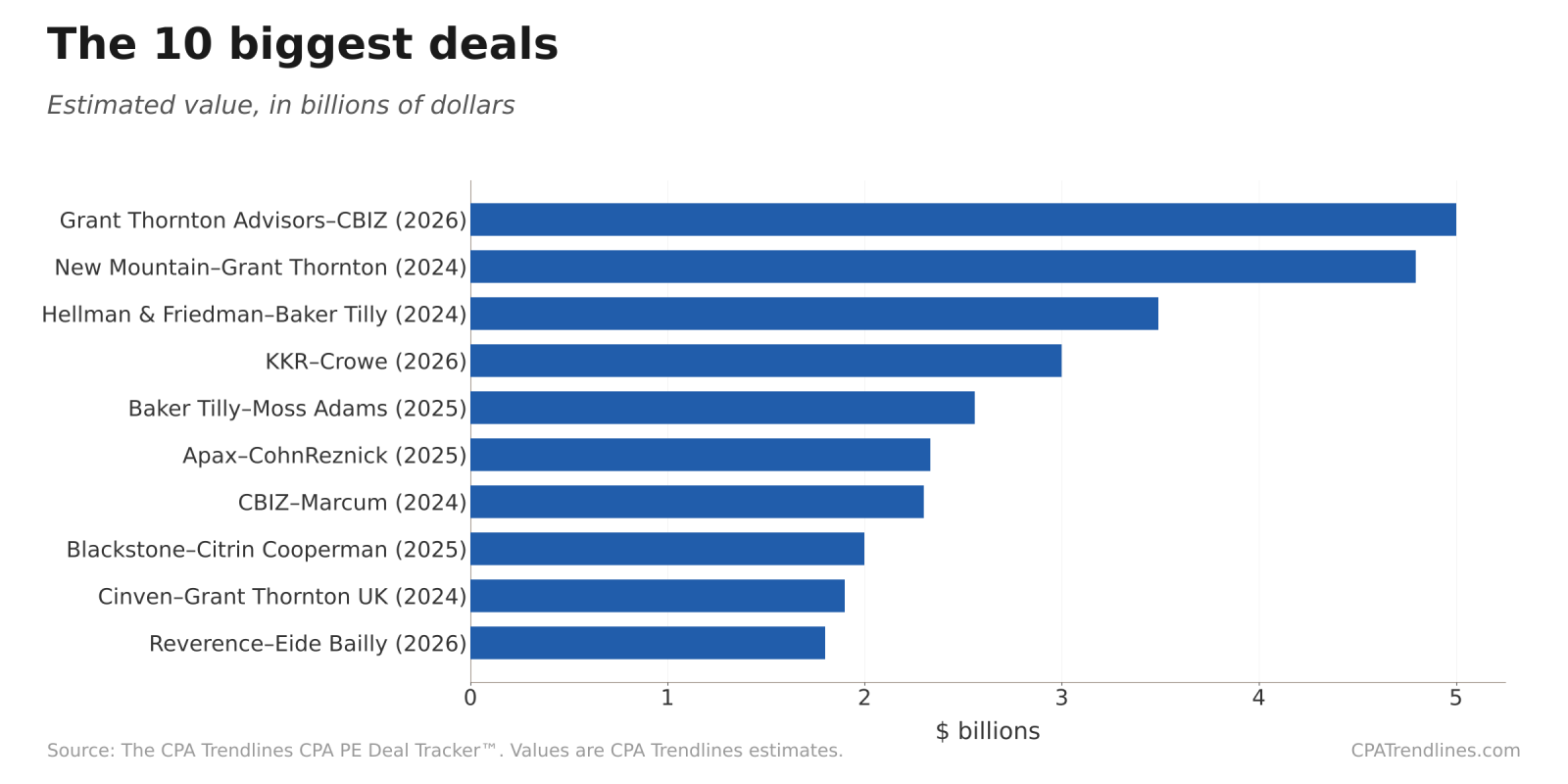
The more capital enters the profession, the more the buyers start to look like targets. The clearest example is Grant Thornton’s $5 billion agreement to acquire CBIZ, announced July 29, 2026. In that deal, one investor-backed firm buys a public company that had spent years as one of the profession’s most active acquirers.
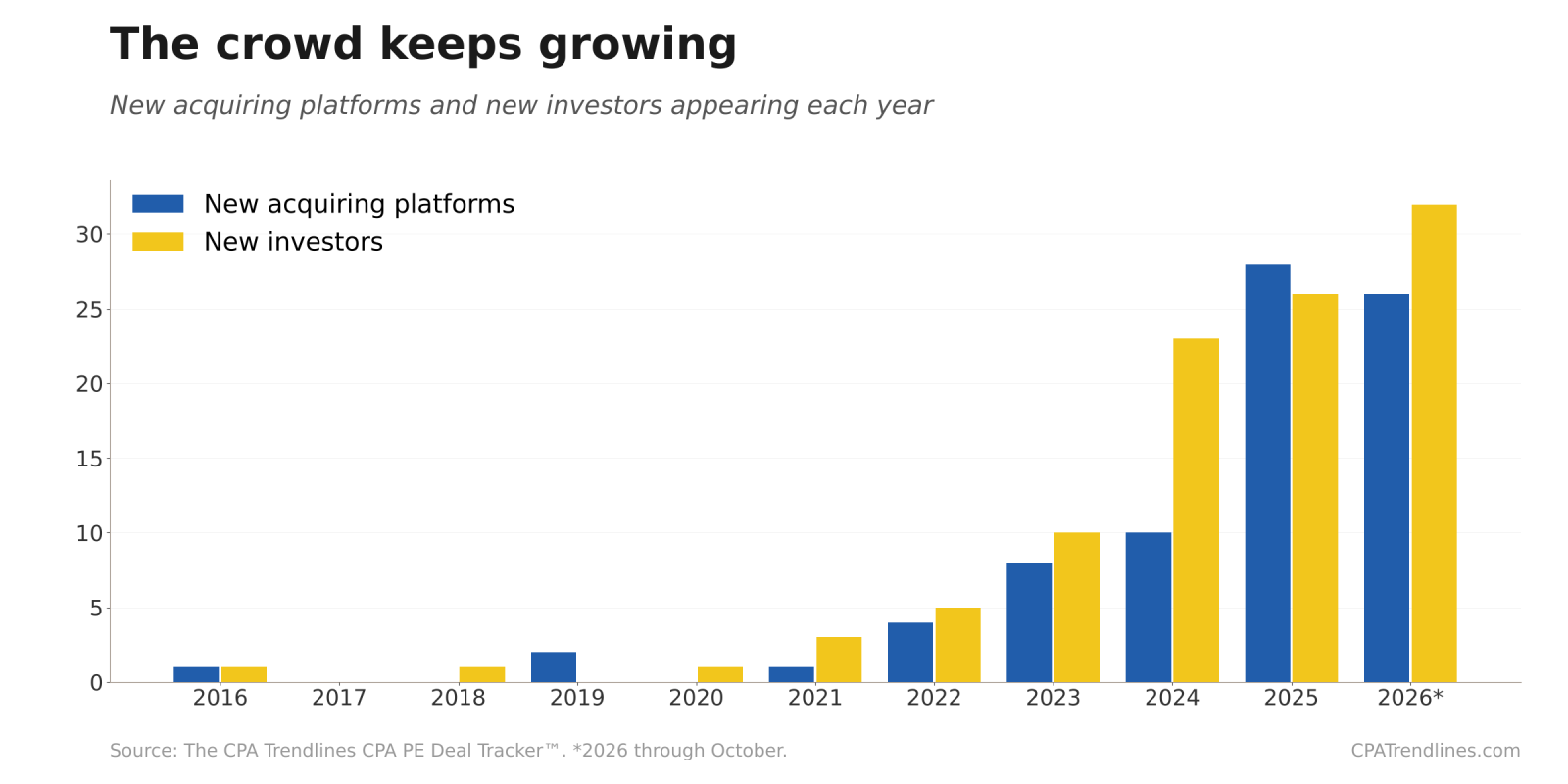
That is what a maturing market looks like. Early platforms keep adding firms, sponsors trade or recapitalize their holdings, and new entrants arrive with fresh funds. Nothing in the numbers suggests a fixed endpoint. What they suggest is a profession whose ownership structure is changing faster than most firm owners expected even three years ago.
PE Deal Tracker™ DataBank
MORE: SEARCH, SORT AND FILTER ALL THE DEALS – By firm acquired, private equity investor, CPA firm platform, and date. Plus exclusive insights and notes on the biggest deals, in the CPA Trendlines CPA PE Deal Tracker™ PRO here.
Beyond the United States
The market is not only American. The record includes 122 international transactions worth an estimated $9.1 billion. Hg’s 2016 creation of CogitalGroup, now Azets, is the earliest platform in the record. Xeinadin, formed from more than 100 U.K. and Irish practices in 2019, is among the most active acquirers of the decade.
10 Firsts
- July 2016: Hg invests in Blick Rothenberg, the first step in building CogitalGroup, later Azets.
- December 2016: Ryan acquires Shiv Om Consultants, the earliest U.S. acquisition in the record.
- October 2018: Onex buys 42% of Ryan at a reported $1.1 billion company valuation.
- July 2019: More than 100 practices form Xeinadin in the U.K. and Ireland.
- August 2020: Waterland invests in Moore Belgium, the first of seven firms it backs.
- July 2021: TowerBrook invests in EisnerAmper, the first large U.S. CPA firm to take private equity.
- April 2022: Citrin Cooperman discloses New Mountain Capital’s investment, the first reported valuation of a U.S. CPA platform, at $500 million.
- February 2024: Hellman & Friedman invests in Baker Tilly, the first top-10 U.S. firm to take private equity.
- January 2025: Blackstone acquires Citrin Cooperman from New Mountain, the first sale of a U.S. CPA platform from one sponsor to another.
- July 2026: Grant Thornton Advisors agrees to acquire CBIZ, the first time a consolidator is itself acquired outright.
Frequently asked questions
How many accounting firms have been bought by private equity?
The CPA Trendlines CPA PE Deal Tracker™ records 621 selected and significant transactions involving accounting, tax and related-service firms from January 2016 through October 2026. That includes acquisitions by investor-backed platforms, direct private equity investments and a smaller number of deals involving public companies and family offices.
Which private equity firms invest in accounting firms?
More than 100 investors appear in the record. The most active are Alpine Investors, which backs Ascend; Onex, which backs Ryan; Charlesbank Capital Partners, which backs Aprio; DFW Capital Partners; Exponent; TowerBrook Capital Partners; Audax Private Equity; and New Mountain Capital. Venture firms such as Bessemer Venture Partners and Thrive Capital are also active.
What is the largest private equity deal in accounting?
The largest is Grant Thornton Advisors’ agreement to acquire CBIZ, valued at $5 billion and announced July 29, 2026. New Mountain Capital’s 2024 investment in Grant Thornton, Hellman & Friedman’s 2024 investment in Baker Tilly and KKR’s 2026 investment in Crowe follow.
Why is private equity buying CPA firms?
Investors see recurring revenue, sticky client relationships and a fragmented market of firms whose owners are nearing retirement. Firms, for their part, gain capital for technology, succession and acquisitions that partner capital alone rarely funds.
How much are accounting firms selling for?
CPA Trendlines research finds that the majority of deals are generally valued at about 2.1 to 2.4 times revenue and about 13 to 15 times EBITDA. Prices vary with size, service mix, growth and profitability.
What is an alternative practice structure (APS)?
An APS splits a CPA firm in two. Investors own the advisory, tax and consulting business, while licensed CPAs keep majority ownership of a separate attest firm that performs audits. The two firms share staff, systems and services under a services agreement.
Can a CPA firm be owned by private equity and still do audits?
Yes, through an alternative practice structure. State licensing rules and professional standards require CPAs to own a majority of the attest firm, so the audit practice remains separately owned even when investors control the rest of the business.
Is the private equity wave in accounting slowing down?
Not yet. Through October 2026, it already counts more transactions than any full year before it. Monthly activity cools from March through July 2026, then rebounds sharply in August.
What happens to partners when a firm sells to private equity?
Partners typically receive cash and equity in the new platform, accept lower ongoing compensation and stay on under multiyear employment agreements. Retirement and decision-making arrangements usually change as the firm moves to a corporate structure.