Just when AI automates tax prep, a new processing burden emerges.
Taxing AI: Five Proposals

By CPA Trendlines Research
Artificial intelligence may eventually prepare the tax return, calculate the liability and transmit the payment. One human activity may remain unchanged: paying the taxes. And Congress is already trying to decide who does the paperwork.
All the new tax ideas present the prospect of several new tax systems, each with different taxpayers, records, calculations and reporting calendars, layered onto the existing corporate and excise tax structure. For accountants, that means considerably more than another line on a return.
MORE in AI Tech | 3 AI Decisions That Belong in the Partner Meeting | AI in Accounting: Everyone’s Doing It. But When’s the Big Payoff? | What Would You Let AI Do at Your Firm? | AI Startups Bag $1.8 Billion in Funding So Far This Year
The plans draw on the worry that AI will decimate the U.S. jobs base, and the wage-centric income tax system it supports. Individual income and payroll taxes generate 86.2% of federal receipts. If machines replace substantial numbers of wage earners, the government’s largest revenue sources could erode.
Lawmakers cannot agree on what to tax, how to measure it or how much it might raise. Nor have they settled who would pay, who would file, how often or on which IRS forms. Some taxes would be collected from customers by software providers. Others would be assessed directly against corporations. Still others would change depreciation deductions or require companies to transfer stock to the government.
Some would tax the words and images AI generates. Others target the computing power behind them, the electricity data centers consume, the revenue of technology companies or the profits of AI developers. One would have qualifying AI companies pay the federal government in stock rather than cash.
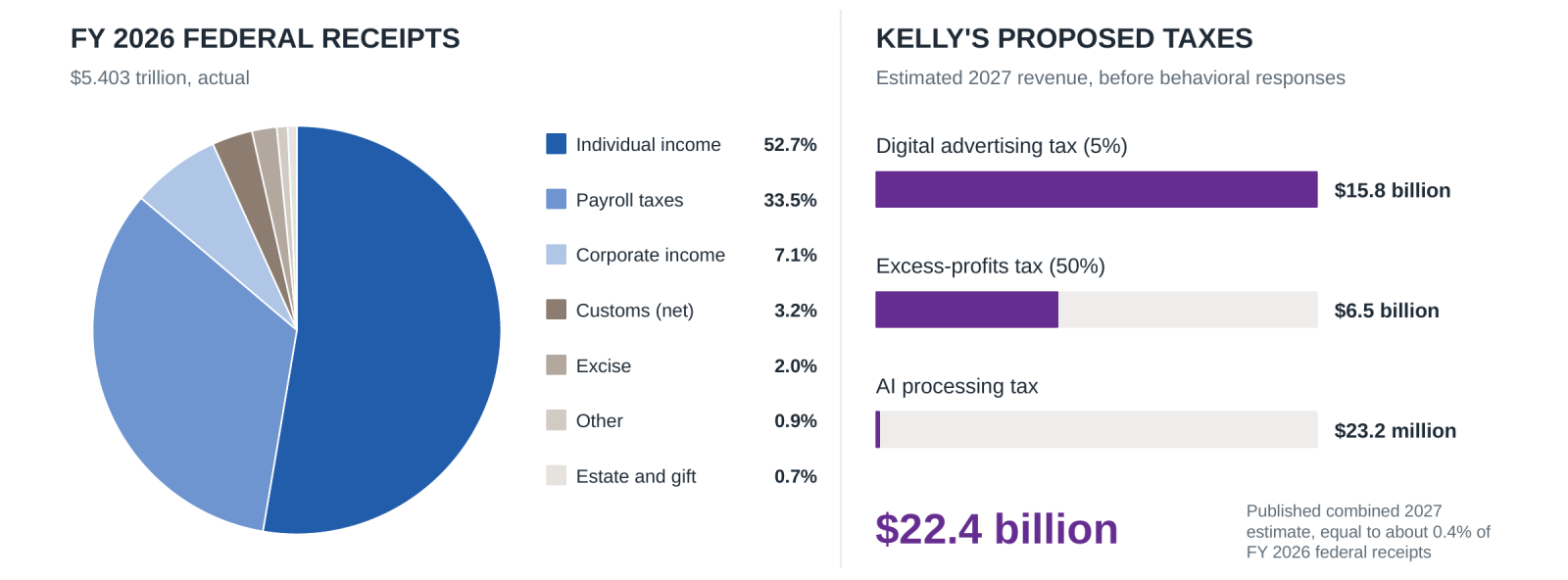
Federal Receipts and an AI Tax
Washington collects $5.4 trillion a year. Kelly’s plan could add about 0.4%

A Tax System Built Around People Who Work
“How many workers AI might replace, and how quickly, remains an open question,” write Elena Spatoulas Patel and Aparna Mathur of the Urban-Brookings Tax Policy Center in their brief, “Taxing Artificial Intelligence.” The authors point out that AI could also expand productivity, raise incomes and produce taxable profits that offset some lost wage revenue.
A Tax Policy Center commentary by Tracy Gordon and Elena Spatoulas Patel, citing research by Karen Dynan, Douglas Elmendorf and Louise Sheiner, suggests new AI taxes could reduce the federal debt by 39 to 49 percentage points of gross domestic product three decades from now. Even so, CBO projects debt rising from 101% of GDP to 175% by 2056, and the most favorable AI scenario still leaves it near 126%.
Silicon Valley Wants a Different Tax Code
One of the most expansive proposals comes from Vinod Khosla, the venture capitalist and early OpenAI investor. In his September essay, “Refounding America: The Tax Code Needs to Change in the Age of AI,” he argues that the government should prepare for an economy in which capital earns a much larger share of national income.
His plan would tax capital gains as ordinary income and eliminate certain tax preferences. Khosla estimates the changes could raise about $400 billion a year — roughly $300 billion from capital gains and $100 billion from ending special tax breaks. The proceeds would first compensate workers displaced by AI, with any remainder rebated as federal income tax refunds to Americans earning less than $75,000. Starting in 2030 or later, he would consider a 20% tax on certain AI computing or token transactions, but only if displacement proves significant.
Khosla’s argument frames a wider debate: Should AI’s benefits be taxed when the technology is built, when customers use it or when companies and investors collect the profits? Taxes on development and use could slow adoption. Taxes on gains and profits collect revenue after the wealth accumulates. The two approaches create very different obligations for accountants.
A Proposed Tax on AI Processing
Sen. Mark Kelly, D-Ariz., offers one of the most detailed collection mechanisms. His Make AI Work for Americans Act, introduced Sept. 24, would establish three federal taxes to finance an AI Horizon Fund for workers and communities affected by economic change.
“Big Tech stands to make enormous profits, while workers are facing real uncertainty about what AI will mean for their jobs and their futures,” Kelly says.
One provision taxes the computational processing used to generate AI content: $1.10 per million processing units, each defined as 10 kilobytes of binary data. That works out to about 11 cents per gigabyte, with the first 10 gigabytes exempt for each covered user annually.
The liability falls on the customer, but the software provider collects the tax and remits it to the Treasury quarterly unless it elects to pay the tax itself. The arrangement resembles sales-tax collection, except that the levy follows processing activity rather than the invoice amount.
Consider a CPA firm subscribing to an AI-powered tax research platform. The tax might appear as a separate charge or be folded into the subscription price, but the firm generally would not file its own excise return. Instead, the provider’s accountants would need records to calculate taxable processing, identify covered users, apply the annual exemptions and reconcile collections with quarterly remittances.
The IRS, meanwhile, has no designated AI excise tax return. It already uses Form 720, Quarterly Federal Excise Tax Return, for many excise taxes, some of which require more frequent deposits. But Kelly’s bill does not name Form 720 as the vehicle, leaving Treasury to develop the schedules, instructions and reporting systems.
Who Would Pay and Report the Proposed AI Taxes?
| Proposal | Direct taxpayer | Expected reporting or collection |
|---|---|---|
| Kelly: AI processing | Covered AI user | Provider collects and remits quarterly; no IRS form assigned |
| Kelly: digital ads | Covered advertising platform | Return required; filing frequency and form unassigned |
| Kelly: excess profits | Covered AI-related business | Annual tax calculation; form unassigned |
| Casar: token value/revenue | Covered AI company | Annual tax calculation; procedures pending |
| Wyden: data center receipts | Covered facility operator | Draft leaves rate and filing details open |
| Warner: depreciation limits | Asset-owning business | Existing income-tax system; Form 4562 may be affected |
| Sanders: equity excise | Covered AI company | Initial stock transfer, plus qualifying later equity issuances |
Three Taxes, Three Different Calculations
Kelly’s bill goes further. It also proposes a 5% tax on qualifying digital advertising revenue and a 50% tax on excess profits of certain AI-related companies, generally taxable income exceeding 40% of gross receipts, subject to the bill’s definitions and revenue thresholds.
That creates three tax bases in one bill. The processing tax depends on technical usage records, the advertising tax on revenue records and user locations, and the excess-profits tax on taxable income, gross receipts and potentially complex ownership structures. A company could owe one tax but not another, or face reporting requirements while owing nothing. One subject to all three might have to reconcile data from engineering, billing, accounting and corporate tax systems — technical measurements never designed for federal tax compliance, which administrators would then have to verify.
The $380 Billion Question
A Nov. 12 analysis by Tax Foundation economists Richard DiSalvo and Andrew Lautz estimates that Kelly’s three taxes could generate $22.4 billion in 2027 and $380 billion over 10 years, before behavioral or broader economic effects. The first-year figures reveal a striking imbalance.
Proposed tax |
Estimated 2027 revenue |
Digital advertising tax |
$15.8 billion |
Excess-profits tax |
$6.5 billion |
AI processing tax |
$23.2 million |
Total, rounded |
$22.4 billion |
Source: Tax Foundation, Nov. 12, 2026. Estimates exclude behavioral and broader economic responses. Published $22.4 billion total may not equal the sum of individually rounded components.
The advertising tax accounts for about 71% of projected first-year revenue and the excess-profits tax about 29%. The AI processing tax, despite its direct connection to the technology Congress wants to tax, contributes about 0.1%. Much of the excess-profits tax could initially fall on a single company.
The researchers treat the 10-year figure as a ceiling, not a forecast, warning that restructuring and other behavioral responses could substantially reduce receipts. That matters because lawmakers are contemplating new spending programs funded by taxes whose collections are hard to predict. Tax Foundation says the processing tax “may serve as a brake on technological development.” The Gordon-Patel commentary adds that slowing AI adoption can shrink the base of an AI-specific tax while reducing the productivity gains it might otherwise generate.
Another Bill Would Tax Tokens
Rep. Greg Casar, D-Texas, takes a different approach. His AI Tax and Work Protection Act would impose an annual tax on covered AI companies equal to the greater of a percentage of the value of AI tokens processed or a percentage of covered AI transaction revenue. The initial rates are 2% of token value and 3% of revenue when the specified unemployment rate is 5% or less, rising as unemployment increases. Casar introduced the bill Aug. 6 with Reps. Valerie Foushee, D-N.C., and Sara Jacobs, D-Calif.; his office announced it Aug. 7.
“This bill says: we will not let AI billionaires get rich by putting you out of work,” Casar says. The revenue would finance a proposed Work Protection Administration supporting employment through infrastructure, housing and other public programs.
The tax would generally be paid by covered AI companies, not customers. But it raises a problem familiar to anyone who works with software businesses: What exactly is a taxable token? Models break text and other material into units differently, so the same question can generate different token counts. A flat-rate subscription may not correspond to any number of tokens, and a company using its own models internally may never issue an invoice.
In its Nov. 18 report, the Congressional Research Service cites shifting token definitions, changing technology and bundled subscriptions as obstacles to designing and enforcing a token tax. Tax professionals would need records and valuation rules that today’s accounting systems do not necessarily produce, especially for internal use or related-party arrangements.
Data Centers Become Tax Targets
Other lawmakers are pursuing an approach more familiar to corporate tax practitioners: Tax the infrastructure.
Sen. Ron Wyden, D-Ore., has released discussion drafts — not introduced legislation — that would change the tax treatment of data centers and impose an excise tax on their gross receipts. The proposal targets operators of facilities used for AI training, inference, data storage and related services. Wyden says the data center boom is raising concerns about local infrastructure, utility costs and employment. His Aug. 6 announcement says U.S. data center construction has quadrupled over four years and projects roughly $700 billion in hyperscaler data center spending in 2026, figures from his office that this account has not independently verified. Comments on the August proposal were due Aug. 31.
The October discussion draft leaves the excise rate to be set once revenue estimates are available. It would also restrict bonus depreciation, Opportunity Zone benefits and some real estate investment trust arrangements for data centers, changing income tax calculations even where no excise return is required. Wyden says the effort is meant to protect taxpayers and help support workers affected by economic disruption.
For related-party and internal facilities, where no customer bill exists, the draft would impute receipts by adding depreciation on data center assets to operating costs — including rent, energy, water, wages and services — and applying a 67% markup, roughly equivalent to a 40% profit margin on revenue. That raises new questions about cost allocation, related-party pricing and facilities that run both AI and conventional workloads.
A $29.9 Billion Depreciation Fight
Sen. Mark Warner, D-Va., introduced the Data Center Tax Accountability and Disclosure Act, S. 5054, in July 2026 to deny bonus depreciation to data centers used at least 20% for developing or operating AI. The bill shows how Congress could tax AI without creating a new excise tax at all, simply by changing the timing of deductions already claimed on income tax returns.
An Aug. 13 Tax Foundation analysis estimates the bill would raise $29.9 billion over 10 years under conventional scoring, while warning that the gain mainly reflects timing rather than a sustained increase and that higher after-tax investment costs could discourage some domestic construction.
The mechanism fits existing compliance systems, but the definition does not. Data centers handle a mix of AI training and inference, email, financial transactions, cloud storage and conventional applications. A facility might look heavily devoted to AI when measured by electricity but less so by revenue, processing time or installed capacity. Different denominators could produce different depreciation treatment for the same building.
Electricity Offers a Simpler Tax Base
Rep. Andrea Salinas, D-Ore., proposes taxing electricity consumed by covered data centers at 1 cent per kilowatt-hour. Compared with tokens or internal AI transactions, electricity is easy to measure; utilities already meter it and large facilities track it closely.
But an electricity tax raises a different question: Does it address the problem lawmakers say they want to solve? A data center can consume enormous amounts of power while providing services that replace no workers, and an AI application can displace labor without much U.S. electricity use. The tax captures a measurable activity without a direct link to job losses, and its cost could pass through to cloud customers, software developers and eventually the businesses using AI.
One Proposal Would Collect Shares Instead of Cash
Sanders, I-Vt., proposes an entirely different mechanism. His American AI Sovereign Wealth Fund Act would impose an excise tax, paid in newly issued equity, on AI companies with more than $200 million in receipts from covered businesses. The initial issuance would give the government a 50% stake, held in a public fund.
Although Sanders describes the levy as one-time, the bill also requires additional equity transfers when covered companies later issue stock, including certain employee equity awards. For accountants, that means identifying qualifying revenue, tracking ownership interests and documenting every subsequent issuance, along with questions about valuation, financial reporting, dilution and classes of equity that no cash tax raises.
Economists Question the Starting Point
Tax economists, meanwhile, question whether AI-specific taxes address the underlying fiscal problem at all. Gordon and Patel argue that the debate has moved too quickly to choosing a tax before identifying the problem and whether a tax can solve it. Strengthening the taxation of capital income, they suggest, could do more than narrowly targeted levies — a position that partly overlaps with Khosla’s, though it does not endorse his revenue estimates.
That creates a bind for lawmakers financing worker assistance. A tax that discourages adoption could reduce productivity gains and future revenue, while one designed to maximize collections might do little about job displacement or environmental costs.
The Congressional Research Service draws a related distinction in its report, “Taxing AI: Alternative Approaches,” which catalogs taxes on tokens, computing power, electricity, advertising, capital investment, data center receipts, corporate profits and stock ownership. An electricity tax might address energy demand; a token tax, usage; a profits tax, the most successful companies; a depreciation limit, investment incentives. None measures how many jobs AI eliminates or ensures the money offsets lost wage taxes. CRS also flags potential constitutional concerns: Taxes on physical assets or company stock, including Sanders’ stock-based tax, could be treated as direct taxes subject to apportionment.
Accountants Could Inherit the Paperwork
For accounting firms, the implications depend on the client situation in the AI economy. A small CPA practice buying AI software might see a new invoice charge without filing anything. A software developer’s accountant could become responsible for calculating, collecting and remitting usage-based taxes. A data center operator’s accountant could face gross receipts taxes, revised depreciation and new rules for separating AI from conventional computing. A large technology company’s accountant could face overlapping taxes on advertising, computing, profits and infrastructure. And accountants at companies using AI internally could have to value transactions that never produce invoices.
Each tax would run on different records: engineering logs for computing taxes, customer-location and revenue data for advertising taxes, taxable income for profits taxes, equipment classifications for depreciation limits and new valuations for internal AI use. The IRS would decide how those records are kept, reported and examined.
Existing machinery offers a start. Excise taxes are commonly reported on Form 720, and depreciation on Form 4562, flowing into the business return. But no current form resolves how to measure a token, allocate computing capacity or value internally generated AI services, or sets payment calendars for taxes Congress has not enacted. That work would fall to Treasury and the IRS, then to taxpayers and their advisers.
Another Tax, or Several New Tax Systems?
The most consequential feature of the AI tax debate may be its fragmentation. Congress is not weighing one tax on a clearly defined activity but several, each aimed at a different part of an industry whose products and business models keep changing. A tax on computing differs from a tax on revenue, which differs from one on profits; an electricity tax differs from a depreciation limit; and a mandatory equity transfer resembles none of them.
Those differences determine more than the amount owed. They decide who becomes a taxpayer, what records must be kept, how often returns are due and whether the tax is paid directly or passed along in the price of software and computing.
For now, lawmakers have offered proposals, economists have produced competing analyses, and CRS has cataloged the unresolved problems. No consensus exists on how to measure AI’s economic contribution, identify the jobs it displaces or choose the tax base that best captures the resulting income. Yet the proposals are moving into the legislative process, and the country could be building a new layer of federal taxation before it has defined the underlying transactions.
AI may automate bookkeeping, research, tax preparation and financial reporting. It may also create a new generation of tax records, calculations, reconciliations and disputes. The machines may do more of the work. But the obligation to account for it — and to pay taxes on it — will still belong to someone.