Holding Steady, Tuning Workflow, and Testing AI.
By CPA Trendlines Research

With the 2026 filing season approaching, most accounting firms are not racing to rip and replace their technology stacks. Instead, they are making selective adjustments, tightening workflows, and cautiously experimenting with artificial intelligence — all while keeping a close eye on staffing limits, client behavior, and return on investment.
JOIN the Busy Season Barometer survey here.
MORE TAX, PRICING, PAY, HIRING, and THE 2026 OUTLOOK
That restrained approach comes through clearly in CPA Trendlines’ Busy Season Barometer, which shows a profession that is less focused on transformation than on execution. The dominant theme across survey waves is not disruption, but discipline.

More than four in ten firms say they plan no changes to their technology tools and services for the coming tax season. Among those who expect changes, the emphasis is on workflow and productivity rather than on new software categories. Artificial intelligence plays a growing role in those plans, but for most firms it remains an add-on rather than a foundation.
Together, the results provide a snapshot of how practitioners are thinking about technology heading into 2026 — what they are prioritizing, what they are deferring, and where they see real leverage.
Holding steady is the most common strategy.
When asked whether they are considering changes to their tech tools and services for tax season 2026, a plurality of respondents said no. Roughly 43% reported they expect to make no changes, underscoring how many firms believe their existing systems are “good enough” for another busy season.
That does not necessarily reflect satisfaction. In many cases, it reflects caution. Firms remain wary of implementing new tools during peak workload periods, especially after years of disruption tied to remote work, staffing turnover, and shifting client expectations.
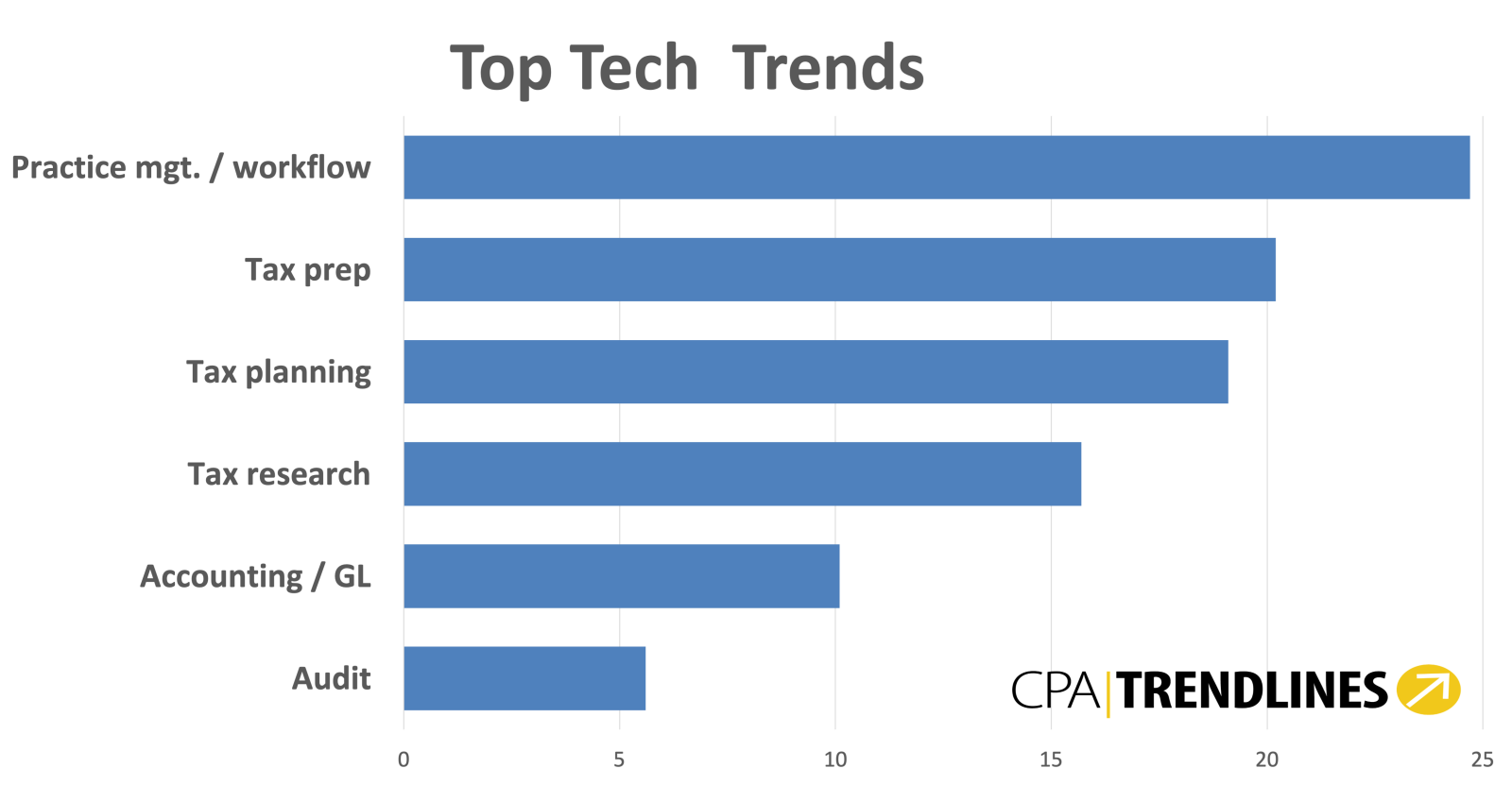
Among firms that are planning changes, the adjustments tend to be targeted. Workflow tools, tax preparation software, planning and research platforms, and client portals all rank ahead of broader system overhauls. The pattern suggests firms are trying to extract more value from the tools they already have rather than introducing unfamiliar systems.
Workflow, not AI, is where most firms are placing their bets.
Across the Barometer, workflow-related changes emerge as the most common area of planned investment. About one-quarter of respondents say they are making changes to workflow or practice management tools — more than any other category.
That focus aligns with the pressures firms describe elsewhere in the survey. Staffing shortages remain widespread, returns on extensions are expected to remain elevated, and client readiness remains uneven. In that environment, workflow efficiency becomes a form of risk management.
Firms are looking for tools that reduce handoffs, improve visibility into work in progress, and compress the time between client intake and a review-ready return. The goal is not necessarily to do more work, but to do the same work with fewer bottlenecks.
Many respondents describe efforts to streamline portals, standardize processes, and enforce more consistent use of existing systems. Several note that the biggest gains often come not from new software, but from better discipline around how current tools are used.

Where AI fits — and where it does not.
Artificial intelligence is clearly on firms’ radar, but adoption remains cautious. Only a small number of respondents say they are actively using AI across multiple workflows. The largest share reports piloting or testing AI in limited areas, while others say they are interested but not yet planning adoption.
When firms are asked where AI can deliver the greatest value, the answers are pragmatic. Tax preparation and review top the list, followed closely by bookkeeping and transaction coding, workflow management, and client communication. Advisory and marketing applications rank lower, and audit-related uses trail further behind.
Those rankings reinforce a consistent message: firms are most interested in AI where it can remove repetitive work, speed internal processing, and support review, not where it introduces new risk.
The comments add nuance. Few respondents reject AI outright. Many describe it as promising, inevitable, or useful in narrow contexts. At the same time, concerns about accuracy, hallucinations, data security, and professional liability surface repeatedly. Human review remains non-negotiable.
Several respondents draw a clear distinction between internal use and client-facing deliverables. AI may help draft, summarize, or analyze, they say, but final judgment must stay with licensed professionals.
“It’s getting better, but still has lots of room for improvement,” says a partner based in Jacksonville, Fla., and working at a firm with eight offices in Arkansas and Arizona. “AI will need to be supervised by a human for the foreseeable future.” The firm, which has eight offices in Arkansas and Arizona, is currently piloting AI in limited areas. But the really big gains could come in audit.
Tim Gehring, at Gehring & Farrwood in Pullman, Wash., says it’s a “useful tool in certain circumstances, but I don’t see it taking my job away anytime soon.”
In Bakersfield, Calif., a solo owner is “excited for the potential, but,” she says, “it needs better training in accounting applications.”
“At this point, I think it is over-hyped,” says a partner at a three-office firm in Wisconsin. “We will see what really happens over the next few years. There are many applications for robotic-type solutions, but that is not AI.
AI adoption tracks strategy, not comfort.
One of the most revealing findings in the Barometer is the correlation between AI usage and other aspects of firm strategy.
Firms that report active AI use or robust pilots are also the most confident about pricing. They are more likely to expect revenue growth driven by higher revenue per client, rather than by expanding client counts. AI, for these firms, appears to function as margin protection — a way to absorb rising costs and defend higher fees without adding staff.
Those same firms are also more likely to report staffing stress. Rather than signaling surplus capacity, AI adoption appears to be a response to constraint. Firms under pressure to do more with limited staff are turning to AI as a force multiplier, not a replacement.
By contrast, firms that express interest in AI but have no plans to adopt it tend to report flatter pricing expectations and less acute staffing pressure. Firms that say they are not interested in AI at all are the least likely to expect pricing gains.
Notably, AI adoption does not correlate with expectations for returns on extension. Even firms actively using AI continue to anticipate high extension volumes, reinforcing the view that client behavior and regulatory complexity — not internal processing speed — are the primary drivers of extension risk.
Vendor strategies mirror firm priorities.
The way vendors are positioning AI closely mirrors what firms say they want.
Practice management and workflow platforms are emphasizing end-to-end process coverage, tighter integrations, and fewer handoffs. Research providers are focusing on verifiable answers and authoritative sourcing. Compliance vendors are highlighting visibility, audit readiness, and predictive insight rather than raw calculation speed.
Across the market, AI is increasingly embedded inside existing systems rather than offered as a standalone feature. The competitive message is not “look what AI can do,” but “look how much friction we can remove from your day.”
For practitioners evaluating technology options, that framing matters. The most relevant question is not whether a tool has AI, but whether it shortens cycle time, reduces rework, or improves control during peak periods.
What this means for 2026.
Taken together, the Busy Season Barometer paints a picture of a profession in pragmatic mode. Firms are not standing still, but they are not chasing every new capability either. The prevailing strategy is to stabilize, refine, and selectively enhance.
Workflow improvements lead the list. AI experimentation follows close behind, but in bounded, supervised ways. Wholesale technology change remains the exception.
For firm leaders, the benchmark is clear. Peers are prioritizing execution over experimentation, margin protection over growth at any cost, and discipline over disruption. Technology decisions for 2026 are less about vision statements and more about surviving — and controlling — another demanding, busy season.
In that sense, the most telling signal is not how much AI a firm is using today, but how deliberately it is choosing where to use it at all.
