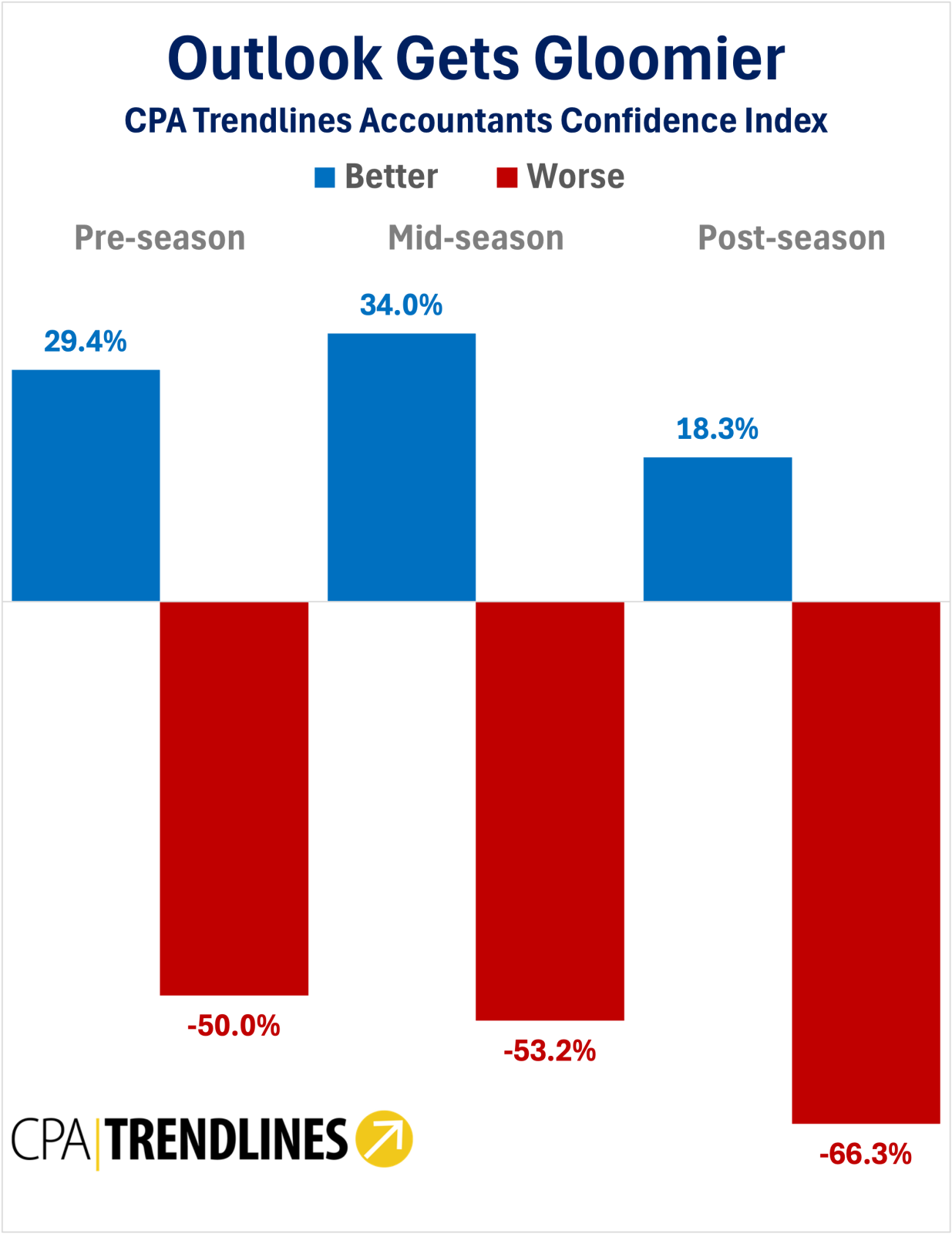
Two-thirds now see tough times ahead.
By CPA Trendlines Research
After processing hundreds, if not thousands, of tax returns for wage earners and small business owners, U.S. accountants’ confidence in the nation’s economy is in a state of collapse, according to the latest CPA Trendlines Busy Season Barometer.
While practitioners entered the winter with relatively stable expectations, the reality of “busy season”—which provides a granular look at the financial health of American businesses—has apparently triggered a sharp reversal.
MORE Busy Season Barometer Join the survey. Get the results
MORE Busy Season
With the end of the 2026 filing cycle, roughly two-thirds of CPAs are predicting that national business conditions will worsen over the next 12 to 18 months, a startling increase from the beginning of the cycle, when only half held a negative outlook. Conversely, the number of optimists dwindled to about 18%, down from nearly 30 points from earlier in the year.
“We’re looking at higher costs and too much uncertainty for our small-business clients,” one sole proprietor noted in the survey, shifting his rating to “much worse.”
The pessimism appears rooted in a “margin squeeze” affecting the broader economy. While the Federal Reserve Bank of Atlanta’s GDPNow model estimates first-quarter 2026 real GDP growth at an annualized 1.3%, CPAs report that their clients are struggling to keep pace with rising costs.
“The lower end appears to be finding it near impossible to overcome basic necessities cost increase,” says one practitioner in Irving, Texas.
The data show a similar downward arc for small-business prospects. Nearly six in 10 CPAs now expect conditions for business owners to deteriorate, up from roughly half at the beginning of the year. Respondents cite a “toxic mix” of persistent inflation, elevated interest rates, and policy instability as primary headwinds.
“Changing government policies, tariffs, and war all make businesses hesitant,” says Robert Hausman of Hausman CPAs in Rockville, Md.
Despite the macro-economic gloom, accounting firms remain surprisingly upbeat about their own internal prospects. More than 40% of practitioners expect their firms to improve over the next 12-18 months, citing increased pricing power, better client selection, and the integration of artificial intelligence.
Bernie Ackerman of BNA CPA in Rock Hill, S.C., notes that AI is making his firm “more efficient and effective,” enabling deeper client advisory services even as the broader economy stutters.
This divergence suggests a profession in transition. Rather than waiting for a return to economic clarity, many firms are aggressively raising minimum fees and shedding unprofitable accounts to protect their own profitability.
“Our clients are still spending, but they’re more anxious about the next shoe to drop,” says Nicholas Grassano of Grassano CPA in Boca Raton, Fla.
The findings align with national indicators. The NFIB Small Business Optimism Index slipped to 98.8 in February, with NFIB Chief Economist Bill Dunkelberg stating that while GDP is rising, “small businesses are still waiting for noticeable economic growth.”
For the accounting profession, the takeaway is one of compression rather than collapse. Experts suggest the next 18 months will be defined by tighter margins and a higher demand for advisory services as businesses look to CPAs to navigate a landscape marked by lower momentum and greater uncertainty.
Business owners caught in the middle
California practitioner Eric Grant cites “federal policies focusing on short-term results with complete lack of concern over future impacts” as a key reason he was more cautious about the economy than about his own firm.
Pennsylvania CPA Tony Coladonato ties his “somewhat better” outlook to “economic stability” and “job growth,” but warns that “it will take time for all of these changes to take effect.”
“It depends on the regulatory environment,” says California CPA David Dillwood, warning that “if the regulatory environment eases a bit, we will see fairly significant advancement. If it doesn’t, we’re in for a slog.”
From early fall into the winter months, sentiment improved modestly. By early spring, that trend reversed decisively. Positive outlooks on the national economy fell to less than one in five respondents, while negative sentiment rose to more than two-thirds. That turning point aligns with broader economic data. Growth slowed, inflation reaccelerated, and interest rates remained elevated. Real GDP expanded at just 0.5 percent in the fourth quarter of 2025, while consumer prices rose 3.3 percent year-over-year. Gasoline prices surged more than 20 percent in a single month, putting immediate pressure on operating costs.
Economists have described the environment in similar terms. “The economic outlook is highly uncertain,” St. Louis Federal Reserve President Alberto Musalem says, pointing to risks from both persistent inflation and a potential weakening in the labor market.
Accountants see those risks playing out directly in their client base. For many small businesses, the problem is not demand, but margins. Costs are rising faster than prices can be adjusted.
“We are on the verge of a recession due to tariffs, inflation and the price of gasoline,” says Jonathan Kaplow in Waltham, Mass.
Others point to policy instability as a key factor shaping business decisions. The Conference Board reports that confidence has improved modestly, but expectations remain weak. “Confidence has improved modestly, bnut remains on a general downward trend,” says Chief Economist Dana Peterson.
Within the accounting profession, the impact varies significantly by firm size. Smaller firms, particularly those serving local businesses, report the most negative outlooks. These firms are more exposed to the financial health of small clients, who tend to feel economic pressure first. Mid-sized firms show more stability, and in some cases modest optimism, reflecting a more diversified client base.
Technology strategy is another dividing line. Firms actively investing in automation and artificial intelligence report more positive outlooks, viewing technology as a tool for managing costs and expanding services. “How we use technology, including AI, to improve operations and productivity” is a key factor shaping outlook, says Ahmad Husami in Fullerton, Calif.
Even amid declining confidence, many accountants see opportunity. “Very excited about the future of my firm,” says Lesley Lewis in Cedaredge, Colo., despite persistent staffing challenges.
That optimism reflects a broader shift in the profession. As conditions become more complex, demand for advisory services is rising. Clients are seeking guidance on cash flow, pricing, tax strategy and operational decisions.
The result is a profession that is becoming more central, even as the environment becomes more difficult.
The broader takeaway is not collapse, but compression. Growth continues, but at a slower pace. Costs remain elevated. Policy remains uncertain. And confidence is increasingly conditional.
For many in the profession, that means preparing not for expansion, but for resilience.