Firms are hiring, but accounting enrollment has swung widely.
By CPA Trendlines
There’s disturbing but not disastrous information about the profession’s labor supply.
Or, to look at it another way, good news and bad news.
The good news is that accounting firms are optimistic enough to foresee a lot of hiring.
The bad-but-not-disastrous news is that the incoming supply of accounting graduates may not keep up with the demand.
So much for optimism.
Since 1971, when the AICPA began its study, “Trends in the Supply of Accounting Graduates and the Demand for Public Accounting Recruits,” the general trend in graduates with bachelor’s and master’s in accounting degrees has generally risen, but not evenly. Growth was steady and steep through the ’70s but then evened off for 20 years. But the new millennium didn’t bring new hordes of CPAs. Quite to the contrary, graduation with accounting degrees rates declined. By 2006, they were down to the numbers of the mid-70s.
But the trend turned upward again and rose steeply, doubling the number of bachelor’s and master’s degrees by 2012.
And that goes double for CPAs. We’ve had it hard. When the recession hit, we lost clients. The clients we didn’t lose couldn’t afford fee increases. But the cost of software increased, and most hardware has had to be replaced twice since the recession first hit. Salaries have gone up, too, especially among accountants, whose ranks have thinned in recent years. And the tax regulations get harder, the waiting time on the IRS line longer, the reporting lengthier.
At long last, economic conditions seem to be improving enough for widespread increases in billing rates and fees. About 85 percent of respondents to The CPA Trendlines Study of Pricing Strategies and Trends see an upward trend underway.
CPA Dave Murray at his eponymous firm in Troy, Ohio, is pushing through “significant increases.” He says, “Our firm is increasingly being paid for our knowledge.” “Yes,” he says, value pricing is becoming an important success strategy. “When it’s worth more to the client we charge more,” he says. And he does it all while maximizing profit margins and retaining clients. “We have a consistent flow of new clients and we no longer have to discount to get them to come in,” he says.
Frank Stitely, at SKC CPAs in Chantilly, Va., and a frequent contributor to CPA Trendlines, is being more careful, with only slight increases. “Personal taxes, specifically, are a commodity, and, in general, compliance services are commoditizing,” he says, with his pricing driven my market forces. On the other hand, the firm bills “per form for personal returns and by proposal for almost everything else.”
Brian Roark in Jenison, Mich., likes to say Integrity Tax’s offices have been doing taxes “since dinosaurs roamed the earth.” But today he’s playing catch-up in the wage markets, pushing through moderate billing increases.
At Southwest Tax & Accounting in Elkhart, Kan., owner Terri Ryman, EA and Quickbooks ProAdvisor, is going for significant price increases as clients struggle with the Affordable Care Act and repair regs. She says her business is growing every year. Ryman is also a prominent member of the National Society of Accountants and the National Association of Tax Professionals. READ MORE →
For the week ending March 18, 81.96 million returns had been received, down 0.4 percent from the same period last year. Of those, 79.63 million had been processed, down 1 percent. READ MORE →
News Alert! The Internal Revenue Service is a big mess. Its budget cut by Congress, it’s underfunded. Underfunded, it’s having trouble providing services to its constituents.
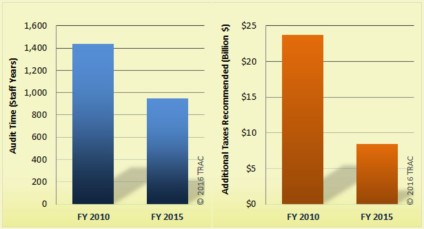
Drop in Audit Time and Recommended Additional Tax — Big Corporations
Nation’s biggest companies benefit from Congressional budget cuts.
By Rick Telberg
CPA Trendlines
Maybe it’s only legend, but if you’re a quotation buff, you’ve probably heard novelist F. Scott Fitzgerald telling Hemingway, “The rich are different from you and me.” Hemingway responds, “Yes, they have more money.”
The same may apply to giant corporations, at least as far as the IRS is concerned. And the consequences are far from amusing.
 Firms are hiring, but accounting enrollment has swung widely.

 Verify now or suffer later.