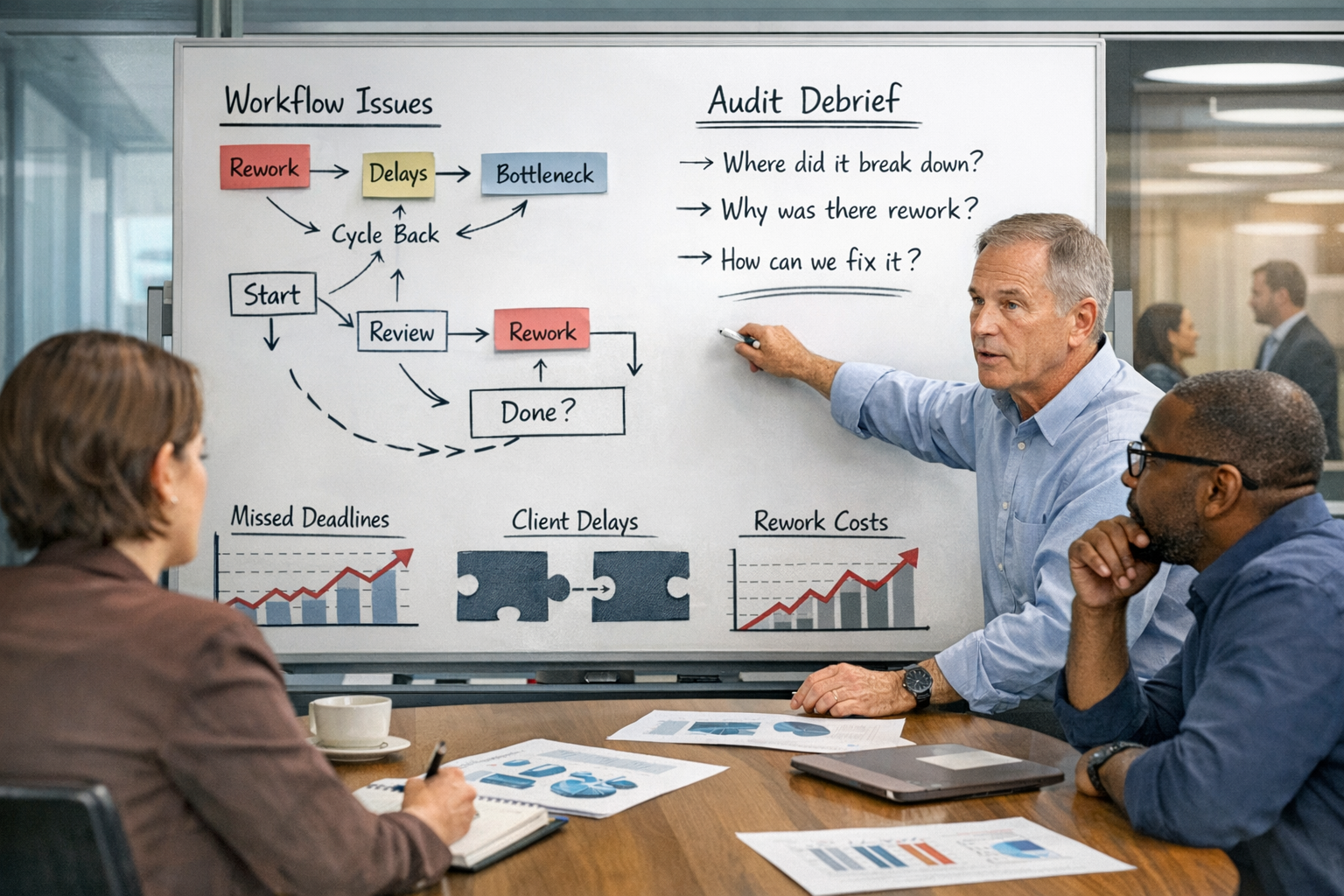
The Post-Audit Debrief Most Teams Get Wrong

Why most debriefs fail to change the next audit—and how to turn them into real design inputs

By William Englehaupt

As one audit cycle closes and the next begins, most teams go through some form of debrief. In theory, this is where learning happens, where teams step back, reflect on what worked, what didn’t, and carry those insights forward.

In practice, it rarely works that way.

MORE Audit & Assurance

Debriefs are often rushed or treated as closure rather than input. The questions are familiar—what went well, what didn’t—but the discussion stays at the surface. Late nights, difficult clients, tight deadlines. The symptoms are easy to identify. The underlying causes are not. READ MORE →

The Hidden Factory in Accounting: Why Rework Is Quietly Eating Your Capacity

The question firm leaders often ask is simple: Where did the capacity go?


By William Englehaupt

Accounting firms rarely struggle because they lack plans, tools, or capable professionals. Most engagements begin with detailed project plans and clear milestones. Yet despite all of that structure, work still arrives late, review pressure spikes at the end, and teams feel chronically overextended.

MORE Productivity | MORE Audit and Assurance

The answer usually isn’t visible on the plan. It sits in what many firms experience but rarely name—the hidden factory.

READ MORE →

Psychological Safety Is a Throughput Issue, Not a Soft Skill

Firms rarely struggle because their people lack intelligence, training, or work ethic.

By William Englehaupt

Most teams are staffed with capable professionals who understand the standards and care deeply about quality. Yet issues still surface late, reviews still congest near deadlines, and leaders are often surprised by risks that “should have been obvious earlier.”

MORE Audit and Assurance

The common explanation is experience gaps or workload pressure. The more accurate explanation is simpler and more uncomfortable: uncertainty is being withheld until it is too late to deal with cheaply. That is not a personality problem. It is a system problem.

READ MORE →

Why “Busy” Is the Wrong Metric in Audit


And the Planning Assumptions Firms Get Wrong.

By William Englehaupt

Walk through almost any accounting firm during busy season, and the signals are familiar: calendars packed wall-to-wall, inboxes filling faster than they can be cleared, and professionals praised for constantly stepping up to meet demands. In many firms, this visible intensity is taken as proof of productivity. If people are busy, the thinking goes, work must be getting done.

MORE Audit & Assurance

But “busy” is not a productivity metric. It is a symptom. And when firms mistake it for performance, they quietly undermine quality, predictability, and morale.

Accounting is not alone in this trap, but the profession is especially vulnerable to it. Long hours and constant responsiveness feel reassuring in high-risk environments. They create the appearance of control. What they rarely produce is a reliable flow.

READ MORE →

SP to RT>>>Why Most Audit Plans Repeat Last Year’s Problems


Here’s why planning often reinforces existing constraints—and how to design for a different outcome.

By William Englehaupt

As one audit cycle closes and the next begins, firms invest significant effort into planning: updating timelines, assigning resources, and aligning on key milestones. On the surface, the process appears structured and deliberate. But beneath that structure, a quieter pattern persists.

Most audit teams believe they are planning for the future. In reality, they are often replaying the past. This is what many would label as SALY, “same as last year.”

MORE Audit process, audit planning

As a Prussian general once observed, “No plan survives first contact with the enemy.” In auditing, that “enemy” is reality: uneven client data, evolving judgment, and the rework that becomes visible once work begins. Most plans are not corrections; they are continuations.

READ MORE →