Why “Busy” Is the Wrong Productivity Metric in Accounting

Many firms get planning assumptions wrong.

By William Englehaupt

Walk through almost any accounting firm during busy season, and the signals are familiar: calendars packed wall-to-wall, inboxes filling faster than they can be cleared, and professionals praised for constantly stepping up to meet demands. In many firms, this visible intensity is taken as proof of productivity. If people are busy, the thinking goes, work must be getting done.

But “busy” is not a productivity metric. It is a symptom. And when firms mistake it for performance, they quietly undermine quality, predictability, and morale.

Accounting is not alone in this trap, but the profession is especially vulnerable to it. Long hours and constant responsiveness feel reassuring in high-risk environments. They create the appearance of control. What they rarely produce is a reliable flow.

READ MORE →

Can a Service Center Model Solve Audit Staffing Shortages?

Providing superior client service eliminates the perception of audit as a commodity.

By Alan Anderson, CPA
Transforming Audit for the Future

Most firms have abysmal project management, which makes it nearly impossible to see if there’s any room to take on extra work. Plus, piling all the work into busy season means your people already work far beyond 40 hours a week. And, if you’re relying on timesheets as a measure of capacity, you may not be capturing the time your staff eats because the work is taking more than 40 or even 60 hours in a week to complete.

MORE: Don’t Take on Audits in an Industry You Don’t Understand | Four Questions to Make Your Firm More Successful as a Business | Say Adios to Audit Fee Pressure | Deliver More Audit Value by Getting Out of the Conference Room | Six Essential Elements in Audit Planning | Before the Audit: More Than Just Planning | Five Crucial Attributes for Successful Audit Leadership | Put the Ethics Code to Work for Your Clients and Your Firm | Is Audit in Crisis Because of Definitions?
GoProCPA.comExclusively for PRO Members. Log in here or upgrade to PRO today.


During the 2020-21 COVID-19 pandemic, some audit firms had to lay people off, or reduce work hours as projects got canceled or curtailed. But the long-term trend for years has been a shortfall in talent that will only get worse. Burnout from overwork is the number one cause of employee turnover.

READ MORE →

Don’t Take on Audits in an Industry You Don’t Understand

Don’t try to wear too many hats. Pick your specialty area and become a guru.

By Alan Anderson, CPA
Transforming Audit for the Future

Industry expertise is essential for businessmindedness. For me, the primary ingredient for building a successful audit practice is to avoid taking on work that you don’t understand. Too many firms say they can audit any balance sheet, but that’s when they can get into trouble. Many firms get sued because they made a bad business decision. They thought they could take on this unique industry and get it right. If you dabble in any industry, you will put your firm and yourself at tremendous risk.

MORE: Four Questions to Make Your Firm More Successful as a Business | Move to Advisory and Assurance with Relevance | How ‘Business Expert CPAs’ Get Their Own Business WrongSay Adios to Audit Fee Pressure | Eight Items to Cover in the Audit Exit to Deepen Client Relationships and Prove Value | Know Your Three Audit W’sPlanning Lays the Foundation of Audit Relevance | How Do We Drive Relevance in Audit? | Before the Audit: More Than Just Planning | Are You Correctly Identifying the Relevance Intersection? | Lack of Relevance Drives Audit Commoditization
GoProCPA.comExclusively for PRO Members. Log in here or upgrade to PRO today.


When the U.S. Department of Labor looked at the quality of employee benefit plan (EBP) audits, they found plenty of problems. That 2014 study found “a clear link between the number of employee benefit plan audits performed by a CPA and the quality of the audit work performed.” Almost half of the firms the DOL looked at performed only one or two EBP audits per year, and 75 percent of those had deficiencies. Over half of those (56%) had five or more deficiencies.

READ MORE →

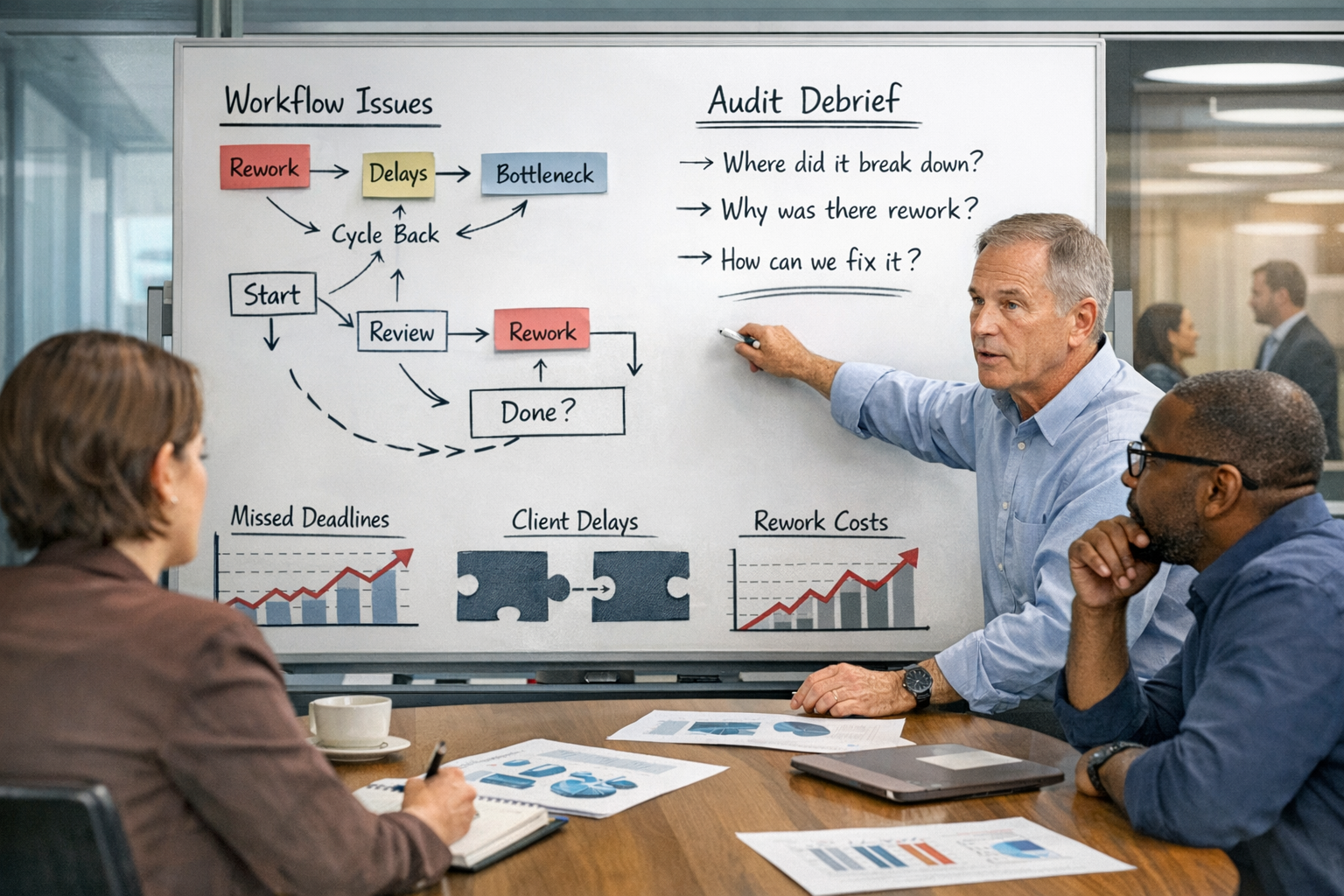
The Post-Audit Debrief Most Teams Get Wrong


Why most debriefs fail to change the next audit—and how to turn them into real design inputs

By William Englehaupt

As one audit cycle closes and the next begins, most teams go through some form of debrief. In theory, this is where learning happens, where teams step back, reflect on what worked, what didn’t, and carry those insights forward.

In practice, it rarely works that way.

Debriefs are often rushed or treated as closure rather than input. The questions are familiar—what went well, what didn’t—but the discussion stays at the surface. Late nights, difficult clients, tight deadlines. The symptoms are easy to identify. The underlying causes are not. READ MORE →

It’s Time for a New CPA Career Track

older woman showing young woman something on office computer screen

How are you assessing your team?

By Alan Anderson, CPA
Transforming Audit for the Future

I’m fortunate to have two great former auditors working with me in Accountability Plus – my son Tyler Anderson and Corey Schmidt, who met working together as auditors. But that firm – like most firms – was focused on total hours worked and realization rates, and had no tracks for auditors who didn’t fit in the normal staff to senior to supervisor to manager to partner progression.

MORE by Alan Anderson
GoProCPA.comExclusively for PRO Members. Log in here or upgrade to PRO today.


As Corey told me, “Tyler and I were good with workflow management and managing processes, and that’s what our firm should have had us focus on.” Corey demonstrated that when he was assigned the employee benefit plan practice at that firm, and through his leadership, improved fee realization from 60 percent to 100 percent.

READ MORE →