Empowerment seems like it would be the easiest attribute to build up in a firm, but it’s actually one of the hardest. Firms go to these Kumbaya events on leadership and trusting your team, but then when they go back to the office the next day, nothing has changed.
Empowerment is last in my book because it’s the furthest from what clients value most. Clients look at What’s In It For Me – they value what’s relevant to them. But empowerment is the most important attribute in our framework. It’s the key to unlocking the power of your team. READ MORE →
Only 1 in 5 firms has an AI strategy, leaving most firms with varying degrees of chaos.
Barely three years since ChatGPT launched, 98% of accountants are using AI regularly. 88% use it in client service.
By CPA Trendlines Research
With artificial intelligence now firmly embedded in the daily life of tax and accounting firms, the profession’s next test is whether practitioners can learn to run AI before AI outruns the practice.
A new crop of research studies and benchmarking surveys suggests firms have yet to fully govern the tools, price the work, train the staff and protect client trust under AI regimes. Reports from the AICPA, Karbon, CPA.com, Blue J, Intuit Firm of the Future, KPMG, Personiv, the ACCA, Rightworks, Business.com and Citrin Cooperman show AI adoption is no longer in doubt. Coping with it is.
Karbon says 98% of accounting professionals use AI, up 15 percentage points from last year, with 55% using it several times a day and 74% using it daily or more often.
Intuit says 88% of accounting professionals used AI for at least one client service in the last 12 months, and 86% used AI for at least one firm operation. Some 46% of firms are investing in AI training, 21% have an AI policy, and 21% have an AI strategy. Intuit says 30% describe AI as embedded by default in daily work, while 54% use it only when it seems useful.
Empowerment means that teams feel like they have ownership over the outcome, outputs and the process of what they are doing. They need to feel it’s OK to try doing things differently and even to make a mistake – and learn from it. The quality of everyone’s work improves when they have the confidence to present new ideas, and to push back when they think there’s a better way to do something. And empowerment delivers results – especially when it is partnered with owned accountability.
Unfortunately, most of us have a better idea of what an empowered team and empowering managers do not look like than what they do look like. Let’s look at a few of the ones you may have seen in your time working. READ MORE →
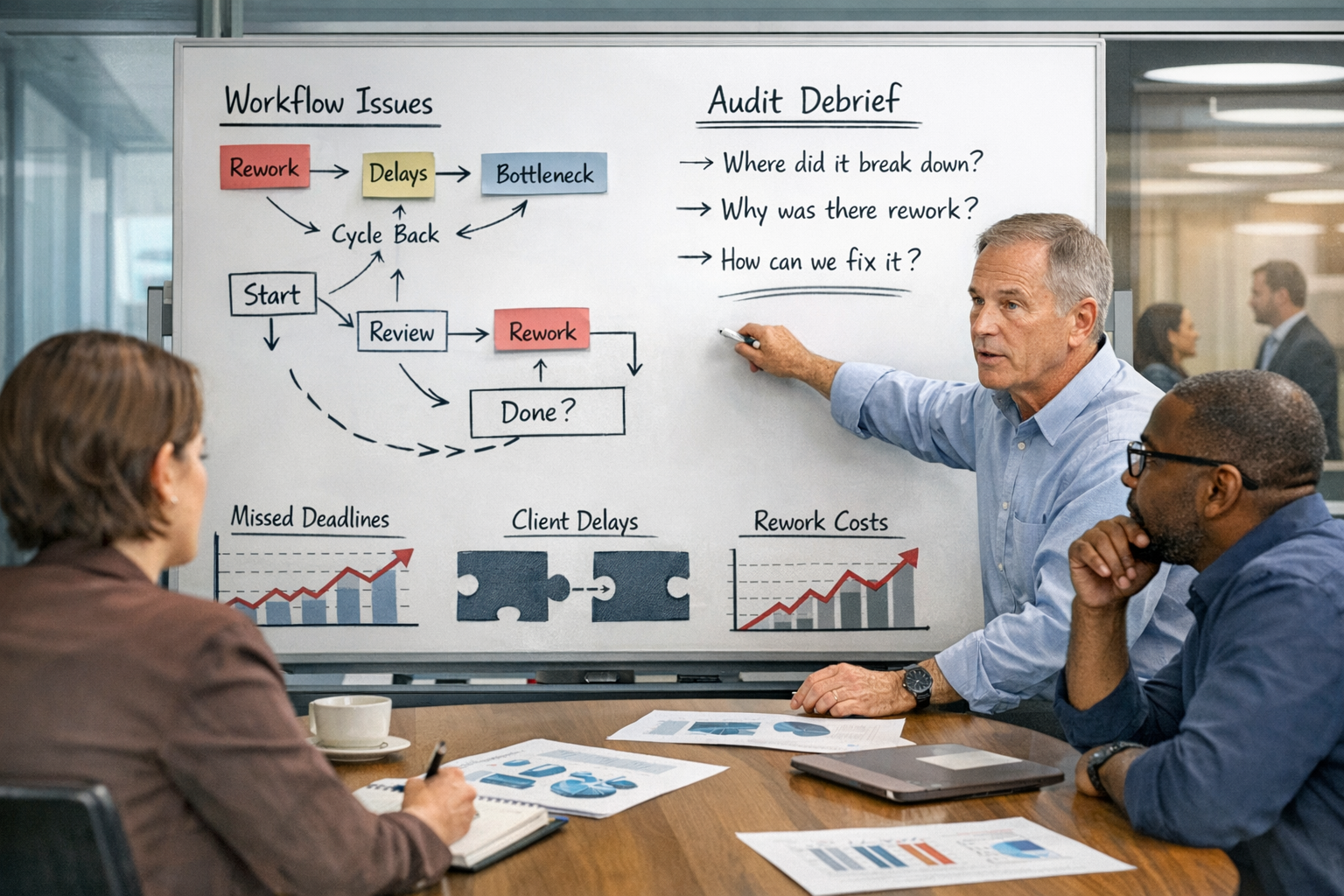
Here’s why most debriefs fail to change the next audit—and how to turn them into real design inputs.
By William Englehaupt
As one audit cycle closes and the next begins, most teams go through some form of debrief. In theory, this is where learning happens, where teams step back, reflect on what worked, what didn’t, and carry those insights forward.
In practice, it rarely works that way.
Debriefs are often rushed or treated as closure rather than input. The questions are familiar—what went well, what didn’t—but the discussion stays at the surface. Late nights, difficult clients, tight deadlines. The symptoms are easy to identify. The underlying causes are not. READ MORE →
Why audit outcomes are set earlier than most teams think—and how to design for a cleaner execution
By William Englehaupt
By the time audit work is under pressure, most of the outcome has already been determined.
Deadlines tighten. Review queues build. Questions surface late. Client pressure magnifies. Teams respond the only way they can: by working longer, moving faster, and relying on experience to close the gap.
It feels like execution is the problem. In reality, execution is where earlier decisions show up.