Why “Busy” Is the Wrong Metric in Audit


And the Planning Assumptions Firms Get Wrong.

By William Englehaupt

Walk through almost any accounting firm during busy season, and the signals are familiar: calendars packed wall-to-wall, inboxes filling faster than they can be cleared, and professionals praised for constantly stepping up to meet demands. In many firms, this visible intensity is taken as proof of productivity. If people are busy, the thinking goes, work must be getting done.

MORE Audit & Assurance

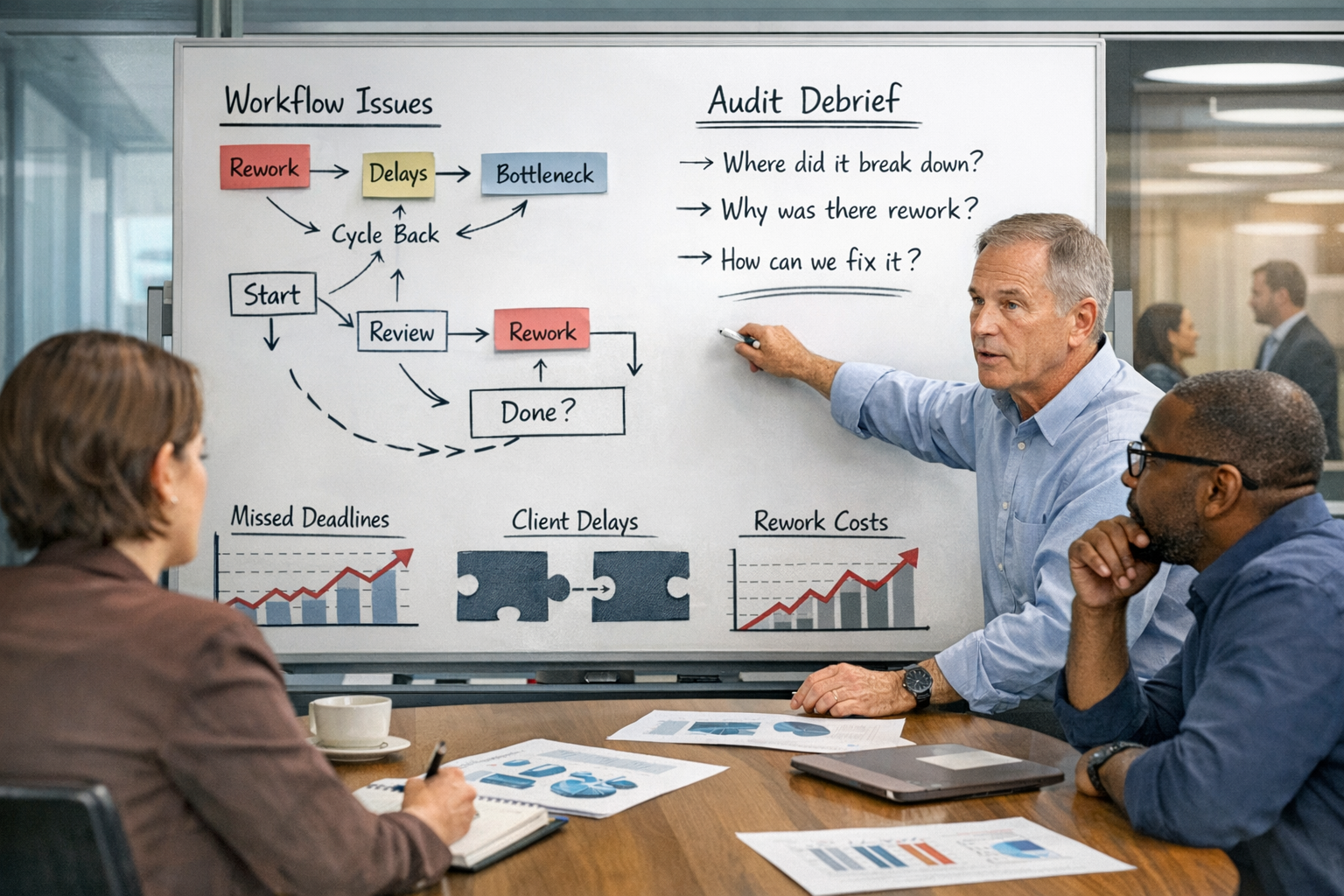
But “busy” is not a productivity metric. It is a symptom. And when firms mistake it for performance, they quietly undermine quality, predictability, and morale.

Accounting is not alone in this trap, but the profession is especially vulnerable to it. Long hours and constant responsiveness feel reassuring in high-risk environments. They create the appearance of control. What they rarely produce is a reliable flow.

READ MORE →

SP to RT>>>Part 1: Why Walkthroughs Break Down (and What It’s Really Costing You)


Why one of the most critical audit procedures quietly becomes one of the least effective

By William Englehaupt

Walkthroughs sit at the center of audit quality. They are the mechanism through which auditors develop an understanding of processes, identify control points, and assess risk in context. Yet in practice, they are frequently one of the least controlled and most inefficient parts of the engagement.

They tend to run late, produce incomplete evidence, and generate follow-up cycles that extend months beyond the initial meeting. By the time year-end arrives, teams are often still resolving questions that should have been addressed months earlier. This is not a failure of technical capability; it is a failure of process design.

MORE Productivity | MORE Audit and Assurance

Most audit teams do not manage walkthroughs as a defined system of work. Instead, they are treated as a sequence of meetings—scheduled, conducted, and documented with varying degrees of rigor. That approach creates the appearance of progress without delivering the underlying objective: a complete, evidence-based understanding of the transaction flow from initiation through financial statement impact.

READ MORE →

SP to RT>>>Managing Walkthroughs Like a Process (Not a Meeting)

How high-performing teams turn a recurring pain point into a source of control and insight

By William Englehaupt

If walkthroughs consistently generate delay and rework, the solution is not incremental improvement in meeting execution. It requires a different approach to how the work itself is structured and managed.

Effective teams begin with a simple but consequential reframing. Walkthroughs are not events; they are a process with a defined start and end point, a sequence of standard activities, and clear ownership for each step. That process typically includes preparation, coordination of PBC requests, structured meeting execution, post-meeting follow-up, and timely completion of documentation and review. When these elements are not explicitly defined, they occur inconsistently, and the gaps between them become the source of delay.

MORE Productivity | MORE Audit and Assurance

One of the most effective ways to stabilize this process is to make the work visible. High-performing teams rely on structured walkthrough trackers that map each step in the process, assign responsibility, and establish expected timing. These are not static checklists but dynamic tools that reflect the flow of work before, during, and after the walkthrough meeting. By making dependencies explicit, they allow both the audit team and the client to understand how delays in one area affect the broader timeline.

READ MORE →

SP to RT>>>Why Most Audit Plans Repeat Last Year’s Problems


Here’s why planning often reinforces existing constraints—and how to design for a different outcome.

By William Englehaupt

As one audit cycle closes and the next begins, firms invest significant effort into planning: updating timelines, assigning resources, and aligning on key milestones. On the surface, the process appears structured and deliberate. But beneath that structure, a quieter pattern persists.

Most audit teams believe they are planning for the future. In reality, they are often replaying the past. This is what many would label as SALY, “same as last year.”

MORE Audit process, audit planning

As a Prussian general once observed, “No plan survives first contact with the enemy.” In auditing, that “enemy” is reality: uneven client data, evolving judgment, and the rework that becomes visible once work begins. Most plans are not corrections; they are continuations.

READ MORE →

***SP to RT 4.14.26 What Happens Before Fieldwork Determines What Happens Under Pressure


Why audit outcomes are set earlier than most teams think—and how to design for a cleaner execution

By William Englehaupt

By the time audit work is under pressure, most of the outcome has already been determined.

Deadlines tighten. Review queues build. Questions surface late. Client pressure magnifies. Teams respond the only way they can: by working longer, moving faster, and relying on experience to close the gap.

MORE

It feels like execution is the problem. In reality, execution is where earlier decisions show up.

READ MORE →