Giles Pearson, FCA, is the Co-Founder of Accountests, whose aim is to help avoid bad hires in accounting firms by using pre-employment skills and personality tests specifically designed for accountants. Prior to starting Accountests, he was a tax and private client partner of PwC in New Zealand for 18 years.
When it comes to identifying and developing the next leaders at your firm, I’m sure you have put a lot of time and energy into your selections. But do you really know which traits are most important for leadership success? How can you confirm to others that your selection process is fair and unbiased? Are the candidates you’re leaning toward ready for a leadership role? Do they really want it?
A personality profile is a good way to get an objective view of a prospect’s work style, and to help them focus on areas for improvement if they want to lead successfully.
Let me share some findings from the BDO Alliance USA Emerging Leaders program, of which we’re a part.
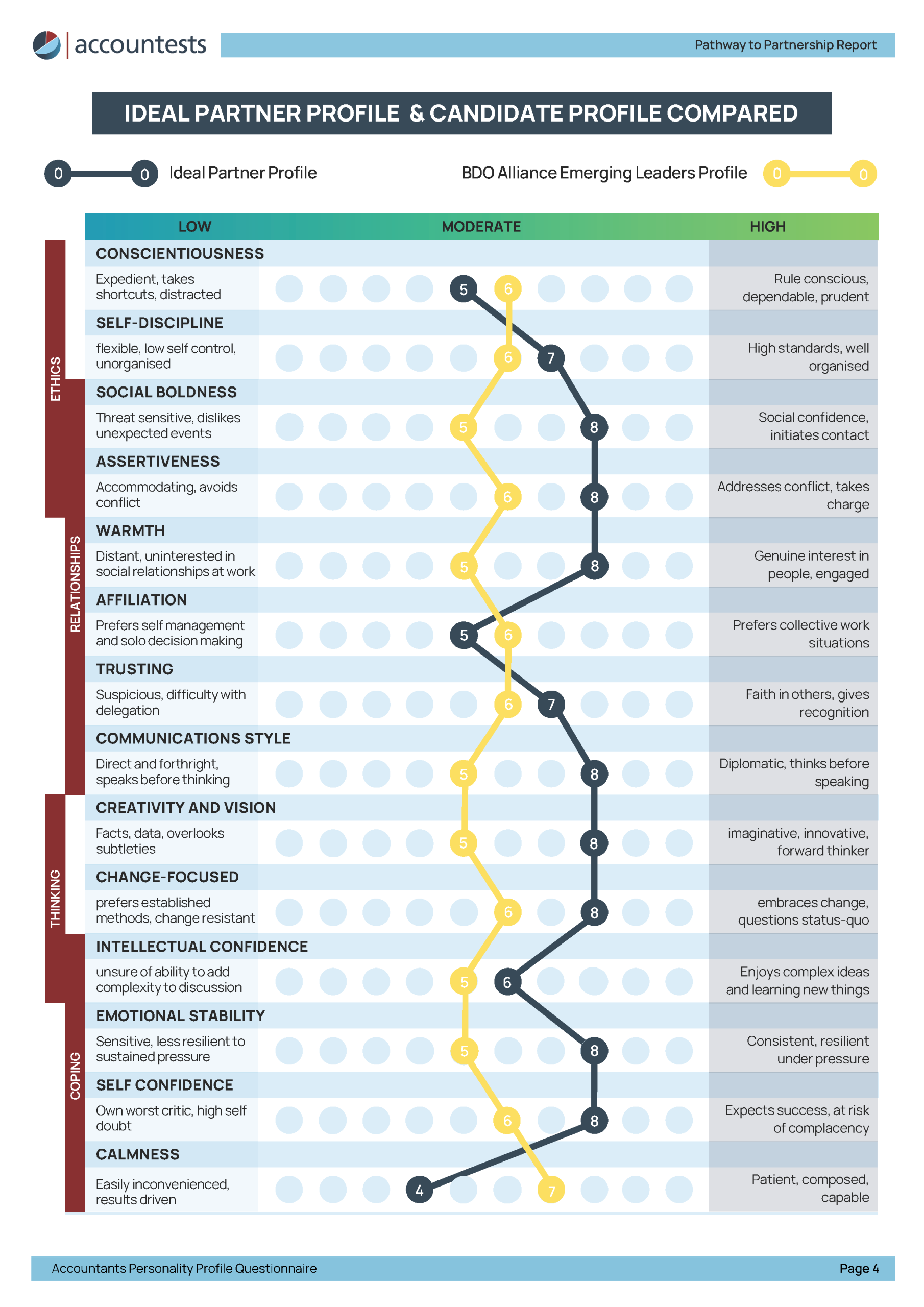
Emerging leaders cluster near benchmark levels in discipline and trust (scores ~6–7) but show consistent, measurable gaps of up to three points in social boldness, communication, creativity, and emotional stability compared with an “ideal partner” profile, based on Accountests P2P personality data. Click to enlarge
The Alliance is an association of independently owned accounting and consulting firms. Each emerging leader is selected by their firm to participate in a year-long leadership training program.
As part of the program in 2025, participants were encouraged to complete our firm’s Pathway to Partnership (P2P) leadership development module. It’s an offshoot of our firm’s Accountants Personality Profile Questionnaire. APPQ is a “Big Five”-style personality profile which measures Openness to experience, Conscientiousness, Extraversion, Agreeableness and Neuroticism. OCEAN, as it is often called, can be used to predict outcomes such as job performance and well-being.
Perception or Expectation?
Kathy Sautters, who runs BDO Alliance’s Emerging Leaders Roundtable Program, said the group is a mix of participants who have achieved partner status and participants on the verge of promotion. “Many of their firms don’t have comprehensive ’path-to-partner’ guidance,” noted Sautters. “The [P2P] tool provides an introspective summary of the intangible criteria required for success outside of the technical depth and client deliverables that are so often emphasized in staff development,” she added. According to Sautters, participants found it valuable to compare “perceived strengths” of current partners to the expectations of future partners and their own ratings.
Two-thirds of the nearly 100 people in the Emerging Leaders program completed the P2P module. One way we analyzed the results across all participants was to compare these emerging leaders to our “ideal leader” profile, developed from industry standards for what “ideal” looks like in professional services.
“Ideal” Is Not “Normal.”
The average score of all accountants for each trait is 5.5 (from our norm group). An “ideal leader” is not the same as your “normal accountant.” Often a score in the upper quartile is preferred for leaders, although for certain traits – such as Affiliation, Conscientiousness and Calmness — a middle score is better. For example, too much conscientiousness in a leader is not a good thing – following all the rules and being prudent is more highly valued for the team but not for the leader.
We don’t expect any candidate to be 100% ideal, but the size of the score gap for each attribute is telling. It gives interviewers, coaches and mentors a place to focus. We don’t focus on whether a candidate has a gap; we focus on how they adjust their work style to compensate for that gap.
For BDO Alliance’s emerging leaders group, two important trends emerged
Participants tended to be closest to the ideal leader profile in Conscientiousness, Affiliation, Self Discipline, Intellectual Confidence and Trusting. The gap was often 5 vs. 6 or 6 vs 7.
Participants tended to be furthest from the ideal on Social Boldness, Warmth, Communication Style, Creativity and Emotional Stability (too low) and Calmness (too high). Here the gap was three points.
To put this analysis into action, let’s take Emotional Stability, for instance, as a trait for which there is often a sizeable gap (5 vs. 8) between a participant and the ideal leader profile. Emotional Stability is the tendency to experience consistent, balanced emotions and to recover quickly from stress.
Too Calm? Or Too Distant?
Some practical ways for leaders to improve their emotional stability could include:
Verbalizing their feelings. For example: “I’m feeling overwhelmed right now – give me a moment before I respond.”
Using a practiced and predictable process to respond to difficult situations or emails – e.g., the “three-minute rule” which suggests waiting three full minutes before responding to an emotionally charged email. A brief pause allows the prefrontal cortex (reasoned thinking) to regain control from the amygdala (emotional reaction).
Calmness is the tendency to remain composed, steady, and unflustered under pressure. Although calmness is a perceived strength, being overly calm can appear passive, lacking urgency, or disengaged in critical moments. Leaders who are too laid back may unintentionally signal indifference, delay necessary action, or fail to energize their teams when momentum is needed.
As an example, leaders could improve this attribute by:
Consciously signaling urgency when required. “This is a priority and needs action today—let’s focus on getting this resolved quickly.” This helps ensure their composure isn’t misinterpreted as a lack of importance.
Setting explicit response timeframes. Define clear expectations (e.g., “Let’s come back with options within the next hour”). This retains composure while introducing an appropriate pace.
Emerging Leaders Play a Role
How do you help your emerging leader to learn the strategies to manage where their gaps to the ideal leader profile are biggest? They might already have a strategy. Is it the best one? If they don’t have a strategy, they might need help to create one.
An experienced mentor or coach can help an emerging leader work through the areas they need to improve.
By the way, firm partners are often not the best people to help them for three important reasons:
There is a significant power imbalance. Most emerging leaders will be reluctant to open up to a senior partner about their fears, worries and even thoughts of quitting.
Senior partners often represent the traditional leadership and business development style of yesterday, such as top-down, command-and-control. That’s not what the profession needs tomorrow.
Existing leaders in accounting are often poor role models because they often work excessive hours and may seem to care more about clients than their team members. I’m a believer in making an independent mentor or coach available to emerging leaders. Independence allows openness and tough conversations in both directions.
Whether the coaches or mentors you identify come from inside or outside your firm, be sure to assess not only their leadership strengths and gifts, but their genuine interest in being a mentor or coach.
Great Coaches Are Made, Not Born
“Impactful coaching relationships are built on mutual trust and vulnerability between the coach and coachee,” noted Samantha Mansfield, senior consultant at ConvergenceCoaching, LLC. “Great coaches aren’t defined by their title or authority,” she added. “Instead, they are excellent listeners, generous with their time, and curious. Most of all, they genuinely care about their coachee as a person as well as their success.”
I remember my own journey to becoming a Big 4 partner. I wish I’d had a mentor when I was progressing to partnership! At first, I couldn’t imagine having the self-confidence — the aura — that the partners seemed to exude. My own personality profile shows that I am highly Conscientious, low on Calmness and Affiliation, and average in Emotional Stability. I had so much self-doubt at the time, I came within a whisper of quitting public accounting and moving to the safety of a corporate accounting job. But I hung in there, and I’m glad I did.