Forensic Techniques Help Beat Fraud

person taking inventory on a tablet

BONUS: 11 services that create a “control culture.”

By Ed Mendlowitz
77 Ways to Wow!

Trained forensic professionals investigate accounting and financial transactions that are, or will become, subject to legal proceedings. It is an early step in a potential war, and many times it is the first shot.

MORE by Ed Mendlowitz
GoProCPA.comExclusively for PRO Members. Log in here or upgrade to PRO today.


Attorneys and c-level executives are often not familiar with forensic techniques and see them as a means to quantify a loss. Financial forensics also provides a means to deter and detect fraud. Today, I share my views on the value of forensic techniques used to deter fraud and encourage CVAs to consider attending the CTI’s Forensic Accounting Academy™ or Fraud Risk Management courses offered through the MAFF programs.
READ MORE →

Six Tasks Required for an Internal Audit

Internal auditing can help any sized business.

By Ed Mendlowitz
77 Ways to Wow!

Every business has a system of internal controls. Very small businesses likely rely on luck and the honesty of their one or two office staff. Small businesses rely on their independent auditors to check their system once a year and large companies employ one or more internal auditors on their staff.

MORE by Ed Mendlowitz
GoProCPA.comExclusively for PRO Members. Log in here or upgrade to PRO today.


This post explains the internal audit process that applies to every size business. Businesses have voluminous transactions; multiple people involved, companywide; and assets that need protection.
READ MORE →

Managing Walkthroughs Like a Process (Not a Meeting)

How high-performing teams turn a recurring pain point into a source of control and insight

By William Englehaupt

If walkthroughs consistently generate delay and rework, the solution is not incremental improvement in meeting execution. It requires a different approach to how the work itself is structured and managed.

Effective teams begin with a simple but consequential reframing. Walkthroughs are not events; they are a process with a defined start and end point, a sequence of standard activities, and clear ownership for each step. That process typically includes preparation, coordination of PBC requests, structured meeting execution, post-meeting follow-up, and timely completion of documentation and review. When these elements are not explicitly defined, they occur inconsistently, and the gaps between them become the source of delay.

MORE Productivity | MORE Audit and Assurance

One of the most effective ways to stabilize this process is to make the work visible. High-performing teams rely on structured walkthrough trackers that map each step in the process, assign responsibility, and establish expected timing. These are not static checklists but dynamic tools that reflect the flow of work before, during, and after the walkthrough meeting. By making dependencies explicit, they allow both the audit team and the client to understand how delays in one area affect the broader timeline.

READ MORE →

What Internal Controls Mean to Clients

man writing in notebook

And how to explain them.

By Ed Mendlowitz
77 Ways to Wow!

What are internal controls? Auditors widely use this term. It also appears multiple times in engagement letters for audits of businesses and not-for-profits, but I do not believe many outside of the accounting profession really know or understand what internal controls are. I will try to explain it here.

MORE by Ed Mendlowitz
GoProCPA.comExclusively for PRO Members. Log in here or upgrade to PRO today.

Internal controls refer to an organization’s system of deterrence, oversight, checks and balances. An illustration is where someone in a business writes and mails the checks to pay a bill. If this same person then receives the bank statement and performs the reconciliation of that account, there would not be any control or oversight on that person and whether the payment was proper and not misdirected. They are checking their own work. This is how many frauds occur.
READ MORE →

Create an Accountability Chart for Your Firm

It beats an org chart and here’s why.

By Jody Grunden
Building the Virtual CFO Firm in the Cloud

“Getting the right people on the bus, the wrong people off the bus, and the right people in the right seats – these are all crucial steps in the early stages of buildup…” – Jim Collins, “Good to Great”

When Adam and I first started the company, we didn’t have much organizational structure. We didn’t need it. But as the company grew, it became necessary to develop an organizational structure. There’s a great quote by Michael E. Gerber in his book “The E-Myth Revisited” that says, “Without the Organization Chart, confusion, discord and conflict become the order of the day.”

We got to a point where we realized that Adam and I didn’t have clarity around our individual roles, and we were overlapping one another. We needed to have clearly defined roles for one another, as well as the people who were working for us. Lack of clarity can cause a loss in production.
READ MORE →

Why Audit Walkthroughs Break Down (and What It’s Really Costing You)

Why one of the most critical audit procedures quietly becomes one of the least effective

By William Englehaupt

Walkthroughs sit at the center of audit quality. They are the mechanism through which auditors develop an understanding of processes, identify control points, and assess risk in context. Yet in practice, they are frequently one of the least controlled and most inefficient parts of the engagement.

They tend to run late, produce incomplete evidence, and generate follow-up cycles that extend months beyond the initial meeting. By the time year-end arrives, teams are often still resolving questions that should have been addressed months earlier. This is not a failure of technical capability; it is a failure of process design.

MORE Productivity | MORE Audit and Assurance

Most audit teams do not manage walkthroughs as a defined system of work. Instead, they are treated as a sequence of meetings—scheduled, conducted, and documented with varying degrees of rigor. That approach creates the appearance of progress without delivering the underlying objective: a complete, evidence-based understanding of the transaction flow from initiation through financial statement impact.

READ MORE →

How to Get Organization Minutes in Order

A 34-point checklist.

By Ed Mendlowitz
77 Ways to Wow! The Checklist Handbook for Advisory Services.

Corporate, LLC, partnership and not-for-profit organizations are usually required to have minutes memorializing certain actions taken by the board of directors or governing body. Yet, many do not either because it has never been done, is a bother, is considered not necessary or overlooked through inaction or unawareness.

MORE by Ed Mendlowitz
GoProCPA.comExclusively for PRO Members. Log in here or upgrade to PRO today.


However, it is something that should be done as a best practice, as recognition that there are non-active stakeholders who need transparency, or as tangible evidence that the actions recorded took place timely. In some instances, the IRS looks for minutes as a symbol that the affairs were handled on a businesslike basis or were not one-sided “secret” actions by those in control.
READ MORE →

The Post-Audit Debrief Most Teams Get Wrong


Why most debriefs fail to change the next audit—and how to turn them into real design inputs

By William Englehaupt

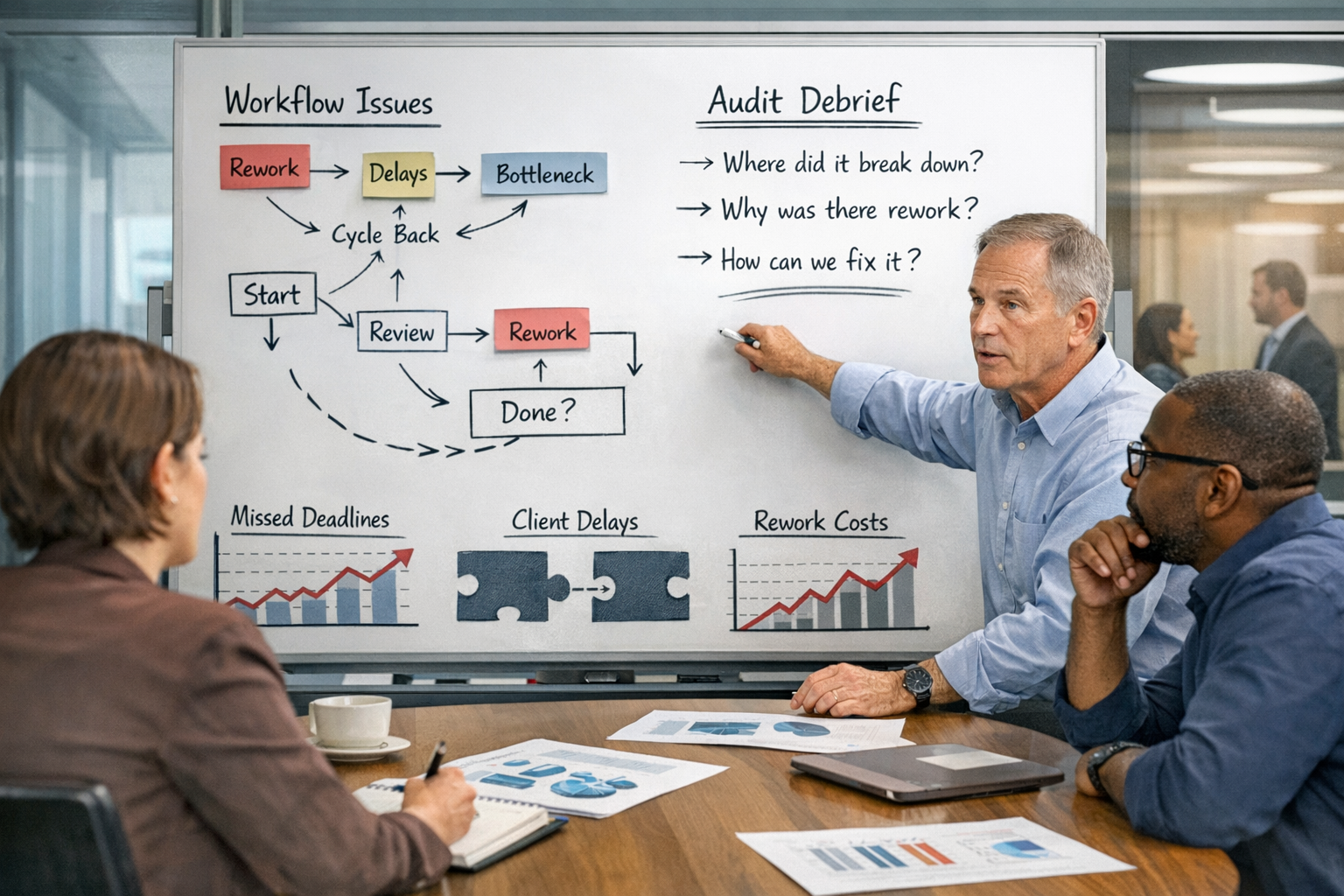
As one audit cycle closes and the next begins, most teams go through some form of debrief. In theory, this is where learning happens, where teams step back, reflect on what worked, what didn’t, and carry those insights forward.

In practice, it rarely works that way.

MORE Productivity | MORE Audit and Assurance

Debriefs are often rushed or treated as closure rather than input. The questions are familiar—what went well, what didn’t—but the discussion stays at the surface. Late nights, difficult clients, tight deadlines. The symptoms are easy to identify. The underlying causes are not. READ MORE →