Tax Prep Billing Rates Lift Busy Season 2026

Busy Season 2026 sets up a year of tough decisions about monumental transformations.

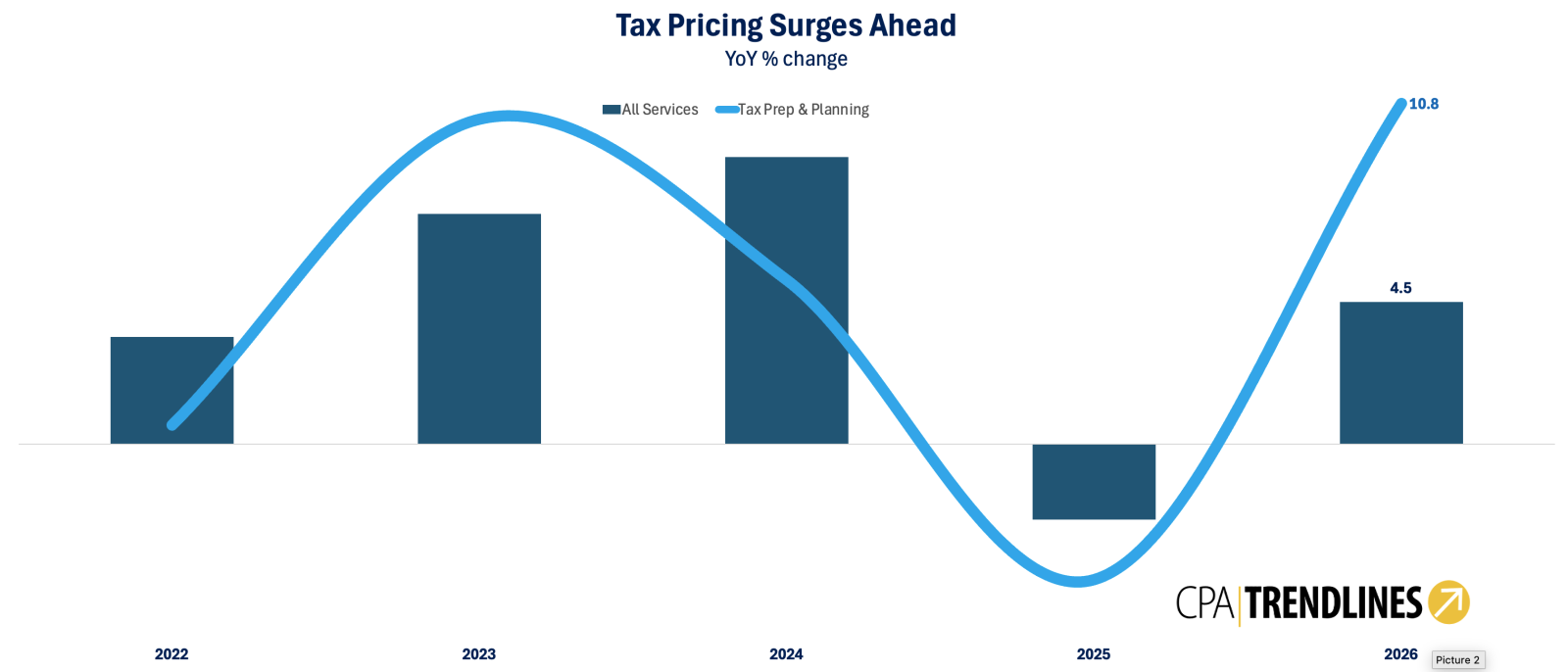
Busy Season 2026: Billing rates for tax prep and planning are increasing at a 10.8% year-over-year rate, rushing past the average tax and accounting fee increase of 4.5%.

By CPA Trendlines

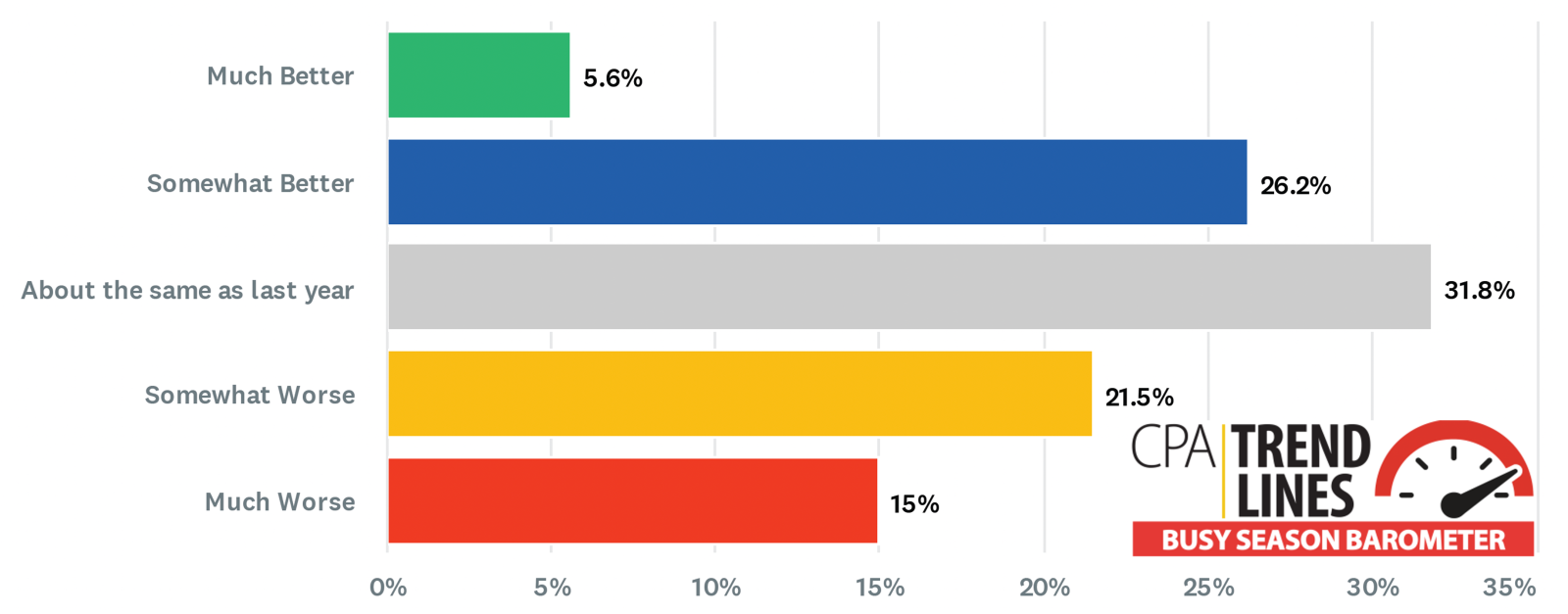
Busy Season 2026: Tax professionals struggle to improve systems and metrics, with “much worse” beating “much better” by three to one.

As tax season 2026 comes to a close, new data show that price hikes for tax prep and planning are running at double-digit rates, even as billing rates for most other accounting services are flattening out, according to new CPA Trendlines research in conjunction with the annual Busy Season Barometer.

MORE Busy Season Barometer
Join the survey. Get the results

MORE Tax Season Trends & Insights

Tax practitioners are finishing the season as a divided profession, with fewer than 6% reporting a “much better” year, against almost three times that many reporting a “much worse” year.

Coming out of tax season, many firms are facing major decisions in the coming months driven by new artificial intelligence investments, a fundamental shift in staffing models, and private equity disruptions.
But the tax divergence is the most analytically interesting. After years of suppressed pricing, CPA firms are clearly extracting significantly more from tax clients — reflecting both labor scarcity and the new complexity premium from new tax laws and less commoditized 1040 work.

For CPA firms, the trends point to a turning point in pricing dynamics. Broad-based price increases that defined the post-pandemic period appear to have run their course. Most service lines are now holding steady or softening month over month, even as their year-over-year gains remain elevated.

What it means for the rest of the year

Year over year, tax prep and planning fees are up on the order of 11%, roughly triple the overall producer price pace and far ahead of what firms are getting for audit, bookkeeping, or other services.

Across the tax and accounting sector as a whole, prices are actually slipping after a long run-up, and several categories—audit, bookkeeping, and a broad bucket of other services are flat or down. But that pause is not showing up in tax. Instead, the latest data look more like a breather after earlier monthly jumps, leaving the 12-month increase in tax pricing still accelerating and firmly in the double digits.

Key Metrics: Per-client revenue gains drive some advances, but profits fail to follow as firms grapple with volatile costs.

For firms, that means tax season is becoming the pricing engine for the entire business model, with clients absorbing much steeper bills for complex compliance and planning work, while more commoditized functions are losing pricing power.

For clients, it means that the part of the engagement most directly tied to filing returns and tax strategy is where fee pressure is likely to remain hottest through 2026.

Double-digit gains from high-value work

Tax preparation prices have surged roughly 28% since January 2016, but the real story is the acceleration — the series was essentially flat from 2016 through 2021 and then broke sharply higher, posting year-over-year gains of 7% to 11% in 2023–2025 before the current reading of 10.8%.

Bookkeeping & compilation is the only line that actually outpaced tax on a raw index basis, up 47% since 2016. But its gains were steadier and more gradual rather than the late-cycle spike.

Financial auditing and the overall CPA index are tracking each other closely and are now showing modest 4% to 5% annual gains. Other accounting services are the clear laggards — essentially flat since 2016 with considerable volatility, ending only about 37% above its 2016 baseline but with erratic swings that suggest lumpy project billing rather than steady rate increases.

The below-the-radar trends

The key exception is tax. Double-digit annual increases indicate that firms continue to command premium pricing for complex, high-demand compliance and advisory work.

In contrast, audit, bookkeeping, and other services are showing signs of normalization. The implication is clear: pricing power in the accounting profession is no longer uniform. It is concentrated in areas where demand is strongest, capacity is tightest, and value is most differentiated. As firms move beyond tax season and into the remainder of 2026, the question is whether March marks a temporary pause—or the start of a broader plateau in accounting-firm pricing. For now, the data suggest this: the era of across-the-board fee increases is ending. The era of selective pricing power has already begun.

To be sure, prices in tax preparation and planning have steadied, but that stability masks strong underlying momentum. The category is up 10.8% from a year earlier, following 9.4% a month before and 9.0% a month before that. That puts tax pricing at nearly three times the overall inflation rate and well above the broader CPA sector. The data suggest firms are successfully resetting fees for complex compliance work, advisory services, and high-demand filing support.

Accounting firms hit pause on price hikes, except in tax

Outside of tax, accounting firms are cutting prices for the first time in three months, falling 0.2% from last month but remaining up 4.5% from a year ago.

The latest data depict a profession that has largely completed its post-pandemic repricing cycle. Fees remain elevated compared with a year ago, but the momentum behind further increases appears to be fading—except in tax.

On a simple annualized basis, the decline translates to a negative 2.4% rate if sustained over a full year. That marks a clear shift from the steady upward pressure seen over the last two to three years. Still, the 4.5% year-over-year increase keeps accounting services well above their pre-pandemic norm, when annual gains typically ran closer to 1% to 2%.

For core CPA work, the data tell a similar story: billing rates are down 0.2% on a month-to-month basis but up 5.4% over 12 months. The combination of flat-to-negative monthly readings and solid annual gains suggests firms are holding prices rather than pushing them higher.

Economy-wide contrast: Inflation re-accelerates

Meanwhile, consumer inflation is firming, running about 3.3% year over year. That divergence is notable because accounting pricing remains slightly hotter than the overall economy on a 12-month basis, but unlike the broader market, it is no longer accelerating month to month. In practical terms, CPA firms entered tax season with already-elevated pricing—and then paused.

Beneath the surface, pricing trends vary sharply by service line. The gap between tax and audit pricing is now the widest in more than a decade, underscoring a structural shift within the profession.

Financial auditing: Losing momentum

Audit pricing is moving in the opposite direction. Financial auditing prices are down 0.4% on the month after a modest increase the month before. On a simple annualized basis, the latest monthly movement implies a negative 4.8% pace. Year over year, audit prices are up just 2.1%, roughly half the overall CPA-sector rate and much closer to historical norms.

The contrast with tax is stark. While tax services continue to command premium pricing, audit appears to be facing more resistance, likely reflecting competitive pressures, client sensitivity to fees, and a more standardized service structure.

Bookkeeping and compilation: Stable but slowing

Bookkeeping and compilation services sit in the middle of the pack. Prices are unchanged for a second consecutive month after a 0.6% increase three months ago. The year-over-year gain is running at 2.6%, down from 3.2% a month ago and 3.7% two months ago. This segment appears to be stabilizing at a lower growth rate. As a more commoditized, transaction-based service line, bookkeeping offers less room for aggressive price increases, especially as automation and outsourcing continue to exert downward pressure.

Other accounting services: Mixed signals

The “other accounting services” category—which includes a range of advisory and specialized offerings—was also flat in March. That follows a volatile start to the year, with a sharp increase in January and a pullback in February. Despite the new stability, prices are still up 3.7% year over year. The pattern suggests ongoing demand for specialized services but less consistent pricing power than in tax.

Leave a Reply
