Prove It: PE-Backed Firms Must Now Deliver on Their Big Strategies

Private Equity’s Accounting Playbook Is Shifting from Dealmaking to Operating Systems

CPA Trendlines CPA-PE Deal Tracker™ — May 2026

Target Platform/Buyer Sponsor Funding Strategy
Jackson Thornton Ascend Alpine Investors PE-backed Wealth management, Gulf Coast expansion
Jefferson Wells U.S. Sikich Bain Capital involvement Institutionally backed Consulting and staffing capabilities
Copeland Buhl Frazier & Deeter Conventional M&A First Midwest footprint
Price Kong Aprio Charlesbank PE-backed Arizona and cannabis specialization
SWKJD Citrin Cooperman Blackstone PE-backed South Florida expansion
Gorfine Schiller & Gardyn Sorren DFW Capital PE-backed Mid-Atlantic expansion
Gordon Advisors Cohen & Co. Lovell Minnick PE-backed Michigan expansion
ArightCo Abbott Stringham & Lynch Conventional M&A CAS and fractional CFO scaling
ASO Advisors Windsor Path Family-office backed Private capital Platform’s second deal
GBC Advisory Springline Advisory Trinity Hunt Partners PE-backed Oklahoma expansion
MCA Connect Grant Thornton Advisors New Mountain Capital PE-backed AI and digital transformation
Burke & Associates Platform Accounting Group / Shoreline Cynosure Group Private capital Massachusetts expansion
Nine out of 12 of the month’s notable deals are funded by outside capital, led by Grant Thornton’s deal for a tech consultancy and Sikich’s for a staffing service.
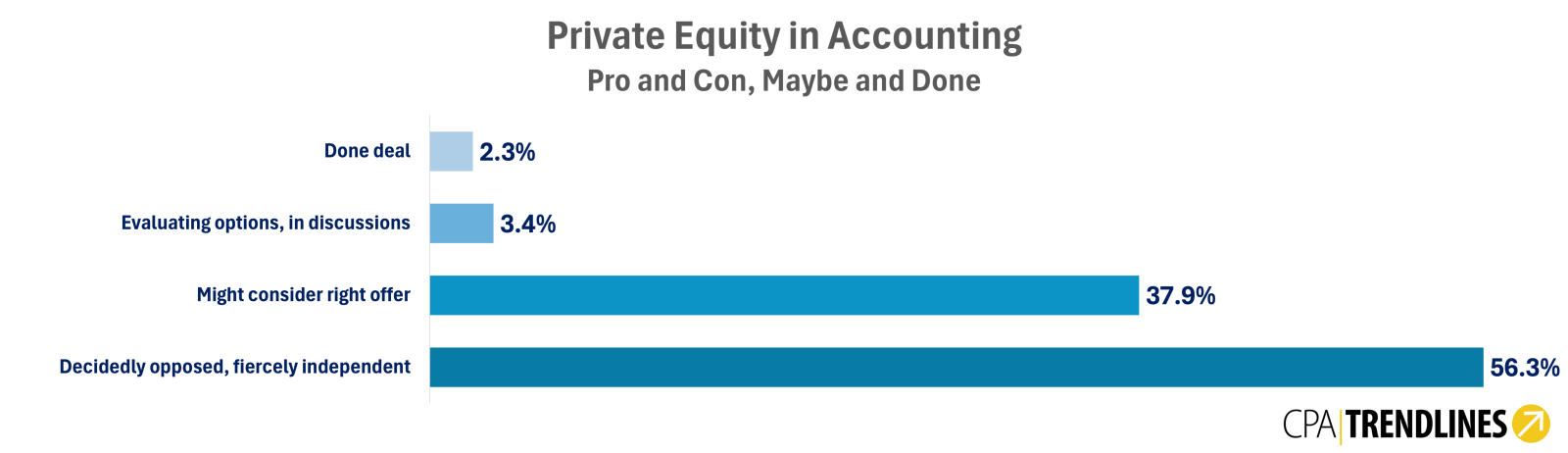
Half “decidedly opposed” and the other half in favor, in talks or done. (CPA Trendlines Research)

By CPA Trendlines

Marking a new phase in the private equity takeover of the CPA business, the next test for accounting platforms will be proving that serial acquisitions can be converted into integrated firms, not just larger collections of offices, partners and legacy systems.

MORE CPA-PE DEAL TRACKER™: How Big Buyouts Are Turning the Profession into a Platform |  PE Wars: The CPA Platform Economy Is Concentrating Fast | Alan Whitman: Why the Next Big CPA Firms Won’t Look Like CPA Firms The PE Takeover: Audit Problem? What Audit Problem? | 1,000 Deals Show Where PE Money in Accounting Really Goes. | The 7.6x Machine: How Grassroots Firms Are Taking Private Equity for a Ride | Deal Tracker(™): PE Platforms Accelerate the Grab for CPA Firms | With Apax Sale, CohnReznick Starts Building a National Platform | PE Deal Tracker™ for Feb. 2026: 57 deals in 60 days | PE Deal Tracker™ Update: Alan Whitman Plants a Flag in the Private Equity Landscape | Alan Whitman: Breaking the Mold with PE Backing
MORE Private Equity

Call it: The Implementation Imperative. It’s the place where grand schemes on paper meet the concrete realities of running a business. The first phase was acquisition. The second was consolidation. The next is all about making it work.

The May 2026 edition of the CPA Trendlines CPA-PE Deal Tracker™ illustrates the change. And a CPA Trendlines survey in April shows 44% of accountants are eager, open or already closed on a deal.

Some of the accounting industry’s newest PE-backed acquisitions are no longer traditional CPA firms at all. Instead, buyers increasingly are targeting offshore staffing engines, AI consultants, workflow platforms, CAS infrastructure and digital-transformation specialists — the operational machinery increasingly needed to run accounting firms at scale.

Grant Thornton Advisors, backed by New Mountain Capital, agreed to acquire technology consultancy MCA Connect to deepen its AI, data and digital-transformation capabilities. Sikich’s acquisition of Jefferson Wells U.S. expands consulting and staffing capacity in healthcare, life sciences, energy and technology. Abbott, Stringham & Lynch acquired ArightCo to scale outsourced accounting and fractional CFO operations. Windsor Path acquired ASO Advisors, the non-attest advisory arm of Agresta, Storms & O’Leary, reinforcing the growing institutional focus on centralized advisory operations.

Momentum Downshifts

Ascend, backed by Alpine Investors, is building operational infrastructure through acquisitions tied to offshore staffing and scalable delivery systems, including its Sentient Solutions transaction in India and Mexico.

Mega-platforms increasingly are buying technology, AI, offshore staffing and advisory infrastructure, while many traditional firms continue merging mainly for succession, geography and staffing capacity.

Across private equity more broadly, rising interest rates, longer holding periods and slower exits are forcing firms to rely less on financial engineering and more on operational performance. “In the U.S., private equity is moving into a phase defined less by market momentum and more by execution,” Forvis Mazars says in its 2026 U.S. Private Equity Report. Investors increasingly are prioritizing “operational influence,” “execution capability” and “disciplined growth strategies” rather than “scale for its own sake.”

New Economic Realities

Forvis Mazars argues that “execution, rather than leverage, is helping drive returns today,” adding, “financial engineering is no longer enough” and “execution is the new alpha.”

The accounting industry appears to be absorbing that same logic. William Blair’s second annual accounting-services survey finds firms focusing heavily on AI deployment, offshore labor, workflow redesign, pricing discipline and operational scalability. Nearly two-thirds of respondents already are deploying AI in targeted workflows, while almost 70% expect increased use of non-U.S. labor over the next three to five years. The survey also shows that larger and externally capital-backed firms generally are further along in operationalizing AI systems and offshore staffing models.

At the same time, the economics of the profession are tightening. Compensation costs are rising faster than many firms can comfortably absorb. Technology investment requirements are mounting. CPA shortages persist. CAS and advisory require new workflows and staffing models. And PE-backed firms face growing pressure to demonstrate sustained EBITDA growth in a higher-rate environment where exits may take longer and financing is more selective.

The Flip-Era Test

Another pressure is arriving from the capital cycle itself. The first generation of PE-backed CPA platforms is entering accounting’s private equity “flip” era, in which one sponsor sells to another.

Since 2021, PE funds have taken ownership of about 24 of the top 100 CPA firms, including at least 10 of the top 30. The International Federation of Accountants estimates that consolidation in accounting has increased fourfold since 2021, counting more than 1,000 deals worldwide.

The next owners may have less room for easy value creation.

Jennifer Wilson of ConvergenceCoaching warns that high entry prices may make it difficult for sponsors “to grow the thing enough and squeeze enough profit to get the ROI.” The risk, she adds, is integration fatigue: “You don’t have time to integrate. You just run to the next one.”

Centralized Management Discipline

Forvis Mazars reports that 67% of U.S. PE firms say financing issues were affecting buy-and-build strategies, while operational complexity emerges as one of the top challenges hurting portfolio performance.

The result is a growing emphasis on operational discipline.

“As private equity reshapes the accounting landscape and traditional partnership models strain under talent shortages and succession challenges, strong governance has become the real differentiator,” Dan McMahon of Integrated Growth Advisors says in Today’s CPA, published by the Texas Society of CPAs.

McMahon argues that PE-backed firms increasingly are replacing traditional managing-partner models with centralized executive leadership, KPI-driven management systems and formal operating structures. “Today’s PE-backed firms solve that differently: they install professional CEOs, not managing partners,” he notes.

Beyond Deal Counts

The same operating-model focus is appearing across the accounting conference circuit and consulting ecosystem.

At events such as Accounting Today’s Firm Growth Forum, Digital CPA and Scaling New Heights, discussion topics center on AI implementation, workflow integration, staffing leverage, governance systems, offshore delivery models and what some advisers now call “PE-style operating discipline.”

CPA Trendlines’ CPA-PE Deal Tracker suggests the broader consolidation wave remains strong. The tracker counts 78 PE-linked accounting, tax, wealth-management and adjacent advisory events through April 30, up 77% from the same four-month period in 2025. At that pace, 2026 would annualize to roughly 234 events, compared with 175 in all of 2025 and 88 in 2024.

But even as transaction volume accelerates, the industry conversation appears to be evolving beyond deal counts.

Execute at Scale

Increasingly, investors, operators and advisers are focusing on whether PE-backed firms can successfully integrate acquisitions, standardize workflows, centralize technology, deploy AI, expand advisory capacity, institutionalize governance and scale operations without losing profitability or service quality.

The first years of PE in accounting rewarded speed: assembling platforms, aggregating revenue and establishing geographic scale.

The next phase may reward something harder: integrating dozens of acquired firms into coherent operating systems capable of sustaining margins, standardizing workflows and deploying AI at scale.

For years, the central question was whether private equity would permanently reshape accounting. Now the question may be which firms can actually execute at scale once the acquisitions are complete.

Leave a Reply
