Accounting Firms Face a Productivity Test as Demand Outruns Capacity.
Accountants Demand Index: Steady Growth in New Work
By CPA Trendlines Research
The tax and accounting profession’s biggest problem is no longer finding work. It is finding the time, people, and technology to do it.
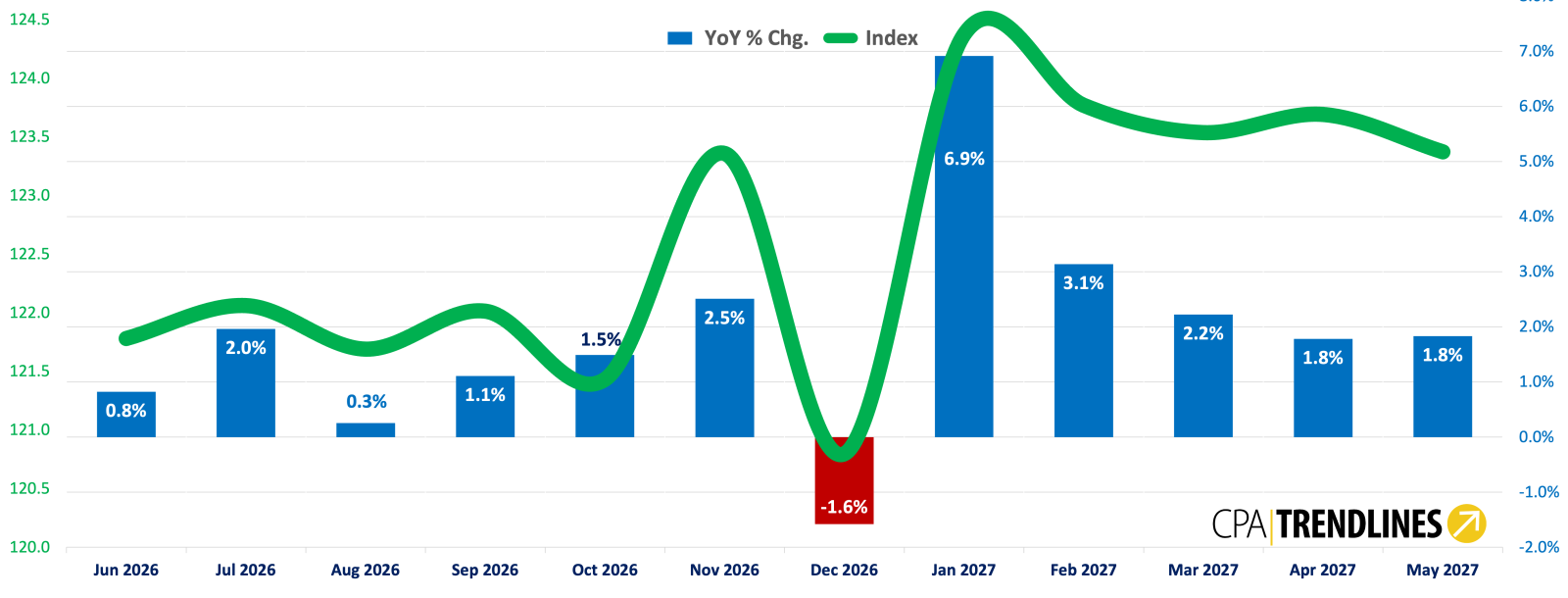
The new CPA Trendlines Accountants Demand Index, which slipped in May, remains firmly above year-ago levels. The proprietary index of economic indicators fell to 121.2 in May, down 0.3 percent from April but still up 1.8 percent from a year earlier and comfortably above its 2019 baseline level of 100.
The next six months are forecast to follow a pattern firm owners will recognize. June softens. July surges with the sharpest single-month gain in the forecast window. Then August stalls, nearly flat, which is where the index makes its call.
History says late summer is the reset. This year, the data says the reset holds: the index climbs steadily through September, October and into November, reaching its fall peak before December pulls it back below zero.
Four key indicators
Beneath the surface, the index is telling a more important story: Business demand for tax and accounting services, particularly advisory, shows no signs of easing. In fact, the nation’s high-propensity business applications are running 20 percent to 30 percent above pre-pandemic levels, closing last month at 146,555 nationally.
Employment in the tax and accounting sector remains historically high. Yet the profession is increasingly struggling to convert that demand into additional production through traditional hiring. The result is a profession entering a new phase of its evolution: the productivity economy.
Tax and accounting firms spent much of the past decade worrying about finding and keeping clients. Would clients continue outsourcing accounting work? Would automation eliminate compliance services? Would younger entrepreneurs seek alternatives to traditional CPA firms? Those concerns now seem laughably misplaced. Today, the challenge facing many firms is not a shortage of opportunities, but a shortage of capacity.
The CPA Trendlines index combines four key indicators that collectively measure the industry’s operating environment: employment in the tax and accounting sector, average hourly earnings, average weekly hours worked, and high-propensity business applications, a measure of new businesses likely to become employers. Together, the metrics provide an early look at future workloads for accounting firms.
Advisory in demand
The May reading reflects a market that remains fundamentally healthy. Employment in the sector stands at approximately 1.11 million workers. High-propensity business applications total 146,555. Average hourly earnings are high and persistent, at $45.59 per hour, while the average workweek stands at 35.3 hours. None of those figures suggest a market in retreat. Instead, they suggest a market operating under increasing strain.
The broader economy is showing similar signs. The National Federation of Independent Business reports that labor costs are surging.

“Labor costs increased significantly to the highest reading in the survey’s history,” says longtime NFIB Chief Economist Bill Dunkelberg. Small-business owners, he adds, face mounting pressure to retain workers.
When small businesses struggle to hire, accountants feel the effects. Labor market stress often creates additional work for accountants rather than reducing it. Clients become more cost-conscious. Payroll decisions become more complex. Workforce planning becomes more important. Advisory demands increase.
Doing more without more
At the same time, the NFIB says that hiring plans have weakened substantially. Only a net 9 percent of small-business owners plan to create new jobs over the next three months, the lowest reading since Covid-battered May 2020. An increasing number of economists believe the labor market is settling into a new equilibrium.
Economists at TD Economics describe the current environment as a “low-hire, low-fire” phase. In an increasingly common pattern across the economy, employers appear reluctant to hire aggressively because of economic uncertainty, elevated labor costs and questions about future demand. At the same time, they are hesitant to lay off workers because recruiting and training replacements remains difficult and expensive.
The result is a labor market characterized by caution rather than contraction. Workers stay put. Employers hold on to staff. Hiring slows. Layoffs remain limited. Overall employment changes little. For accounting firms, it’s a familiar feeling.
Few firms are conducting major layoffs, nor hiring aggressively enough to solve their staffing shortages. Most are simply trying to do more with the people they already have.
More selective
The Chicago Fed expects the low-hire, low-fire market to last a while. That observation may help explain one of the most puzzling developments in accounting over the past several years.
Despite widespread complaints about staffing shortages, industry employment has remained relatively stable. At the same time, many firms report being busier than ever. The traditional explanation has been that firms are understaffed. A more nuanced explanation may be that firms are becoming more productive.
Technology investments, workflow automation, outsourcing arrangements, client culling initiatives and pricing improvements are allowing firms to generate more revenue without proportionate increases in headcount. Indeed, across the profession, firms are firing up artificial intelligence, automated workflow systems, client portals, document processing tools and offshore staffing models.
Many firms have also become more selective about the clients they serve. Low-margin engagements are being terminated. Problem clients are being released. Compliance work is increasingly standardized. Advisory work is becoming a larger share of the revenue mix. These changes do not necessarily reduce demand. They increase the amount of demand that can be handled by a limited number of professionals.
New business formation
Historically, growth in accounting firms depended heavily on adding people. More clients required more staff. More revenue required more partners.
Today, firms can increase revenue through price increases, automation, workflow improvements and advisory services without adding employees at the same rate.
But now the number of firms deploying high-efficiency strategies may be reaching a critical mass, according to the CPA Trendlines index. The modest decline in May should therefore not be interpreted as a warning sign. If anything, it may represent a normalization following several years of exceptionally strong demand. The more important signal is that demand remains above year-earlier levels despite slowing hiring activity throughout much of the economy.
Goldman Sachs economists project economic growth alongside relatively stagnant job growth. That outlook closely resembles what many accounting firms are already experiencing. Clients continue operating. New businesses continue forming. Demand for tax, accounting and advisory services continues to expand. Yet employment growth remains muted.
The reckoning
The challenge for firms is converting that work into profitable growth without the traditional lever of adding staff. How firms navigate that constraint — through technology, workflow redesign, pricing discipline, or some combination — remains an open question. The answers are still forming.
The May index suggests that the profession is entering that reckoning earlier than most firm leaders anticipated. Demand remains healthy. Business formation remains strong. Employment remains elevated. But the historic relationship between demand growth and headcount growth appears to be loosening, and the profession has not yet settled on what replaces it.
Most of all, it means treating productivity as a strategic asset rather than an operational metric. The May index does not suggest an industry in decline. It suggests an industry evolving.
For decades, accounting firms grew primarily by adding people. The next chapter may look considerably different.
