Where IRS delays become firm work
| IRS function | Documented finding | Potential work for firms |
|---|---|---|
| Practitioner phone line | More than 5.7 million calls, about 57% answered; holds of up to two hours reported, often ending in disconnects | Repeat calls and callbacks; client issues held open longer |
| Authorizations (CAF) | Posted processing time 13 business days; some members report up to 24 | Status checks, resubmitted forms, delayed transcript pulls |
| Correspondence | 6.8 million pieces unanswered; 59% overdue | Tracking unanswered responses; explaining open items to clients |
| Payroll returns | Form 941 averages 72 days to process vs. a 32-day standard | Reconciling account status for payroll clients |
| Identity theft | About 20 months average for cases closed FY2023–25; 582 days for FY2025 closures through June | Case monitoring; refund-status explanations |
| Refunds | About 4.2 million notices seeking bank information; paper checks take 36 days, vs. 13 | Helping clients respond; refund-status inquiries |
| Information returns | FIRE closes Nov. 19, 3 p.m. ET; IRIS becomes the only e-file system Jan. 1, 2027, including prior-year returns and corrections; separate transmitter control code required | New IRIS application, workflow migration, rerouted corrections |
IRS shifts work to accountants with delays, dead phones, and employee departures.

By CPA Trendlines
Despite the IRS’s insistence it’s processing 98% of the returns it receives, practitioners are reporting two-hour phone waits, authorizations that take weeks to post and client problems that remain unresolved after they finally reach an employee.
MORE Tax | Logan Graf: Build a Modern Accounting Business, Not a Job | Jason Ackerman: Roth Mistakes That Cost Clients the Most | The Top Tip for Reviewing Tax Returns
The problem, apparently, is the difference between routine e-filed processing and what happens when a case needs an actual human.
New oversight reports and practitioner complaints show an agency that moves enormous volumes of returns while struggling to clear exceptions.
For accounting firms, those exceptions mean repeated calls, delayed access to records and more time explaining why a filed return has not produced a finished case.
No one has yet measured the hours firms absorb or bill for that work. But the evidence points to an operating pressure that processing totals alone cannot capture: a smaller IRS leaves more administrative work for the practitioners helping taxpayers deal with it.
Getting through is only the first hurdle
In a letter to IRS CEO Frank Bisignano, National Association of Enrolled Agents President Emily Aprea describes long waits, disconnects and representatives unable to resolve problems. Enrolled agents and other tax professionals “often wait on hold for up to two hours, only to be disconnected,” she says.
“The problem became more acute after April 16 and has not improved,” Aprea says.
Aprea notes 57% of the 5.7 million calls to the practitioner priority service went unanswered.
NAEA notes that the Centralized Authorization File unit posts a processing time of 13 business days, while some enrolled agents report waits as long as 24 business days.
The association says the gap often compels practitioners to resubmit requests to obtain account information or act for a client, so delays can prevent transcript review before filing and complicate representation afterward.
“CAF delays create a deadweight compliance cost, shifting costs to taxpayers, representatives, and other IRS functions,” the NAEA says.
Processing success leaves room for long waits
GAO’s review offers an important counterweight to claims of broad operational collapse. Overall processing performance during the 2026 filing season resembles 2025, and more taxpayers use self-service options.
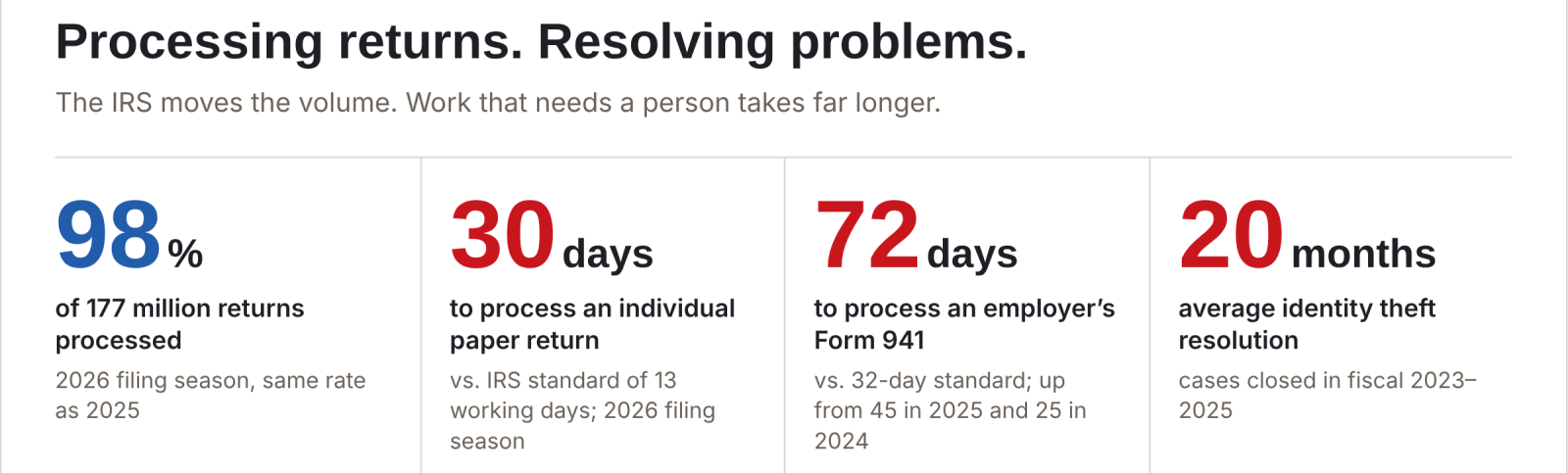
But individual paper returns take an average of 30 days to process, roughly twice the prior year and well beyond the IRS standard of 13 working days. Employer quarterly returns on Form 941 take 72 days on average, up from 45 days in 2025 and 25 days in 2024, against a 32-day standard. IRS officials blame the loss of experienced IT acquisition staff, which delayed programming updates.
The unit that answers phones and letters ended the filing season with 16 percent fewer staff than a year earlier.
Of 2,239 new hires, 524 completed full training by peak season. Average phone wait time more than doubled, to eight minutes from three, and 73 percent of callers reached live help, compared with 87 percent in 2025.
Meanwhile, the IRS is moving the goalposts, lowering its answer-rate target to 70 percent from 85 percent.
The inventory of unanswered correspondence at the end of the filing season fell 11 percent, to 6.8 million pieces, and the share considered overdue dropped to 59 percent from 64 percent. Before the pandemic, that end-of-season inventory typically ran around 2 million.
For firms, the tradeoff moves part of the wait from the phone queue to the mailbox without eliminating it.
GAO’s review of 2025 shows how quickly service slipped when experienced staff left.
About 17,000 employees, or 17 percent of the workforce, departed through deferred resignation and early retirement in 2025.
After 1,700 processing employees left, most in late June, paper returns took 36 days to process at fiscal year-end, compared with 27 days a year earlier.
In identity theft cases, a report from the Treasury Inspector General for Tax Administration finds that taxpayers waited about 20 months on average for resolution of cases closed in fiscal 2023 through 2025. Interest alone on delayed refunds owed in those cases totals about $124.2 million.
TIGTA finds an average processing time of 655 days, 533 of them spent waiting for an employee to be assigned. Once assigned, about half close within 30 days. Most of the delay sits in the queue.
To be sure, there is progress, too. The identity theft inventory fell from 473,608 in 2024 to 315,740 in 2025, a decline of about one-third, as the IRS closed more cases than it received.
But IRS management admits that claims resolved during 2025 still averaged 582 days, about 19 months.
Fewer audits do not mean fewer notices
Enforcement is changing unevenly. TIGTA reports that individual examination starts fell 30 percent between 2024 and 2025, while Examination and Collection staffing declined about 27 percent. Examination-related revenue fell 35 percent.
Collection revenue, by contrast, rose 17 percent between 2023 and 2025, largely because automated collection notices resumed after pandemic-era pauses. The IRS sent about 3.2 million notices to individual nonfilers in fiscal 2025 after sending none in fiscal 2023.
Total receipts offer limited reassurance. Taxpayers paid a record $5.3 trillion in 2025, but enforcement revenue accounted for less than 2 percent of it. TIGTA cautions that the downstream effects of workforce losses are likely to become more apparent over time.
Oversight of preparers reveals a related problem. A new TIGTA report identifies more than 38,000 preparers using noncompliant preparer tax identification numbers — invalid, revoked, suspended or expired — on more than 2.2 million returns through October of processing year 2025.
Another GAO report finds that efforts to address ghost preparers, paid preparers who do not identify themselves on the returns they prepare, are fragmented across six IRS offices. Because the tracking systems are not connected, the IRS does not know how many ghost preparers it has identified, investigated or addressed.
Digital service creates its own exceptions
The move away from paper reduces some manual work while creating new cases that require intervention.
Executive Order 14247, issued in March 2025, directed the government to stop issuing paper refund checks.
GAO reports that the IRS sent about 4.2 million notices by early May seeking the banking information needed to issue refunds electronically, and paper-check refunds that do go out take 36 days on average, compared with 13 in 2025.
The same executive order creates a disclosure question for firms serving exempt organizations.
The AICPA is asking the IRS for guidance on using Form 8050 to direct refunds on Forms 990-T, 990-PF, 4720 and 1120-POL. Because several of those returns generally must be made available for public inspection, the AICPA wants the form to state that it is excluded from public-inspection copies.
The next filing season arrives before January
The IRS lists Nov. 19 at 3 p.m. Eastern as the last opportunity to file information returns through FIRE. Testing ends Nov. 1, and changes to FIRE transmitter control code applications end Nov. 9.
Current FIRE users need a separate transmitter control code for the Information Returns Intake System, which becomes the only electronic filing system for information returns on Jan. 1, 2027, including prior-year returns and corrections. The transition reaches into unfinished work as well as the next filing cycle.
New deduction rules bring another unresolved workload.
A TIGTA audit of the Working Families Tax Cuts Act, the 2025 law widely known as the One Big Beautiful Bill, identifies about $976.8 million in questionable car-loan interest deductions on more than 473,000 returns, with a potential tax effect of $122.4 million.
Funding remains unsettled beyond the stopgap running through Dec. 11.
The administration’s fiscal 2027 request seeks $9.8 billion in discretionary funding, which Treasury describes as $1.4 billion, or 12.2 percent, below the fiscal 2026 enacted level of $11.2 billion. The request remains a proposal. Separately, $54 billion of the IRS’s original Inflation Reduction Act funding has been unilaterally rescinded by the White House as of fiscal 2026.
Nevertheless, some correction work got simpler. Last week the IRS updated the employee-plan correction system and announced an IRA correction program effective May 1, 2027.
For firm owners, cases needing an employee remain difficult to finish. A high processing rate says how much work moved through the IRS, but leaves open how much work firms and clients must do when a case stops moving.