‘Feeling better about being independent.’
Turning PE Risks into Market Opportunities
(Projected consequences of PE ownership)

Private equity can look like a threat to one firm and still a new opportunity for the firm down the street.
In the new CPA Trendlines CPA PE Deal Tracker™ survey, practitioners and practice owners describe a market in which consolidation may concentrate larger firms while leaving clients, employees, and business niches available to savvy and agile independent operators.
MORE Private Equity | The CPA PE Deal Tracker™ | By the Numbers: 10 Years of Private Equity in Accounting | PE-Owned CPA Firms Surge into Advisory Buyouts | PRO Tracker™: The Complete List, 621 Deals, 10 Years | Steve Stagner: From Mattress Firm to CPA Firms | Springline’s Tim Brackney: Expect Accounting Firm IPO | With $1.8 Billion Deal, Eide Bailly Set for Explosive Growth | Allan Koltin: What Elite CPA Firms Do Differently | The 7.6x Machine: How Grassroots Firms Are Taking Private Equity for a Ride
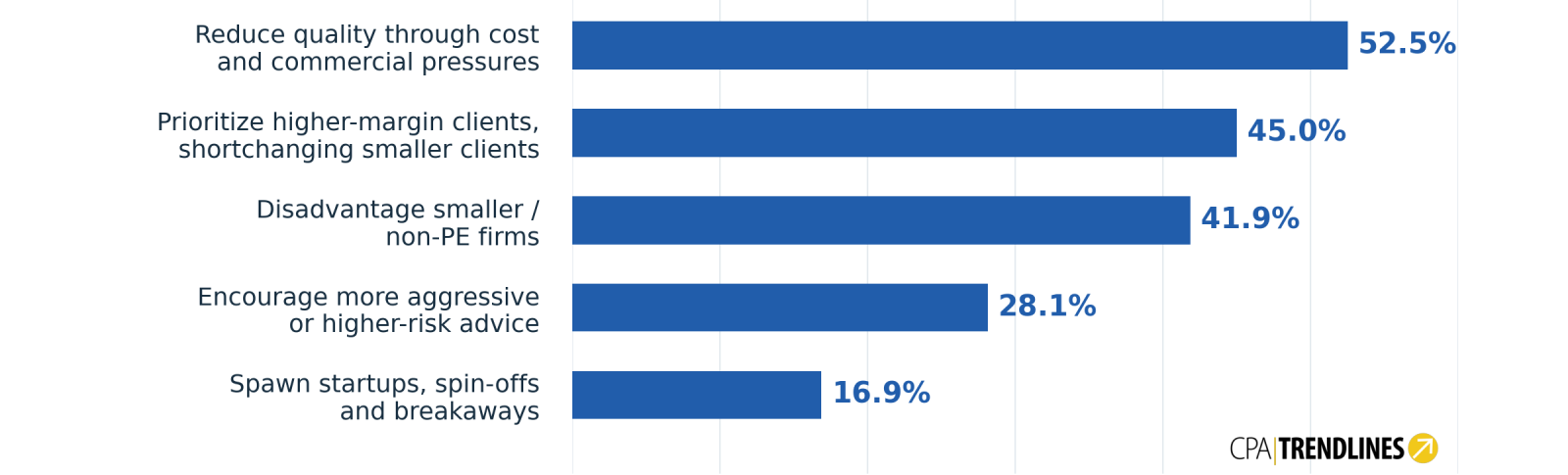
The new CPA Trendlines CPA PE Deal Tracker™ survey shows that more than half of practitioners expect private equity to reduce work quality, 45 percent anticipate smaller clients being shortchanged and 28 percent foresee more aggressive or higher-risk advice.
Among PE resisters, 43.2 percent expect disadvantages for smaller or non-PE firms, compared with 38.7 percent among the PE-curious and PE-committed.
Yet the possibility of new startups, spinoffs, and breakaways draws almost identical shares: 16.8 percent of opponents and 17.7 percent of the curious and committed.
“Lots of great talent jumping ship from PE firms,” says the still-independent owner of a local tax-centric firm in rural Watsonville, Calif., “makes me feel better about being independent.” So far, it’s working: The firm is projecting above-average growth in revenue, profit and headcount next year, buoyed by more high-value work, including advisory.
Private equity takeovers, says Angela Nummy at Northeast Tax and Business Solutions in Waterford, Conn., are “driving the small potatoes straight into the arms of my small boutique firm serving micro and lifestyle businesses.” Nummy expects to catch some of those “small potatoes” with a warm embrace of AI efficiencies.
Practitioners on different sides of the ownership question also anticipate a more polarized profession.
“I think the middle will be gone,” says the owner of a firm in Troy, Mich., predicting a marketplace of “a bunch of huge firms and a bunch of small ones.” His philosophy: “Work hard and invest in yourself and your people, be fair with your prices, and the clients will come.”
Even among those in play, a solo owner in Greenfield, Wis., says there’s “no middle ground,” just “large firms and solo firms.” Specializing in bookkeeping, the firm’s 350 clients average about $15,000 a year in billings.
At a cloud-based firm in Redlands, Calif., another PE opponent links consolidation to the pressures facing clients themselves, saying, “PE demands for profit and consolidating firms will mirror the current economy’s K shape.”
She adds, “There will always be demand for independent smaller firms, but they will either be competing for more of the higher-value clients (less of them) or the small-business clients who are barely making it.”
That leaves two possible positions for independents, both challenging: competing for higher-value relationships or serving smaller businesses under pressure.
In Pittsburgh, the owner of a firm serving 200 clients sees the work that will endure. “The smaller firms might be at a disadvantage as being not as profitable,” he says. “But the smaller clients still need the work performed properly.”