Success, long the defining strength of U.S. accounting firms, is fast becoming their most dangerous liability, according to Oz Demirdovan, a PKF executive with a global portfolio.
Flush with steady profits, deep client rosters, and decades of compliance-driven demand, many firms see little reason to change—just as the ground beneath them shifts, Demirdovan tells Liz Farr in this episode of The Disruptors.
The paradox is stark: the very stability that built the profession now insulates it from the urgency to adapt, leaving some of its most successful players at greatest risk of falling behind.
Demirdoven has worked in accounting worldwide, spending more than five years at Allinial Global. From his perspective, the most striking difference between accounting in the U.S. and the rest of the world isn’t just our complex regulatory environment.
“The biggest difference isn’t only regulation, it is mindsets,” he explains. “I would say, in North America, especially in the United States, firms are still very compliance anchored.” READ MORE →
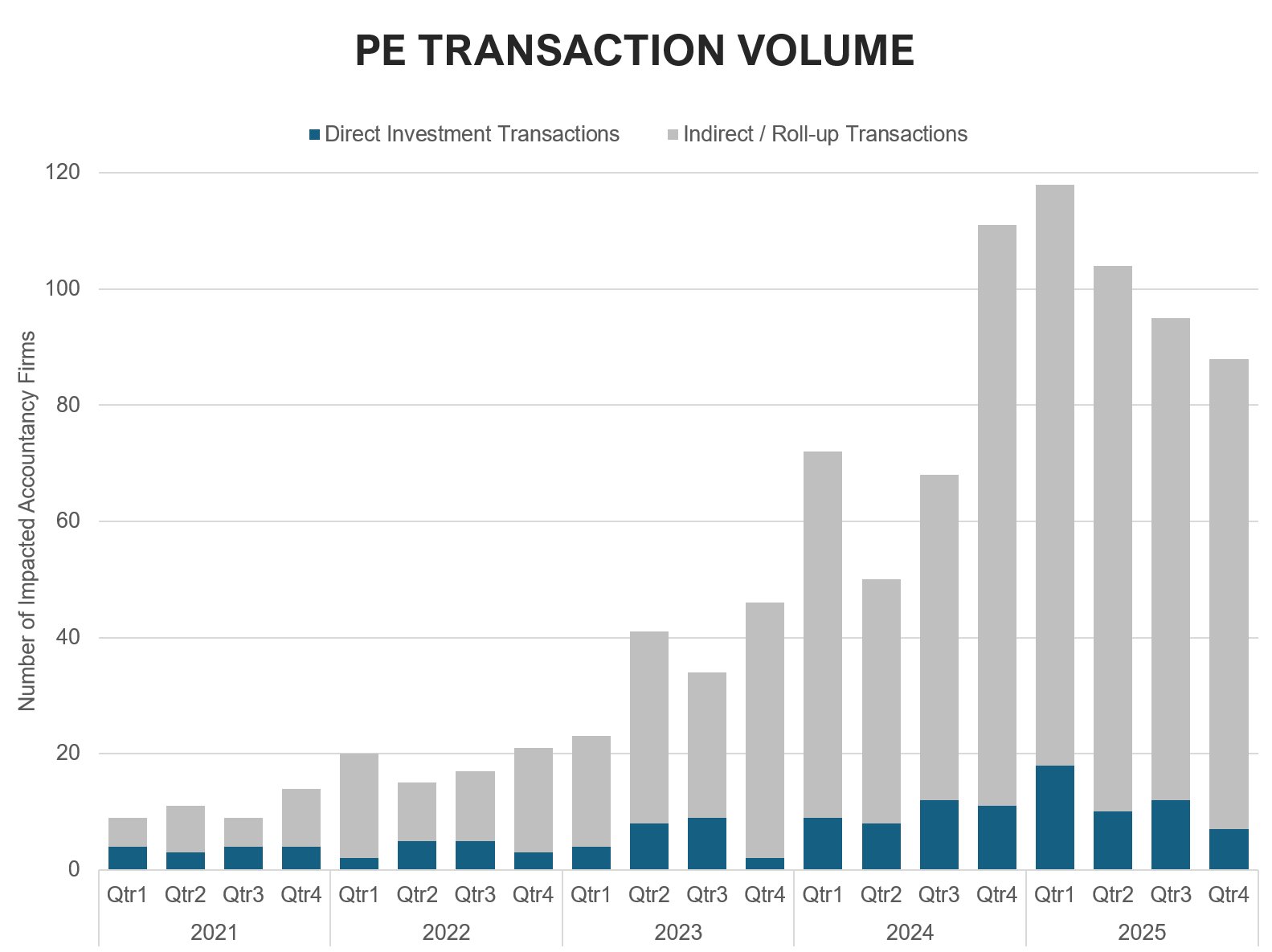
Fewer than 200 investors triggered almost 900 acquisitions.
Global issues: 1,052 total firms impacted, 177 direct PE investments, 875 roll-up acquisitions, 7.6× 2025 roll-up multiplier, 4× multiplier growth since 2021.
By CPA Trendlines Research
A multiplier that has grown fourfold since 2021 reveals a transformation driven not by new private equity entrants, but by platform firms consuming the mid-market at speed.
It belies the notion that PE is taking over the accounting profession. In fact, new global research argues that local and mid-size firms worldwide are taking control of their own futures and using institutional capital to pick up the tab.
The numbers that define private equity’s advance into accounting do not look the way most people expect. The headlines feature the big firms and the brand-name investors — TowerBrook Capital and EisnerAmper, New Mountain Capital and Grant Thornton, Ares Management and Baker Tilly. But the actual architecture of the transformation is being built one level below: in the relentless, largely unnoticed roll-up of smaller practices into PE-backed platforms.
Accounting leaders face pressure to choose a path that could reshape talent pipelines and firm culture for years to come.
Sponsored by “It’s NOT Just the Numbers: How to Move Beyond the Numbers and Deliver REAL Value for Your Clients.” by Penny Breslin and Damien Greathead. See Today’s Special Offer
Deloitte’s decision to dismantle its diversity, equity, and inclusion (DEI) program for 173,000 U.S. employees is sending shockwaves through the accounting profession, exposing deep divisions on a global scale and forcing firm leaders to weigh politics against talent priorities.
The move—ending DEI goals, disbanding related departments, eliminating annual reporting, and ordering staff to remove pronouns from email signatures—came just hours before Deloitte UK issued a memo affirming its commitment to DEI.