When Tax Meets AI, Savvy Tax Pros Turn to ‘Tax Platforms 2026’
Your 2026 Roadmap for the Tax Tech Transformation

By CPA Trendlines Research
DOWNLOAD: Get the free ebook here
Your 2026 Roadmap for the Tax Tech Transformation
By CPA Trendlines Research
DOWNLOAD: Get the free ebook here

Every year, the 2025 Rosenberg MAP Survey asks the industry’s top consultants to share their observations from CPA firms across the country: How do you think the next 12 months will unfold? Trends? Predictions? Other thoughts? Also, how would you assess the last 12 months? Trends? Observations? Struggles?
We need more revenue per person, and private equity alone won’t solve that.
By Michelle Golden River
The Rosenberg Survey
Fee increases and higher minimums will continue, but incremental 5-10 percent hikes simply won’t close the massive revenue-per-person gap (our big proportion problem) or allow firms to pay salaries competitive with other emerging professions. The firms that make real progress will untether pricing from time, secure current revenue levels before implementing efficiency gains, and position prices around the buyer’s perceived worth rather than costs.
 Exclusively for PRO Members. Log in here or upgrade to PRO today.
Charging for time creates an artificial cap on revenue because time is finite. Beyond a certain point, an hourly rate can also be perceived as unreasonable. The sooner firms learn to price using other revenue models, the better.
READ MORE →
But are trends already on the upswing again?
By CPA Trendlines
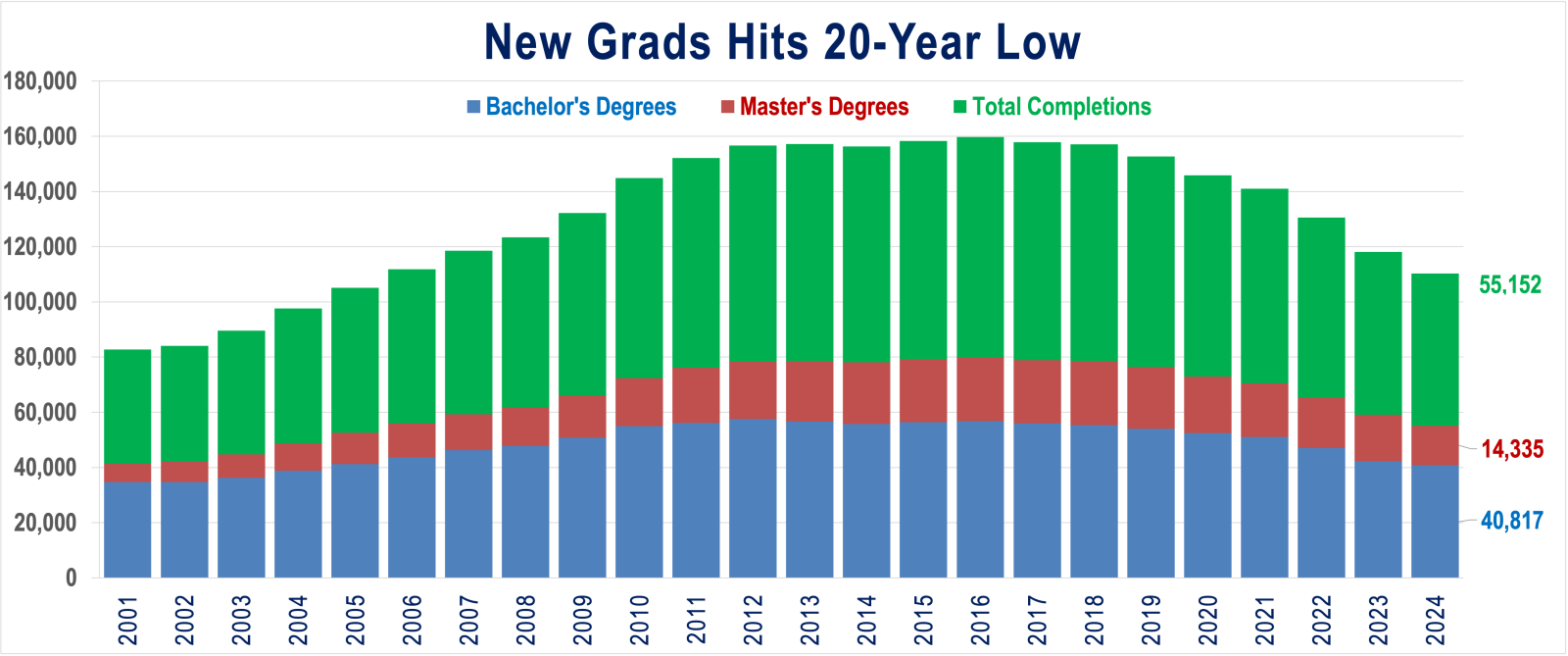
The pipeline of U.S. accounting graduates has fallen to its lowest level in roughly 20 years, capping a decade-long slide of about 17% in completions even as demand from public accounting firms remains strong, according to the latest release of a much-watched study.
In this report:
The tension between shrinking supply and resilient demand
Bachelor’s degrees: From mid-2010s peak to current lows
Master’s degrees: A steep 15% drop in the last academic year
CPA Exam Trends: The new baseline
Potential Turning Point? New growth in enrollments
In addition, the CPA exam pipeline has thinned over the past 10 years, with new candidates and successful passers both down from earlier peaks, though 2023 saw a temporary surge tied to the rollout of the CPA Evolution exam.
New research is also revealing that while auditors remain in steady supply, the tax profession is facing a severe and deepening talent drought.
And yet, new enrollment data point to a possible turning point, with accounting program enrollments up double digits in 2024–25 and firms signaling plans to keep hiring as many or more graduates in the year ahead.
Every year, the 2025 Rosenberg MAP Survey asks the industry’s top consultants to share their observations from CPA firms across the country: How do you think the next 12 months will unfold? Trends? Predictions? Other thoughts? Also, how would you assess the last 12 months? Trends? Observations? Struggles?
M&A will intensify, especially for midsized firms.
By Carrie Steffen
The Rosenberg Survey
Artificial intelligence will continue to reshape the daily work of CPAs – transforming mundane tasks and enabling deeper advisory roles. Many are wrestling with what this means for new grads who are hired into entry-level roles that historically have been learning opportunities. I do wonder about how we will accelerate skills development for high-value skills like fraud detection, strategic analysis and client interaction.
My guess? We will begin to see a shift. Traditionally accounting grads went to public accounting for a few years then left for private industry (for many reasons). But my prediction is we will begin to see a slow flip of that script.
READ MORE →
Every year, the 2025 Rosenberg MAP Survey asks the industry’s top consultants to share their observations from CPA firms across the country: How do you think the next 12 months will unfold? Trends? Predictions? Other thoughts? Also, how would you assess the last 12 months? Trends? Observations? Struggles?
Hours will become obsolete.
By Carl George
The Rosenberg Survey
Firms will continue to upgrade their client profiles and disengage from clients who no longer fit. The result is more time will be spent on higher-value clients and emerging high-value clients. A strategy long overdue for some.
Exclusively for PRO Members. Log in here or upgrade to PRO today.
This strategy meets the challenge of transactional versus relationship-driven. The key is to put a process in place that defines a high-value client, to prioritize the plan for each client, and to develop a side strategy that affords the appropriate resources (time and people) to give the high-value clients their due.
READ MORE →