How PE Drives Billing Rates Higher

New Paper Links Post-2020 Surge to Consolidation and Pricing Power.

Barrios and Abramova: As PE moves into accounting, researchers see more roll-ups, more non-audit work and higher fees

By CPA Trendlines

A new study says private equity’s post-2020 rush into accounting is pushing up fees.

In “Financializing the Professions: The Rise of Private Equity in Accounting,” Inna Abramova of London Business School and John M. Barrios of Yale School of Management examine what happens when outside capital enters a profession historically organized around partner ownership and licensing rules. Using data from 1999 to 2024 that link “more than 3,600 PE transactions” to mergers and acquisitions, labor markets, and audit pricing, the authors report that private equity investment “increases sharply after 2020.”

MORE Private Equity

The paper lands amid a widening regulatory and standards-setting response. State boards of accountancy, NASBA, the AICPA and international ethics setters have been studying whether alternative practice structures and private equity investment create new independence risks or oversight gaps. The study adds market-level evidence — not a case study of a single deal, but measurable signals of consolidation and pricing power.

“The word has gotten out there that accounting firms are great investments,” consultant Allan Koltin says. Finance professor Sabrina Howell, who has studied private equity, describes it as “the tip of the spear driving consolidation” in a traditionally fragmented industry.

READ MORE →

Busy Season 2026: IRS Problems, Staffing Issues and Client Wrangling Emerge as Top Pressures

IRS dysfunction replaces OBBBA as top concern.

On the front lines (clockwise from top left): Woodard, Dienhart, Volk, Stitely, Tejero, Brady, Svihla.

By CPA Trendlines

Join the survey. Get the results.

With only a week to go before the opening of filing season 2026, tax practitioners are focusing on IRS dysfunction as their biggest potential problem this year

And no wonder. The agency was already chronically underfunded, buried under a mountain of overdue paperwork, and crippled by ancient computer systems when it lost 25% of its workforce in early 2025.

JOIN the Busy Season Barometer survey here.

MORE TAX, PRICING, and THE 2026 OUTLOOK

Today 63% of tax professionals say a beleaguered IRS poses the single biggest risk to this year’s tax season, up from 54% just a couple of months ago, according to the CPA Trendlines Busy Season Barometer.

READ MORE →

Outlook 2026: NATP Shows Tax Prep Prices Surging and Diverging

Experience, complexity, and scarcity redefine the market

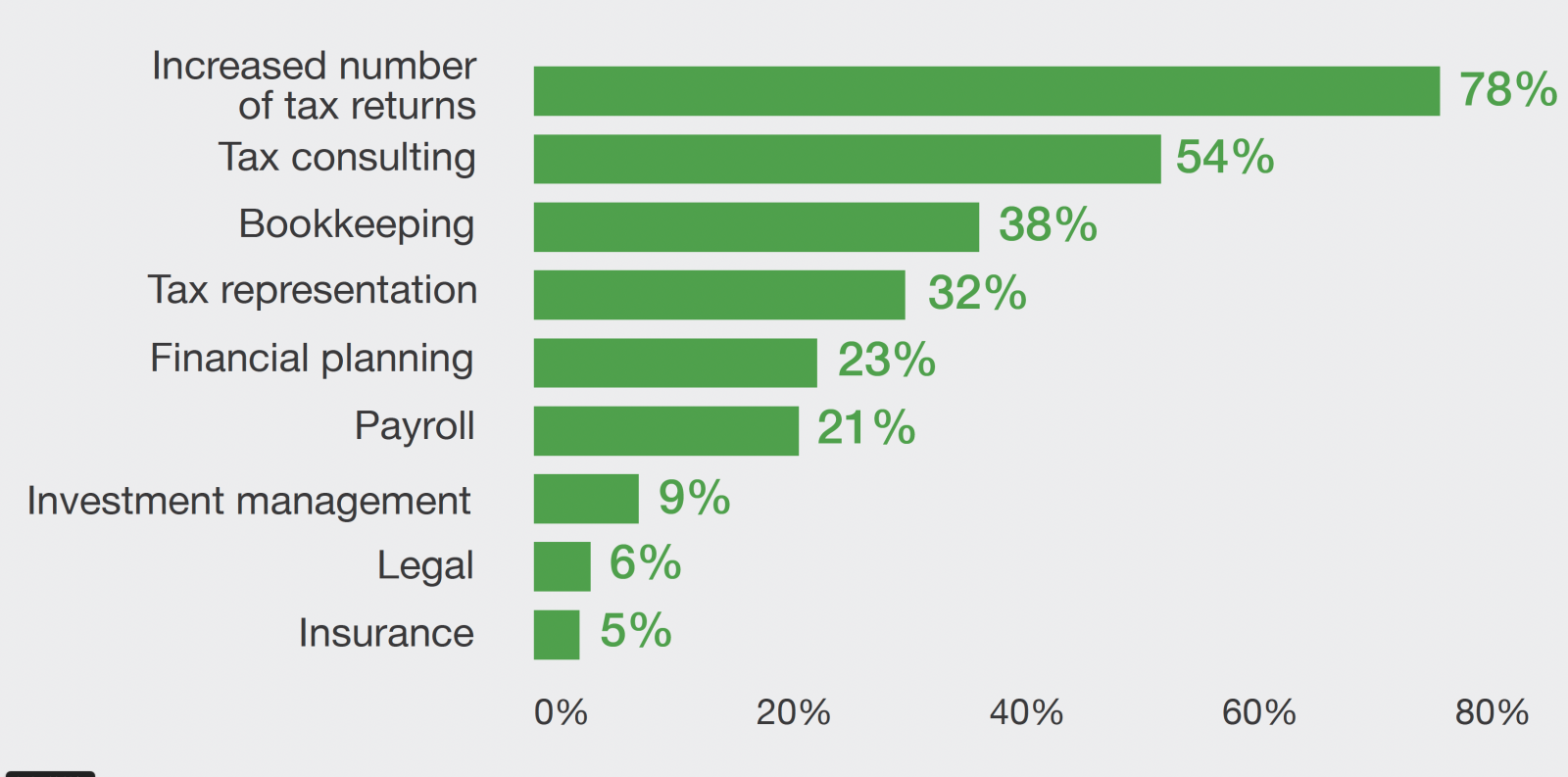
Volume and consulting drive growth: Of the 48% of firms reporting advances, 78% credit more business and 54% credit higher-grade services. Source: NATP

By CPA Trendlines

Tax preparation is getting markedly more expensive in 2026, and not in the slow, incremental way many firms have long assumed they can explain away.

In a widely used pricing model, the National Association of Tax Professionals reports the average base charge for a Form 1040 with Schedules is $236, up from a 2024 average of $162 reported in the same study series. That’s a 45.7% nominal increase in two years for the profession’s signature product, before a single schedule, state filing, or complexity premium is added.

JOIN the Busy Season Barometer survey. Get the results.

MORE TAX and PRICING

The U.S. tax preparation market is not merely more expensive.  It is increasingly stratified, with pricing that clearly distinguishes between complex professional work and the lower tiers of retail and do-it-yourself alternatives.

Across multiple independent pricing measures, certified public accountants and credentialed tax professionals command fees that are substantially higher than the base costs advertised by major retail chains, software platforms, and dwindling government-sponsored free filing options. The result is a world of tax preparation pricing that reflects not only the complexity of engagement but also client expectations, risk management, service delivery models, and clear segmentation of value. READ MORE →

Dunn: Time’s the Wrong Growth Metric | Gear Up For Growth

Stop counting minutes. Start creating meaning.

Originally published May 2025
This is a preview. The complete 1-hour video episode, with commentary and transcript, is first available exclusively to PRO Members | Go PRO here
Sponsored by CPA Trendlines Go PRO – Get More! Go PRO!  See Today’s Special Offer

Subscribe to CPA Trendlines podcasts anywhere: AppleGoogle/YouTubeSpotifyiHeartDeezer, Amazon Music, AudiblePlayer FMAudacy, RSS.
Get free gits, exclusive access, and more! Get more! Go PRO! 

Gear Up for Growth
With Jean Caragher
For CPA Trendlines

In a re-energizing episode of Gear Up for Growth, Paul Dunn makes the case that the billable hour isn’t just outdated—it’s holding firms back. The four-time TEDx speaker and cofounder of B1G1 challenges accounting leaders to rethink how success is measured and to lead with purpose, not punch clocks.

Gear Up for Growth spotlights the best strategies for smart and efficient growth in today’s competitive landscape. More Gear Up for Growth hereMore Jean Caragher here | Get her best-selling handbook, The 90-Day Marketing Plan for CPA Firms, here | More CPA Trendlines videos and podcasts here

Talking with host Jean Caragher, Dunn reframes the profession’s obsession with time as a distraction from what clients actually value. “It’s not about the inputs,” he says. “It’s about the outcomes.” When firms anchor their work to results—and to the human impact behind those results—growth follows naturally.

More than two decades after coauthoring “The Firm of the Future,” Dunn remains a vocal critic of six-minute increments. While some firms are inching toward value pricing and advisory-led models, he argues the real shift requires courage. Measuring work by time, he notes, is “the opposite of human flourishing.” Measuring by impact, on the other hand, elevates both clients and teams.

READ MORE →

Why Offer Three Service Levels?

Hand drawing a rainbow-colored 3

You still can add on other services.

By Jody Padar
Radical Pricing – By The Radical CPA

A tiered service offering should provide your clients with three options. According to experts in mindset and pricing, if you provide three options, people will usually choose the one in the middle. That’s the one you are aiming for them to buy.

Also, don’t forget that people buy the payment, not the car. There’s an entire mentality around monthly pricing. If you tell a client it’s a $24,000 engagement, they will balk. They would rather pay $2,000 a month than the full amount all at once. Of course, some clients will offer to give you the full engagement amount up front if the price is discounted. From a cash flow perspective, you can offer a small discount if a client is willing to pay this way.

Creating your service packages is not a one-size-fits-all activity. There should be different tiered service options for each client persona. It is also important for clients to know that they can upgrade or downgrade their service level when needed.
READ MORE →