“A time of uncertainty.”
Looking ahead to 2027, clockwise from top left: Bankler, Selner, Smith, Dienhart, Sethman, Walsh.
By CPA Trendlines Research
Heading into the election booths last week, the issues of inflation, interest rates and Washington’s next move were weighing heavily on the nation’s accountants.
According to the CPA Trendlines Accountants Confidence Index, 42.6 percent expect national business conditions to worsen over the next 12 to 18 months, compared with 30.9 percent expecting improvement.
MORE in Surveys & Research | Michael Annichine: Why Women’s Health Belongs in the Career Conversation | Bonnie Buol Ruszczyk: Caregivers Caught in the Middle | National Study Asks Accounting Professionals How Life Outside of Work Impacts Their Careers | 2026 Accounting MOVE Project Finds Caregiving Is Quietly Stalling Accounting Careers | If AI Is Saving Time, Why Are You Still Working Late? | AI Cuts Cost per Task to 21 cents from $10.35
JOIN the SURVEY: CPA Trendlines is canvassing the profession to gauge emerging issues and to identify new success strategies including current and future business conditions, artificial intelligence, private equity, client accounting services, and busy season management. The survey takes less than nine minutes, and participants can request an exclusive early look at the topline results.
Click here to Join the survey. Get the results
Expectations for clients are less downbeat: 36.6 percent expect better conditions and 25.8 percent expect worse. The largest client-outlook group, 37.6 percent, expects little or no change.
“Even though business conditions are generally favorable, it is a time of uncertainty,” one accountant tells CPA Trendlines before the midterms, recommending that clients keep doing what works without taking too many risks.
The CPA Trendlines Accountants Confidence Index
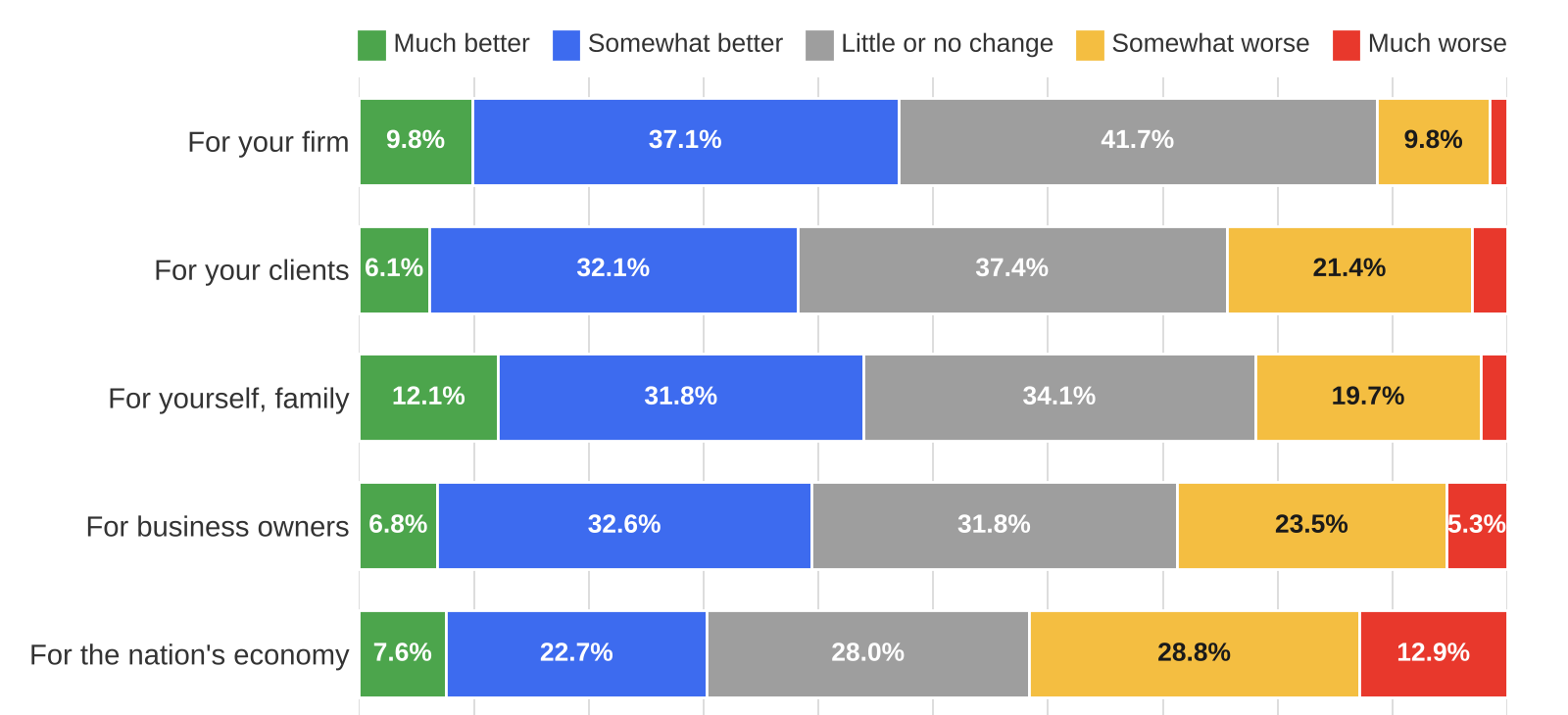
Accountants are more optimistic about their firms than the national economy over the next 12 to 18 months, with 47 percent expecting business conditions at their firms to improve, while 11.4 percent expect deterioration and 41.7 percent anticipate little or no change.
National expectations lean the other way: 41.7 percent expect worse conditions, 30.3 percent expect improvement, and 28.0 percent foresee little change.
Expectations for clients and business owners fall in between. Some 38.2 percent anticipate better conditions for clients, compared with 24.4 percent expecting worse, with 37.4 percent expecting little change.
Leaning positive
For business owners generally, 39.4 percent foresee improvement and 28.8 percent expect deterioration.
Accountants also lean positive about their personal and family circumstances, with 43.9 percent expecting improvement and 22.0 percent expecting worse.
The first post-election answers, still preliminary, are modestly less pessimistic, showing five-point shifts. National deterioration is expected by 37.8 percent, down from 42.6 percent before the vote. Optimism barely changes, at 29.7 percent afterward versus 30.9 percent before. Expectations of client improvement rise to 43.2 percent from 36.6 percent.
Prices remain part of the calculation
Comments about costs do not all point in the same direction. A respondent expecting national improvement cites “Inflation down.” Brian Walsh of BWEA expects little change nationally or for clients and writes: “Prices continue to increase.”
Todd Bomser of Bomser & Co. Inc. expects little national change and somewhat better client conditions. The concerns Bomser lists are “War in Iran, National Debt, Interest Rates & Inflation.”
Interest rates enter decisions even when the forecast is positive. Bob Krech of RGK Enterprises Inc. expects national and client conditions to improve somewhat. Krech’s advice is to “Avoid major purchases until interest rates come down.”
Washington divides expectations
Political expectations cut both ways. Before the vote, one respondent expecting much better national conditions cites “Republicans maintaining control of the Congress.” Afterward, another expecting much worse national and client conditions names “Democrats taking over Congress.”
Thomas Hileman points to “The election and the fight between the parties.” Hileman expects little national change but somewhat better client conditions.
Different forecasts bring similar precautions
James A. Smith of Smith, Jackson, Boyer & Bovard expects client conditions to improve somewhat while national conditions remain roughly unchanged. Smith’s preparation list is direct: “Reduce debt, control cash flow, increase use of technology.”
Dan Selner of Perpetual Resources Inc. expects little national change and somewhat better client conditions, and offers a longer checklist: “Pay down debt, increase savings, especially retirement savings, set an annual spending plan and be sure to consult with a financial advisor and/or accountant BEFORE making any large financial decisions.”
Kathleen Dienhart of Dienhart CPA Inc. describes clients already adapting: “Most of my clients have gotten much better at saving due to the continued uncertainty in the future economy.” Dienhart expects little or no change nationally or for clients.
Less gloomy than the last two years
The latest outlook is less gloomy than the warnings accountants delivered in the past two tax seasons. In April 2025, CPA Trendlines’ “Accountants Turn Negative Amid Tariffs, Trade, Uncertainty” reports that 74 percent expected the national economy to worsen over the next 12 to 18 months. Before the inauguration, almost 60 percent expected improvement and only 26 percent anticipated deterioration. By April, the share expecting conditions to become “much worse” reached29 percent.
Pessimism remains pronounced a year later. In “Red Flag Warning: Accountants Lose Faith in the Economic Outlook,” published April 13, 2026, roughly two-thirds expect national business conditions to deteriorate, while about 18 percent expect improvement. Accountants enter that filing season with about half anticipating deterioration; by April, the negative outlook has widened considerably.
Economic indicators
The latest pre-season reading puts national pessimism at 42.6 percent — still ahead of optimism at 30.9 percent, but below both the April 2025 and the 2026 readings. Concern remains the prevailing view, although it no longer commands the overwhelming majority reported in spring 2025.
At this time, accountants are looking at an economy that offers a mixed backdrop. Annual consumer inflation stands at 3.7 percent, down just 0.1 percentage point from April’s 3.8 percent. Underlying inflation, excluding food and energy, eases somewhat more, from 2.8 percent to 2.6 percent. Prices are still rising, although slightly more slowly than in April. The national unemployment rate stands at 4.1 percent, down from 4.3 percent in April.
Borrowing costs, however, are moving against consumers and business owners. Freddie Mac’s average 30-year fixed mortgage rate reached 7.18 percent on Nov. 5, up from 6.37 percent in April, an increase of 0.81 percentage points.
Accountants’ improved outlook accompanies modest improvement in inflation and unemployment, alongside more expensive mortgage financing. The combination leaves room for greater confidence about business conditions while preserving the financial pressures behind respondents’ advice to conserve cash and approach major purchases cautiously.