But the Busy Season Barometer finds that the real test comes after the work begins.
By CPA Trendlines Research
Barely seven months after accountants closed a disappointing tax season, they are forecasting a better one for 2027. The latest CPA Trendlines Busy Season Barometer puts expectations almost exactly where they stood before last season began to unravel.
MORE Busy Season Barometer: The Accountants Demand Index: How it Works, How to Use It | CPA Firms Show Signs of Profit Weakness, Even as Fees Strengthen | Tax Season Leaves Accountants Drained, Disappointed | 21 Hard-Earned Lessons from Tax Season 2026 | Red Flag Warning: Accountants Lose Faith in the Economic Outlook | Tax Prep Billing Rates Lift Busy Season 2026 | Tipping Point: Accountants Scramble for AI-Enhanced Tax, GL, and Workflow Apps | Busy Season 2026: Clients, Pricing, Staffing… CRUNCH | Busy Season 2026: Chaos Looms as DOGE Cuts and OBBBA Changes Collide
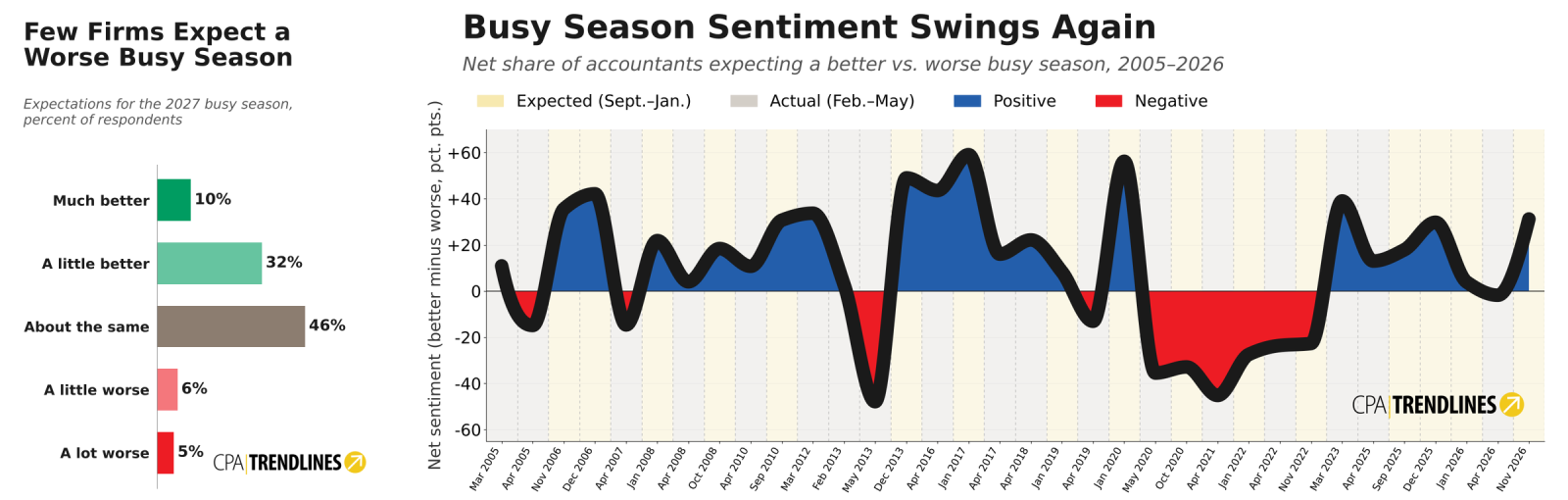
Some 42.8 percent expect the coming busy season to be better than 2026. Only 11.6 percent expect worse. The resulting net positive reading of 31.2 percentage points nearly matches the positive 29.8 recorded last December.
Last year’s early optimism did not survive tax season. By April, the Barometer’s reading had fallen to negative 1.8, a reversal of more than 30 points as late clients, staffing constraints, technology problems, and the “Liberation Day” launch of a new tariff regime overwhelmed practitioner confidence.
Now the profession is starting over. The question is whether conditions have changed enough to produce a different result.

Optimism returns, but confidence is limited
Only about one in 10 accountants and firm owners expect a substantially better season. Most of the optimists anticipate modest improvement. Meanwhile, nearly 46 percent expect little change.
The numbers describe a profession leaning toward improvement without expecting a breakthrough.
Philip Laube of The Tax Lobby CPA Firm puts the outlook in measured terms. “Caution and focus on basics. Not a time for aggressive expansion, but I think things will be positive,” Laube says in response to the survey’s question about preparing clients for the economy ahead.
Nina Tross of AZ Business Solutions Inc. sees demand holding up. “Clients are busy, work volume is steadily increasing, and more small businesses are looking to outside resources to help with their company,” she reports.
That distinction is revealing. Accountants can see favorable business conditions without expecting those conditions to make the annual filing season significantly easier.
The forecast that failed
The profession has been here before, and recently. Last December, the Barometer reached a net positive 29.8, reflecting considerable confidence ahead of the 2026 filing season. By April, that reading stood at negative 1.8.
As CPA Trendlines reported in April, some of the early concerns faded as practitioners adjusted to conditions. Anxiety over IRS operations, for example, was identified by 63 percent in January but only about 30 percent in April.
Other problems became more prominent once the work began. By April, 57 percent identified clients who were late or unprepared, while 46 percent cited too much work and too little time.
The difficulties were not necessarily evident in advance. Their effect accumulated through the season, as firms confronted client delays, workflow bottlenecks and the practical limits of their staffing and systems.
The financial results were equally mixed. About 58 percent reported higher revenue, but only 44 percent reported higher profit.
The season could therefore produce more business and stronger billing without producing a correspondingly better experience for the people doing the work.
Twenty years of recurring surprises
The latest forecast fits a pattern documented in CPA Trendlines’ historical Busy Season Barometer coverage.
The April 2026 review of two decades of survey experience describes an industry whose expectations are frequently disrupted by changes in tax administration, legislation, technology and workload.
The 2013 filing season was affected by late tax legislation and related implementation problems. The pandemic disrupted the 2020 season. IRS processing backlogs and service difficulties shaped the experience in 2021.
These disruptions differ in their causes, but they illustrate a recurring limitation of preseason forecasts: Accountants know the work they expect to receive, but they cannot fully anticipate the conditions under which they will have to complete it.
More business does not necessarily mean a better season
The new survey helps explain why optimism and caution can coexist.
Some 52.3 percent of firm owners expect to handle more clients during the 2027 busy season. About 72.5 percent expect higher revenue, while 78.4 percent expect higher prices or billing rates.
Yet only 56.5 percent expect higher net profit, and just 18.3 percent anticipate increased staffing.
Among accountants expecting more clients who answered both the client-volume and staffing questions, 68.5 percent do not expect to increase headcount.
One small-firm owner offers a reminder of the risks. She says, “IT has been a nightmare,” describing several weeks lost to technology problems. Despite that experience, the same practitioner expects a much better 2027 season.
The steady middle
Geoff Arnold of Geoffrey J. Arnold, CPA, describes a substantial workload without concern about the coming season. “I’m 76 and working with 620 tax clients per year. I’m doing fine,” Arnold reports. He expects the coming busy season to be about the same.
Eric Grant of Eric Grant CPA offers a similar assessment of current operations, although his outlook for the season is slightly negative. “Everything is working okay – nothing unusually well, though. I believe AI will provide some opportunities within the next three to six months,” Grant says.