The CPA profession’s divide deepens over PE.
Concerns and Consequences over Private Equity
 Even as the private equity takeover of the CPA business spreads from the largest national firms to Main Street practices, the profession’s divisions appear to be hardening, with a growing share of partners and owners lining up against PE and citing threats to their reputation for integrity, independence and objectivity.
MORE Private Equity | The CPA PE Deal Tracker™ | By the Numbers: 10 Years of Private Equity in Accounting | PE-Owned CPA Firms Surge into Advisory Buyouts | PRO Tracker™: The Complete List, 621 Deals, 10 Years | Steve Stagner: From Mattress Firm to CPA Firms | Springline’s Tim Brackney: Expect Accounting Firm IPO | With $1.8 Billion Deal, Eide Bailly Set for Explosive Growth | Allan Koltin: What Elite CPA Firms Do Differently | The 7.6x Machine: How Grassroots Firms Are Taking Private Equity for a Ride
The new CPA Trendlines CPA PE Deal Tracker™ survey of rank-and-file CPA firm owners shows 58.1 percent now calling themselves “decidedly opposed and fiercely independent,” markedly higher than the 49.5 percent CPA Trendlines reported in June. And what was once “a bare but discernible majority” of CPAs open to PE has become a clear and measurable minority.

“PE will weaken the brand and may eliminate the attestation function and public interest that the CPA has been an advocate for,” says the “fiercely independent and decidedly opposed” John Lawson, managing shareholder at SDK CPAs.
To be sure, the ownership divide is uneven. Practitioners can anticipate similar competitive pressures, changes in partnerships, and potential technology gains while taking different positions on PE. What most separates the fiercely independent is the greater frequency with which they anticipate professional costs alongside those changes.
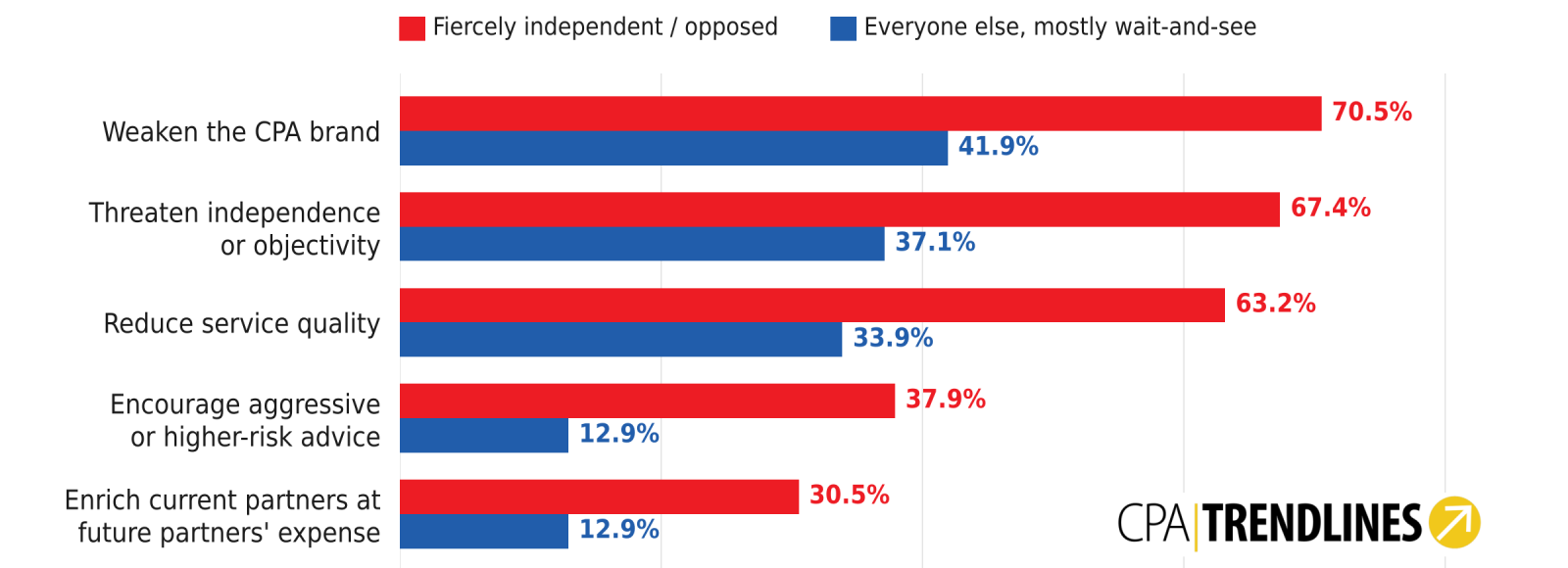
Among practitioners who describe themselves as opposed and independent, 67.4 percent expect investor influence to threaten independence or objectivity. Among everyone else, ranging from firm owners who have done a deal to those who could be persuaded, 37.1 percent share the concern.
Substantial differences also separate the groups over service quality, the CPA brand, higher-risk advice, and whether today’s partners benefit at tomorrow’s partners’ expense.
The CPA name carries the most concern

Aside from the 58.1 percent opposed, 37.7 percent are waiting and thinking, and 4.2 percent in the survey have taken or are seeking PE buyouts.
Some 70.5 percent of opponents worry about damage to the CPA brand, compared with 41.9 percent of the rest. Reduced quality due to cost and commercial pressures draws 63.2 percent of opponents, compared with 33.9 percent of others.
The brand concern is the most widespread among opponents. Independence is the most distinguishing, producing the largest separation between the groups. The concern about advice is narrower but still sharply divided. Some 37.9 percent of opponents expect PE to encourage more aggressive or higher-risk advice, compared with 12.9 percent of other respondents.
A cash-out for one generation, a different bargain for the next
Partnership economics creates another fault line. Among opponents, 30.5 percent expect PE to enrich current partners in the short term at the expense of future partners. Among other respondents, only 12.9 percent worry.
“It seems like it is a way for older partners to cash out and disadvantage managers and newer partners (capping their upside),” says a partner at a local firm.
Others see recognition of the value that partners have already built. “Valuations have increased greatly, and our work as partners growing our recurring revenue is being valued,” says Anthony Sabella, managing partner at Sabella & Marshall CPAs, in the “wait-and-see” contingent.
Those are different assessments of what an ownership transaction means. One emphasizes the position of managers and incoming partners. The other emphasizes the value of an established practice. Neither response places its author in the small group actively pursuing a transaction.
The prospect of converting partners into employees with less control and upside draws a smaller difference between the groups than the generational question: 46.3 percent of opponents cite it, compared with 38.7 percent of other respondents.
Another partner likens the change to medicine, anticipating employees “with less autonomy, less satisfaction and less flexibility.”
Smaller firms see threats — and openings
Some competitive consequences produce much less division.
The prospect that PE disadvantages smaller or non-PE firms draws 43.2 percent of opponents and 38.7 percent of other respondents. The possibility of new startups, spin-offs, and breakaways draws almost identical shares: 16.8 percent and 17.7 percent.
Dale Geeslin of Geeslin Group, who counts himself among the fiercely independent, anticipates a polarized market of “a few mega firms and smaller local firms.” He says, “The middle market will be underserved.”
“Every week we get new clients leaving because they don’t know anyone, can’t get anyone, and aren’t getting good value,” says an opposed respondent in management at a local firm.
Still, the opposition doesn’t rule out potential operating benefits. Faster adoption of advanced technology, including AI, is selected by 27.4 percent of opponents and 35.5 percent of other respondents — a much smaller gap than the differences over independence, quality or the CPA brand.