The 3-Part Framework Firms Are Using to Fix K-1 Chaos

“Automation alone” can’t solve the K-1 calamity.

By CPA Trendlines Research Staff

For many firms, the instinctive response to K-1 challenges is simple: adopt better technology.But technology alone isn’t enough.

The firms making real progress are taking a broader approach—aligning people, process, and technology into a cohesive strategy.

MORE Break the K-1 Bottleneck | From K-1 Chaos to K-1 Capital: Turning Compliance Bottlenecks into Advisory Opportunities

Download the full framework.

This three-part framework is emerging as the foundation for sustainable tax transformation:

READ MORE →

Private Equity Brings in the Big Guns

New executives take the reins at CPA firms.

New deals, new faces. Top row: Burger, Brady, Whitman. Bottom row: Cordero, O’Boyle, Garrambone, Comerford.

By CPA Trendlines Research

Jim Brady spent 45 years helping lead Deloitte and Grant Thornton. Dee Burger developed consulting and technology businesses at Capgemini and Insight Enterprises. Alan Whitman built Baker Tilly into one of the nation’s largest accounting firms.

MORE Private Equity

Now all three are taking top positions at accounting firms backed by private equity, as institutional investors increasingly pair growth capital with experienced executives to steer platforms into larger, more diversified organizations.

The CPA PE Deal Tracker™ from CPA Trendlines documents 527 institutional investments and acquisitions involving accounting firms and related businesses from 2020 through June 2026, including 474 transactions backed by institutional capital and 386 private-equity-backed transactions in particular. Much of the consolidation surge focuses on ownership, acquisitions and valuation. But now some executive appointments point to another trend: building deeper executive leadership.

READ MORE →

Accountants Race to Tame AI before AI Outruns the Practice

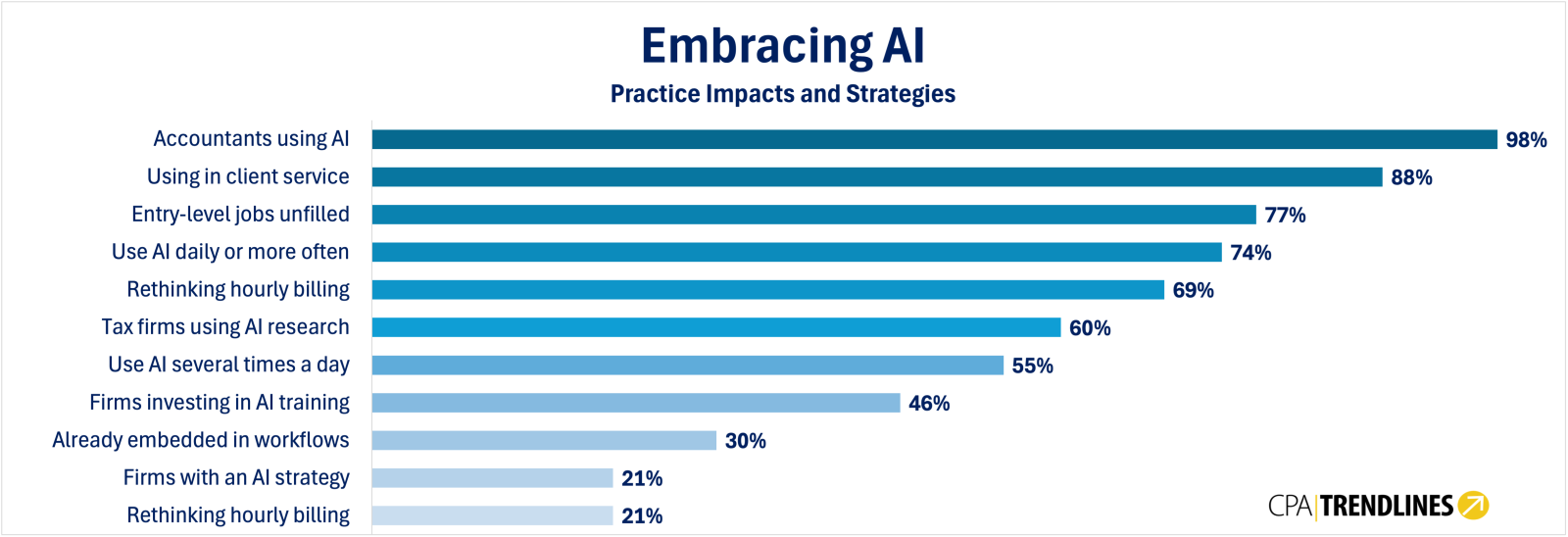
Only 1 in 5 firms has an AI strategy, leaving most firms with varying degrees of chaos.

Barely three years since ChatGPT launched, 98% of accountants are using AI regularly. 88% use it in client service.

By CPA Trendlines Research

With artificial intelligence now firmly embedded in the daily life of tax and accounting firms, the profession’s next test is whether practitioners can learn to run AI before AI outruns the practice.

A new crop of research studies and benchmarking surveys suggests firms have yet to fully govern the tools, price the work, train the staff and protect client trust under AI regimes. Reports from the AICPA, Karbon, CPA.com, Blue J, Intuit Firm of the Future, KPMG, Personiv, the ACCA, Rightworks, Business.com and Citrin Cooperman show AI adoption is no longer in doubt. Coping with it is.

MORE Artificial intelligence | Supkis Cheek: Most Accountants Are Missing This AI Shift | |Private Equity’s Big Bet Faces an AI Shake-Up | Doug Slaybaugh: How to Define “Values in Motion” | At ENGAGE 2026, a Profession Richer and Less Certain Than Ever. | Jen Cryder: From Membership Model to Market Maker | Big 4 Transparency | Three Tech Priorities with Rapid ROI | The Google Playbook for Young Accountants | AI Can Fix Your Workflow—or Break It in Seconds |

Karbon says 98% of accounting professionals use AI, up 15 percentage points from last year, with 55% using it several times a day and 74% using it daily or more often.

Intuit says 88% of accounting professionals used AI for at least one client service in the last 12 months, and 86% used AI for at least one firm operation. Some 46% of firms are investing in AI training, 21% have an AI policy, and 21% have an AI strategy. Intuit says 30% describe AI as embedded by default in daily work, while 54% use it only when it seems useful.

READ MORE →

How Private Equity Turns CPA Loyalty into Legal Risk

Overlapping ownership tests conflict and control. Cue the lawyers.

Rivals in the Loop: Grant Thornton and Wipfli, now stablemates under New Mountain Capital’s billion-dollar investments, seek to maintain separate operations and arm’s-length decision-making. Shown in Chicago: The Grant Thornton Tower on North Clark (left) and Wipfli offices at the Chicago Title building on Wacker (right).

By CPA Trendlines Research

Grant Thornton and Wipfli keep offices barely a half-mile apart in Chicago’s Loop — about a 10-minute walk, or a single stop on the “L.”

Zoom out. After a generation of competitive drive, the rival firms are now part of the same investor’s stable.

MORE Private Equity | What $1 Billion Buys in Today’s CPA Market

Private equity’s push into accounting is making for some strange bedfellows, as some investment firms build out networks of ostensibly independent firms that increasingly overlap in clients, services, acquisitions and talent markets.

With more than 500 deals under study, the CPA PE Deal Tracker™ from CPA Trendlines Research provides a vivid picture of private equity firms quietly adding a new layer of consolidation as they roll up the CPA profession. Sponsors are evolving into holding companies with multiple platforms, built simultaneously on a number of large CPA firms as acquisition engines. At least five sponsors now hold two or more competing platforms at the same time.

“As the Peter Parker principle reminds us, with great power comes great responsibility,” Proskauer Rose LLP, the private-funds legal powerhouse, says in a client playbook. “Sponsors should remember the portfolio company corollary: with greater control comes greater exposure to liability.”

READ MORE →

With $1.8 Billion Deal, Eide Bailly Set for Explosive Growth

Reverence Capital turns a regional powerhouse into a national growth engine.

Eide Bailly MP/CEO Jeremy Hauk: Pre-building a private equity platform in plain sight.

By CPA Trendlines Research

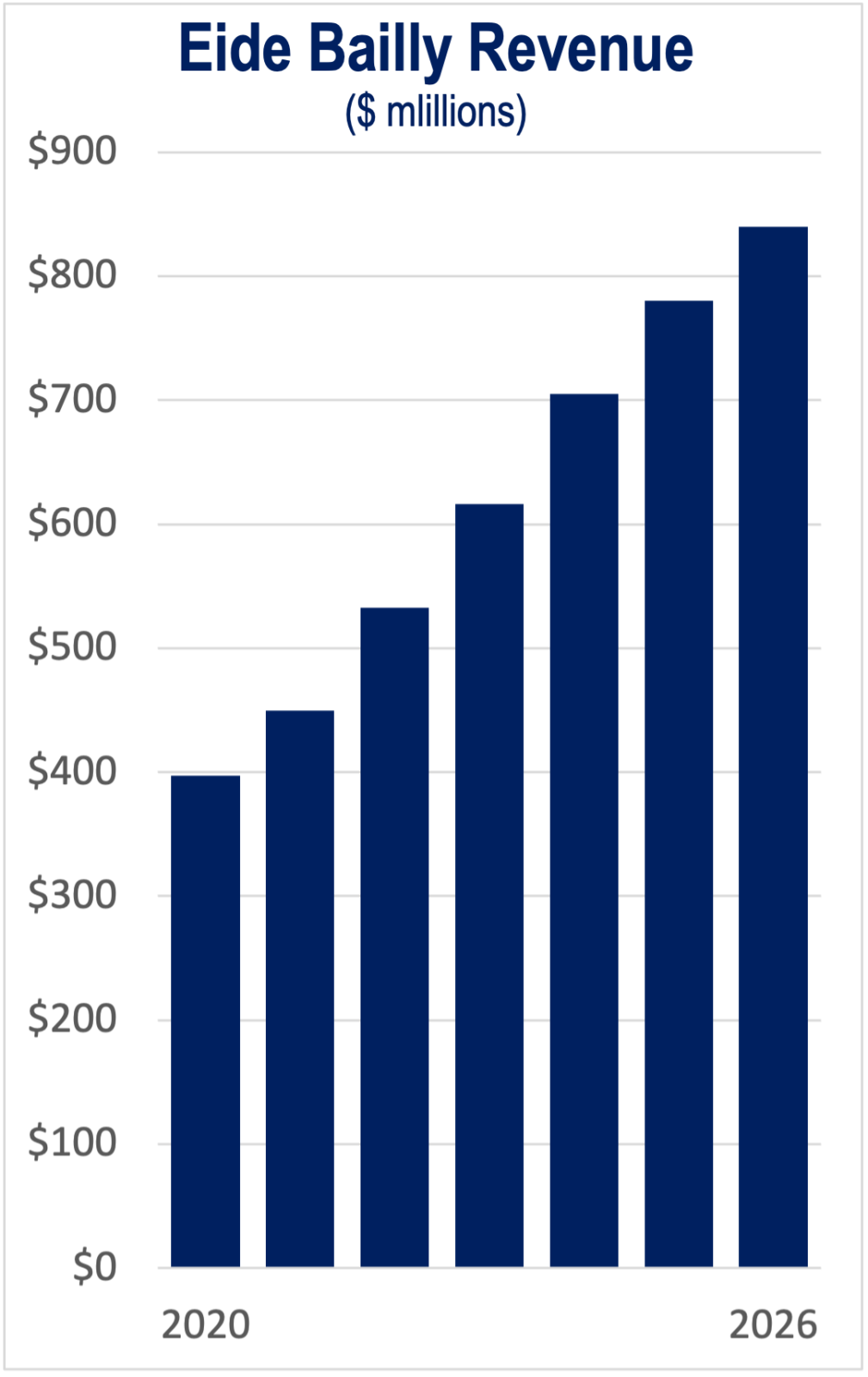
Eide Bailly doubled billings in six years, to $840 million. They plan to do it again, but in half the time.

Eide Bailly didn’t need private equity to roll up more than a dozen local CPA firms in the last two years.

But the Reverence Capital Partners takeover, which values Eide Bailly at about $1.8 billion, means the Fargo, N.D., CPA firm can shift into hyperdrive and take a shot at competing on a national stage. With about $840 million in billings, up from $780 million a year before, the deal prices Eide Bailly at about 2.1 times revenue.

MORE Private Equity | What $1 Billion Buys in Today’s CPA Market

How Big Buyouts Are Turning the Profession into a Platform | Private Equity Turns CPA Loyalty into Legal Risk | PE Forces Firms to Pick a Future | What Elite CPA Firms Do Differently | Private Equity’s Big Bet Faces an AI Shake-Up | Steve Stagner: From Mattress Firm to CPA Firms | Private Equity’s Accounting Playbook Shifts from Dealmaking to Operating Systems

Less than two weeks before Eide Bailly’s deal, Chicago-based Crowe agreed to sell to KKR, famous for leveraged buyouts, for nearly $3 billion, at 2.2 times revenue.

The two deals mean that just over half of the top 30 firms are muscling up for expansion with outside capital. Only five of the firms between No. 6 Baker Tilly and No. 26 Sikich are left as independents. In the top 50, about half the firms are taking outside capital. At 100, it’s 29 firms. Overall, the CPA PE Deal Trackertm from CPA Trendlines Research counts more than 500 deals, most of them in the last three years.

In the top tiers of the accounting profession, the market has split into three clear, distinct philosophies: the PE-backed consolidators (like EisnerAmper or Baker Tilly), the ESOP pioneers (led by BDO), and the traditional independence holdouts (Forvis Mazars, CLA, Plante Moran, and Withum), who view partner-ownership as a major asset for long-term talent retention.


READ MORE →