Jeremy Dubow: Raising the Bar for Talent | Big 4 Transparency

Why equity is the new standard for talent retention.

This is a preview. The complete video episode, with commentary and transcript, is first available exclusively to PRO Members | Go PRO here
Sponsored by The Balanced Millionaire: The Advisor Edition by Dr. Jackie Meyer | See Today’s Special Offer.

Subscribe to CPA Trendlines podcasts anywhere: AppleGoogle/YouTubeSpotifyiHeartDeezer, Amazon Music, AudiblePlayer FMAudacy, RSS.
Build a 7-figure firm in just 4 hours a week!
.

Big 4 Transparency
By Dominic Piscopo, CPA
For CPA Trendlines

Jeremy Dubow, CEO and co-founder of Chicago-based, private-equity-backed Prosperity Partners, explains how entrepreneurship in accounting has shifted from demand-driven to capacity-constrained, and why transparent equity programs are becoming the new standard for talent retention.

MORE Dominic PiscopoMORE Private EquityMORE Pay & Compensation

Dubow joins Dominic Piscopo on Big 4 Transparency to discuss how accounting-firm entrepreneurship and the operating model required to scale have changed since he co-founded NDH in 2003. NDH later sold to private equity and rebranded as Prosperity Partners, which Dubow described as a case study in how firms are adapting to labor constraints, expanding client complexity, and rising expectations around technology and talent strategy.

Quotables
“The demand for accounting services is greater than it ever has been. The challenge is providing the service at a high level in a labor-constrained environment.”
“AI in and of itself is not right now the solution to solve all our problems. Using automation and offshoring gives us the operational leverage to create that capacity.”
“I recognize that my people are being attempted to be poached every single day of the year.”
“Why have a stock price if you don’t disclose what it is?”
“‘’If I worked that 80-hour week, you should too.’ Well, guess what? That doesn’t work anymore.”

Dubow argues the profession has shifted from a demand constraint to a capacity constraint. Client needs continue to expand, but firms increasingly struggle to staff and deliver services proactively at scale.

READ MORE →

Brannon Poe: Is Your Firm PE-Ready? | The Disruptors

Most firms aren’t. Here’s how to change that.

This is a preview. The complete 1-hour video episode, with commentary and transcript, is first available exclusively to PRO Members | Go PRO here
Sponsored by The Balanced Millionaire: The Advisor Edition by Dr. Jackie Meyer | See Today’s Special Offer

Subscribe to CPA Trendlines podcasts anywhere: AppleGoogle/YouTubeSpotifyiHeartDeezer, Amazon Music, AudiblePlayer FMAudacy, RSS.
Build a 7-figure firm in just 4 hours a week!

The Disruptors
With Liz Farr

Brannon Poe, founder of Poe Group Advisors, says the key to a successful firm transaction is fit.  

“I think having a good deal is really about having a good fit,” he says. Besides technical skills, “you have to have management styles that mesh well, you have to have client service philosophies that are aligned,” he explains.  

MORE STREAMING: Oliver: Build a Biz that Runs Without You | Daiber: Use Succession as a Growth Strategy | Cannon: Busy Season is Self-InflictedCarroll: When One Person Can Break the FirmRampe: Build a Roadmap Even When the Road’s Not ThereChang: Killing SALY, One Agent at a Time | Vanover: 5-Star Firms Don’t Bill by the HourKless: Profit Is a Result. Flourishing Is the Purpose | Whitman: Build Culture on ‘Progress,’ Not Change | Shein: No PE? No M&A? No Problem | Hood and Weber: Time to RISEProctor: Turn Dumb Ideas into Brilliant SolutionsCarter-Gray: How 1 Poor Review Strengthened the Firm | Hartman: Upwork to “40 Under 40” in 3 Years |

GoProCPA.com Exclusively for PRO Members. Log in here or upgrade to PRO today.

For sellers, choosing the right buyer matters as much as the price. “I find that the sellers in particular, who keep their focus on fit and choose the right buyer, usually are the happiest with their exit.” 

The last few years have created favorable conditions for accounting firm sales, but not for everyone.  

READ MORE →

Regulators Put PE Under the Microscope

Private equity meets public trust.

By CPA Trendlines Research

The nation’s accounting regulators are signaling that private equity’s rapid expansion into CPA firms has reached a point that demands closer scrutiny.

MORE Private Equity

In a new white paper, the National Association of State Boards of Accountancy lays out a framework of questions that could shape the next phase of regulation for firms backed by private equity or operating under alternative practice structures. At the same time, senior officials at the Securities and Exchange Commission are warning CPA firms to remain focused on “the basics.” The AICPA is also considering revising its independence regime.

READ MORE →

How PE Drives Billing Rates Higher

New Paper Links Post-2020 Surge to Consolidation and Pricing Power.

Barrios and Abramova: As PE moves into accounting, researchers see more roll-ups, more non-audit work and higher fees

By CPA Trendlines

A new study says private equity’s post-2020 rush into accounting is pushing up fees.

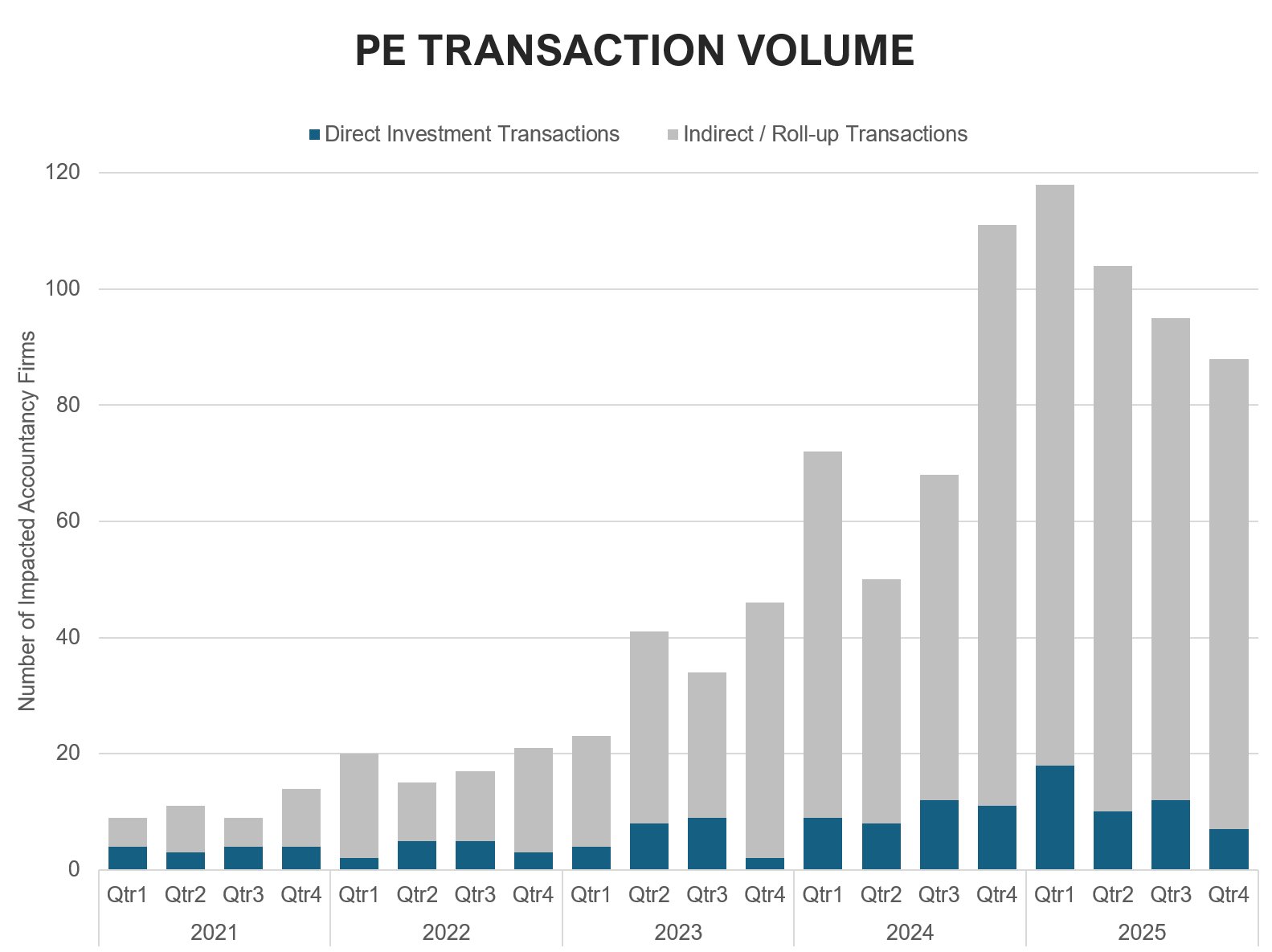
In “Financializing the Professions: The Rise of Private Equity in Accounting,” Inna Abramova of London Business School and John M. Barrios of Yale School of Management examine what happens when outside capital enters a profession historically organized around partner ownership and licensing rules. Using data from 1999 to 2024 that link “more than 3,600 PE transactions” to mergers and acquisitions, labor markets, and audit pricing, the authors report that private equity investment “increases sharply after 2020.”

MORE Private Equity

The paper lands amid a widening regulatory and standards-setting response. State boards of accountancy, NASBA, the AICPA and international ethics setters have been studying whether alternative practice structures and private equity investment create new independence risks or oversight gaps. The study adds market-level evidence — not a case study of a single deal, but measurable signals of consolidation and pricing power.

“The word has gotten out there that accounting firms are great investments,” consultant Allan Koltin says. Finance professor Sabrina Howell, who has studied private equity, describes it as “the tip of the spear driving consolidation” in a traditionally fragmented industry.

READ MORE →

How Private Equity Created $200 Billion in New Riches for CPAs

The math is simple, even if the implications are not.

By CPA Trendlines

For decades, the value of a CPA firm was constrained by one simple fact: partners had to buy each other out with their own money. That reality imposed discipline, but it also capped valuation. Firms were priced to be affordable, not aspirational.

That changed when private equity arrived.

MORE Private Equity

Over the past five years, private equity funding has fundamentally altered how CPA firms are valued — not by changing what firms do, but by changing how the market prices scale, recurring revenue and growth potential. The result has been a sharp, uneven reset in firm values, with some practices worth 2 to 4 times what similar firms would have commanded just a few years earlier.

Before private equity entered the market, the top 500 CPA firms, which generate roughly $146 billion in annual net revenue, would have been valued at roughly $170 billion using traditional pricing norms. Applying today’s private-equity-driven revenue multiples implies a total enterprise value of more than $400 billion — a valuation reset of more than $200 billion without any change in underlying revenue. Even the smallest firms may rise with the tide. The 500th largest firm runs about $6 million a year.

READ MORE →