Techno-pundits have been predicting the demise of office paper for decades. But now it appears that accountants are actually achieving the paperless office, at least technologically, with the help of the Cloud. But actually thinking paperless? Well, that’s another story.
Accountants’ average total compensation held relatively steady in 2011, increasing 0.9 percent from $128,486 in 2010 to $129,591, according to IMA’s 23rd Annual Salary Survey, released this month in Strategic Finance magazine.
If Yogi Berra was ever asked what he thought perception was, he might have said, “The one thing about perception is that people have different perceptions about perceptions.”
We can all try do a good job in trying to present a professional perception to others but the final verdict from our efforts occurs in the eyes and minds of those we are talking, working or meeting with. We can think we presented one way but it may be interpreted in another way. Can you spell perception?
More from Nick Keseric for CPA Trendlines PRO Members (Go PRO here):
Income Statement, Balance Sheet, Cash Flows? It’s time for a fourth statement.
[jwplayer mediaid=”20231″]
Edi Osborne
By Edi Osborne
CEO, Mentor Plus
In the words of Bonnie Raitt, “Let’s give ’em something to talk about; a little something to figure out.”
Fact or fiction, rumors or true business intelligence, those that can make the distinction have a HUGE opportunity to add value to their business relationships.
Recently, I had the opportunity to sit down with several business owners to interview them about how they make business decisions. Decisions, as it turns out, are one of the most important reasons business owners walk away from nine-to-five jobs. Business owners like to have control over their destiny. They actually thrive on the decision-making process and are willing to live with the consequences of those choices. And although, business owners don’t want anyone to take away their options, they do want someone to help them examine them. They want to know that the information they are basing a decision on is accurate and relevant. That it is not conjecture, rumor, or worse yet, self-serving misinformation provided by others at the company. Sounds like a job for a true, trusted adviser, would-be super hero.
Unfortunately, when asked about the quality and quantity of data, business owners utilize daily to inform their decisions, including the real-time, management value of financial statements, their answers paint a very unsatisfactory picture of the decision support provided by their accountant. As the role of CPAs who serve as CFOs in a corporate environment has morphed into that of a CIO — Chief Information Officer — CPAs in public practice continue to lag behind in this transition. When pressed on this issue, many CPAs admit they want to do more, but they are not comfortable outside the realm of compliance matters.
More from Edi Osborne for CPA Trendlines PRO Members (Go PRO here):
So how can public CPAs become Chief Information Officers? How can they utilize their accounting skills to capitalize on the fast growing business intelligence market?
The art of giving and taking feedback for a happy office.
by Rick Telberg
We’ve been asking accountants and finance managers how well their offices use feedback to keep folks happy. It’s clear that a little do-and-don’t advice seems in order for some of the nation’s accounting firms and finance departments.
Our sources report some pretty big problems on the Do side. Out of seven questions in a CPA Trendlines study, five showed that fewer than half the accounting and finance offices nationwide were doing what they should be doing all (or most) of the time.
For instance, feedback offered on behavior — rather than on personality: Only eight percent of managers do it all the time, and only 37 percent do it frequently. A full 20% do it rarely or never at all. Ouch! Whoever’s doing the feedback could use a little feedback themselves.
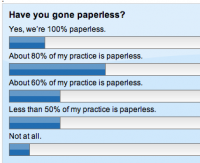 It’s not enough to just “go paperless.” Take the Tech Strategies Survey; see how you rate.
 A new salary survey of management accountants isn’t bad news. but it’s not great news either.

