CPA PE Deal Tracker™: What $1 Billion Buys in Today’s CPA Business

A Tale of Two Theses: Two of the world’s biggest investors place opposing bets. 
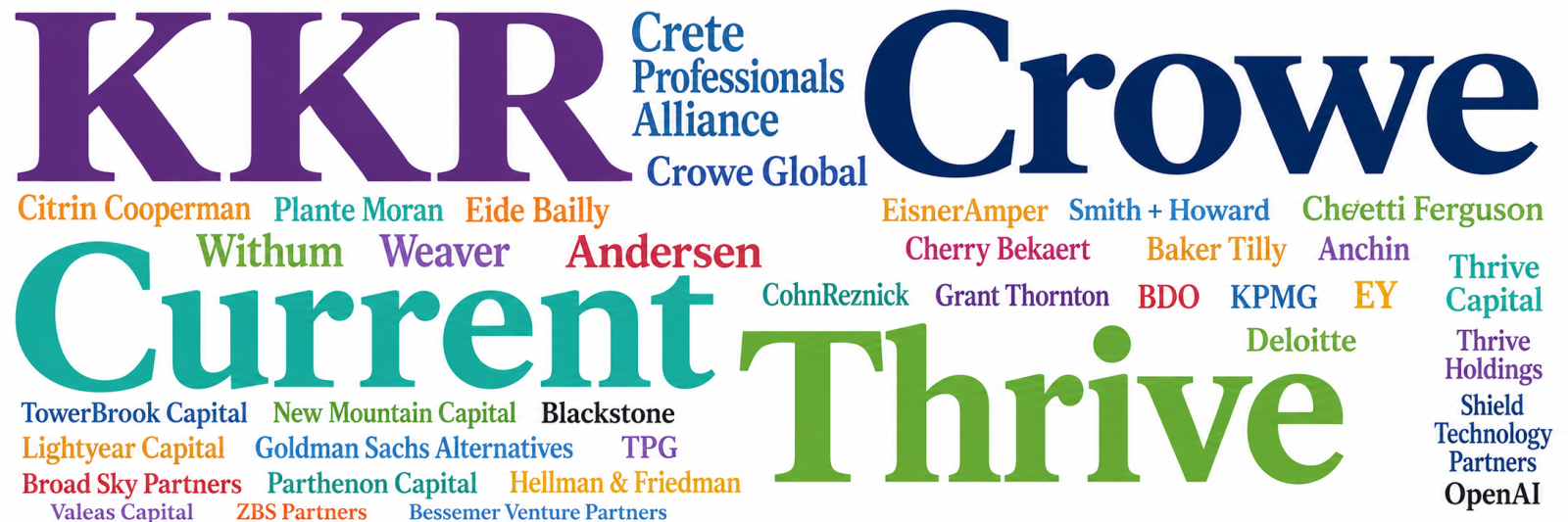
KKR takes Crowe. Baker Tilly lands Anchin. Smith+Howard flips. Cherry Baekert ropes Calvetti Ferguson.

By CPA Trendlines Research

KKR, the global investment firm synonymous with “leveraged buyout,” is taking a majority stake in Crowe, 12th on the top 100 lists, for $2.5 billion to $3 billion, including $1 billion in debt.

MORE Private Equity and Institutional Capital | MORE CPA PE Deal Tracker™: 13 Firms Rolled Up in May. 92 So Far this Year | All 466 Deals for the Last 10 Years | Private Equity’s Accounting Playbook Is Shifting from Dealmaking to Operating Systems | CPA-PE Deal Tracker™: How Big Buyouts Are Turning the Profession into a Platform | Ready the Stack Play: Tech Arbitrage Under Private Equity | Staying Independent: Why Your Best Clients Hope You Turn Down Private Equity |PE Wars: The CPA Platform Economy Is Concentrating FastThe PE Takeover: Audit Problem? What Audit Problem?The 7.6x Machine: How Grassroots Firms Are Taking Private Equity for a Ride | With Apax Sale, CohnReznick Starts Building a National Platform | PE Deal Tracker Update: Alan Whitman Plants a Flag in the Private Equity Landscape | How PE Drives Billing Rates Higher | How Private Equity Created $200 Billion in New Riches for CPAs |

Meanwhile, the Tampa-based platform Crete Professionals Alliance is renaming itself Current and confirming that backer Thrive Holdings is earmarking up to $1 billion to roll up dozens of small and midsize local firms.

Each set of investors is deploying $1 billion or more, but with very different theses. The fact that the market is supporting both suggests the market hasn’t decided which is the better strategy.

The scale play: KKR and Crowe

KKR, the firm that made the leveraged buyout a household term, is financing roughly a third of the Crowe deal with about $1 billion in debt, priced near the international overnight interest rate plus 550 basis points.

Laid against the roughly $225 million in EBITDA, that’s leverage of about 4.4 times earnings, on a price that works out to roughly 11 to 13 times EBITDA and about twice revenue.

Crowe is no small prize. The 80-year-old firm ranks No. 12 on Accounting Today’s 2026 Top 100 at about $1.3 billion in revenue, with 539 partners and more than 5,600 people across 37 offices, and it sits inside a Crowe Global network of 200-plus firms in 130 countries.

It also counts more than 500 private-equity funds among its clients — a firm that audits and advises PE is now becoming PE-owned itself.

Crowe CEO Steven Strammello frames the deal as “staying ahead of what our clients need.”

KKR partner Chris Harrington calls Crowe an “advisor of choice.”

Harris Williams and William Blair advise on the financials, with legal work from Hunton Andrews Kurth, Mayer Brown and Kirkland & Ellis. The deal is expected to close in the third quarter.

The roll-up play: Thrive and Current

Current runs the opposite play.

Founded only in 2023 and partnered with Thrive in May 2024, it now ranks No. 28 and claims more than $500 million across nearly 30 firms, 228 partners, more than 1,800 people and 67 offices, roughly double its size a year ago as Crete.

Current’s backer, Thrive Holdings, is a $1 billion permanent-capital vehicle that Joshua Kushner’s Thrive Capital launched in 2025 to buy and operate service businesses and re-tool them with AI. It also owns the IT roll-up Shield Technology Partners and is reported to be raising up to $2 billion more. Thrive has committed more than $500 million to buy U.S. accounting firms. ZBS Partners and Bessemer Venture Partners are also investors. OpenAI holds a stake too, paid not in cash but in engineers and products embedded inside the firms.

The technology is the pitch. Current’s tax tool processed about 7,000 returns in the 2026 season and cut preparation time by roughly a third. Partner firm Assurance Dimensions, led by Bennie Lewis, reports AI saving hundreds of hours a month in audit testing.

CEO Steve Stagner says Current is “arming the rebels” and that the firms set to lead are “not the largest, but the ones closest to their clients.” He dismisses the conventional roll-up as “cost extraction on a deadline” and pitches a holding period he calls “effectively forever.” Even so, Current’s own April survey complicates the story: 65% of clients say AI would improve their view of a firm, while 75% still prefer dealing with a person.

Two bets, one market

The two deals sit at opposite ends of a widening price barbell.

At the top, institutional buyers pay double-digit earnings multiples: Crowe’s implied 11 to 13 times sits alongside Citrin Cooperman, which entered private equity at a reported 11 times in 2021 and changed hands again at a reported 15 times in 2025.

Current buys trade far cheaper. Brokers put owner-dependent practices at three to six times adjusted earnings, tax-only shops in smaller cities closer to three to four, and the median small firm still around one times revenue.

To be sure, the earnings buyers pay for are partly engineered: converting partner draws into salary plus equity lifts reported EBITDA by an estimated 10% to 25%.

But the gap between roughly seven and 11 times is the whole logic of the roll-up: buy small in the low single digits, integrate, and the platform reprices into the double digits.

The trend is lopsided — the top stretching higher while the floor holds — ever since private equity’s arrival shifted the standard from a multiple of revenue to a multiple of earnings.

What a billion actually buys

So what does $1 billion buy? For KKR, it means Crowe could theoretically take controlling stakes in Plante Moran, the largest still-independent firm left below it at about $1.2 billion in revenue — or, moving down the list, in all three of the independents that follow: Eide Bailly, at about $800 million a year, plus Withum, closing in on $700 million, and Weaver, at more than $400 million. The firm sitting among them, Andersen, is off the table, having gone public on the New York Stock Exchange in December. And that is essentially the whole menu. After those four names, the roster of large independent firms is all but exhausted.

For Thrive, the same billion buys something unrecognizably different. Current could scoop up 100 local firms grossing about $10 million apiece and still be shopping. Its list is not four names but the roughly 50,000 small CPA practices that never appear on any ranking at all.

That gap sets the clock. KKR is racing a closing window — the supply of platform-scale targets shrinks with every deal, and at the very top, the eligible firms now number in the single digits, with more buyers chasing them than there are firms worth buying. Thrive faces no such limit. It can buy for years and barely thin the field.

A four-year wave

Neither deal is a debut. Both are part of the fourth year of a reordering that began in 2021, when TowerBrook Capital staked EisnerAmper and New Mountain Capital backed Citrin Cooperman.

Private equity now holds stakes in roughly a quarter of the top 100 firms and about half of the top 25, with more than 50 private equity-related accounting deals on record through 2025 and consolidation up about fourfold.

The first investors are already cashing out: Citrin moved to Blackstone, Schellman from Lightyear Capital to Goldman Sachs Alternatives, and EisnerAmper recapitalized with TowerBrook.

The deals keep coming

Meanwhile, TPG agreed to back Atlanta’s Smith + Howard, buying out prior owner Broad Sky Partners in a sponsor-to-sponsor flip after the firm grew from under $40 million in revenue to $170 million in about four years.

And Cherry Bekaert, backed by Parthenon Capital, picks up Houston’s $43 million Calvetti Ferguson.

Not to be outdone, Baker Tilly — the Top 10 firm that Hellman & Friedman and Valeas Capital took majority control of, and that absorbed Moss Adams in 2025 — is acquiring New York’s Anchin, Block & Anchin, a 103-year-old firm with $157 million in revenue.

Baker Tilly is naming Anchin managing partner Russell Shinsky as New York managing principal and moving its headquarters from Chicago to New York.

Anchin brings more than 560 people in New York, more than Baker Tilly’s own last publicly reported metro head count, so the firm is widely expected to expand its Hudson Yards space, keep Anchin’s offices or both.

And yet, the combination leaves Baker Tilly with a real-estate puzzle. Its New York headquarters at The Spiral in Hudson Yards runs about 28,000 square feet — a footprint dwarfed by its peers.

CohnReznick holds 125,000 square feet at 1301 Avenue of the Americas, Citrin Cooperman about 110,000 at 50 Rockefeller Plaza, Grant Thornton 135,000 at 757 Third Avenue and BDO 145,000 at 200 Park Avenue, while the Big Four fill whole towers — KPMG about 450,000 square feet at Two Manhattan West, EY 600,000 at 1 Manhattan West and Deloitte some 800,000 at 70 Hudson Yards.

Why the money is here

Both the KKR and Thrive Holdings playbooks are, at bottom, bets on closing that gap — KKR by concentrating capital in one large advisory firm, Thrive by spreading AI across many small ones.

For the owner-operator who never takes a meeting, the consequences arrive anyway. The comparable sales that value a selling firm reset the number under the firm that stays, and the wave that starts at the top 25 now works through the middleweights toward Main Street.

Two genuinely different exits exist where one used to: sell into a platform’s advisory arm on an institutional clock pointed at the next flip, or join a networked model that keeps local brand, leadership and a slice of equity with no exit timer at all. Which is worth more depends on a question no owner controls — whether the next buyer believes scale wins or proximity does, and how much control regulators allow that buyer to hold.

A billion dollars no longer buys just one thing in accounting. It can buy control of a single national advisory firm, or it can buy 30 local practices and the AI software to remake them.

The market is funding both answers at once, the surest sign it does not yet know which is right.

Leave a Reply
