Expect strong demand for tax planning, business advisory and bookkeeping cleanup work.
By CPA Trendlines Research
The CPA Trendlines Busy Season Barometer indicates that tax and accounting leaders anticipate growth in their own firms, even as they prepare for anxious business clients, persistent inflation, and a policy environment that keeps planning on edge.
About half of all accountants in the survey are bracing for a deteriorating economy, with a third expecting rosier scenarios, for a net negative 17.2 percentage points. For small and mid-sized businesses, accountants are at a negative 9.3 points.
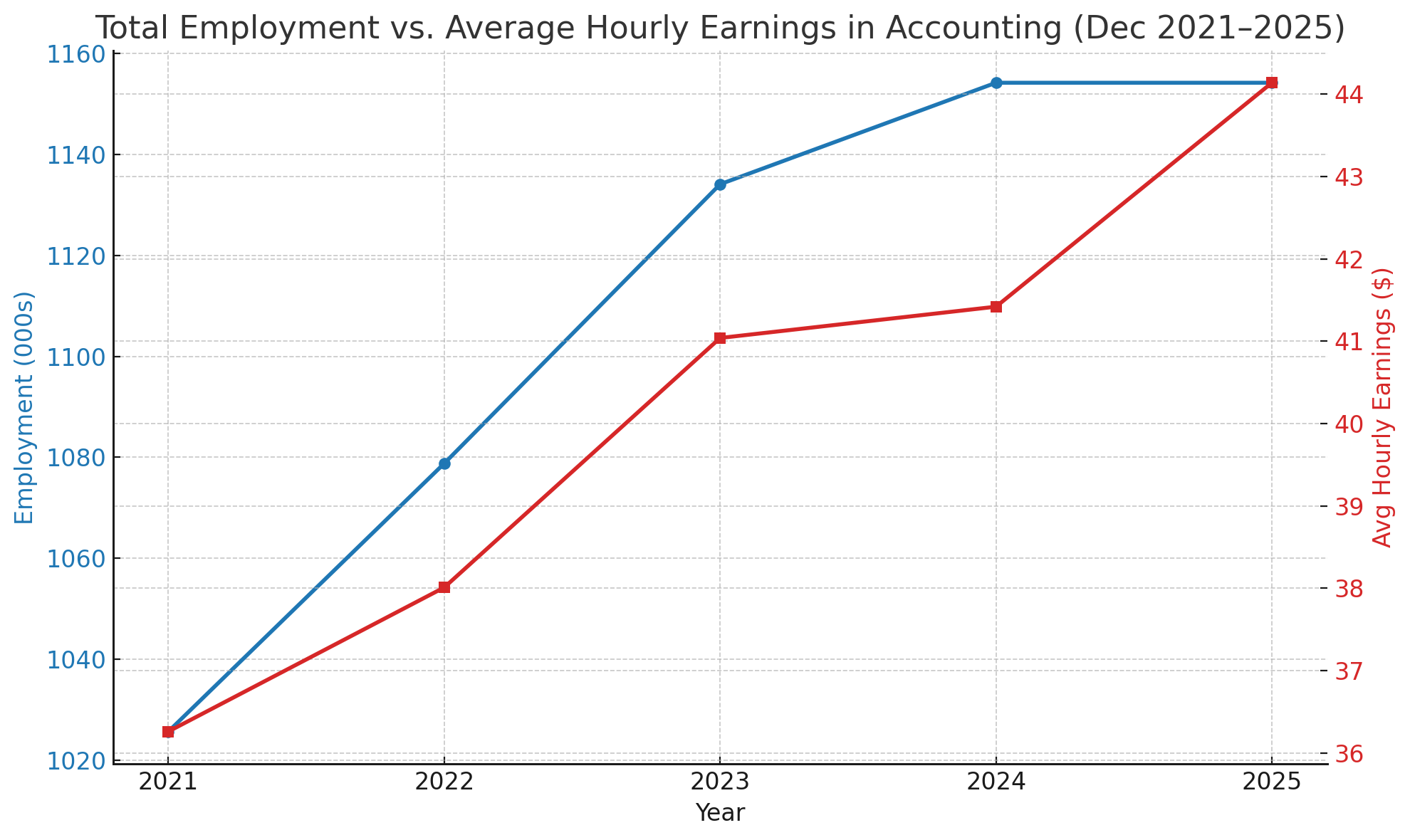
Pivoting with the Paradigm: Staff salaries are rising sharply even as job growth plateaus.
New jobs data signal fundamental pivot for accounting firms.
By CPA Trendlines Research
The year 2026 may be long remembered as the paradigm-shifting moment when accounting firms were forced to pivot everything from their business models to their budgets.
The reason: Salary and pay increases are accelerating even as hiring momentum stalls.
Going into 2026, labor costs have been cleaved from labor supply. The new, structurally higher staffing line is forcing firms to rewrite their budgets as well as business models.
Experience, complexity, and scarcity redefine the market
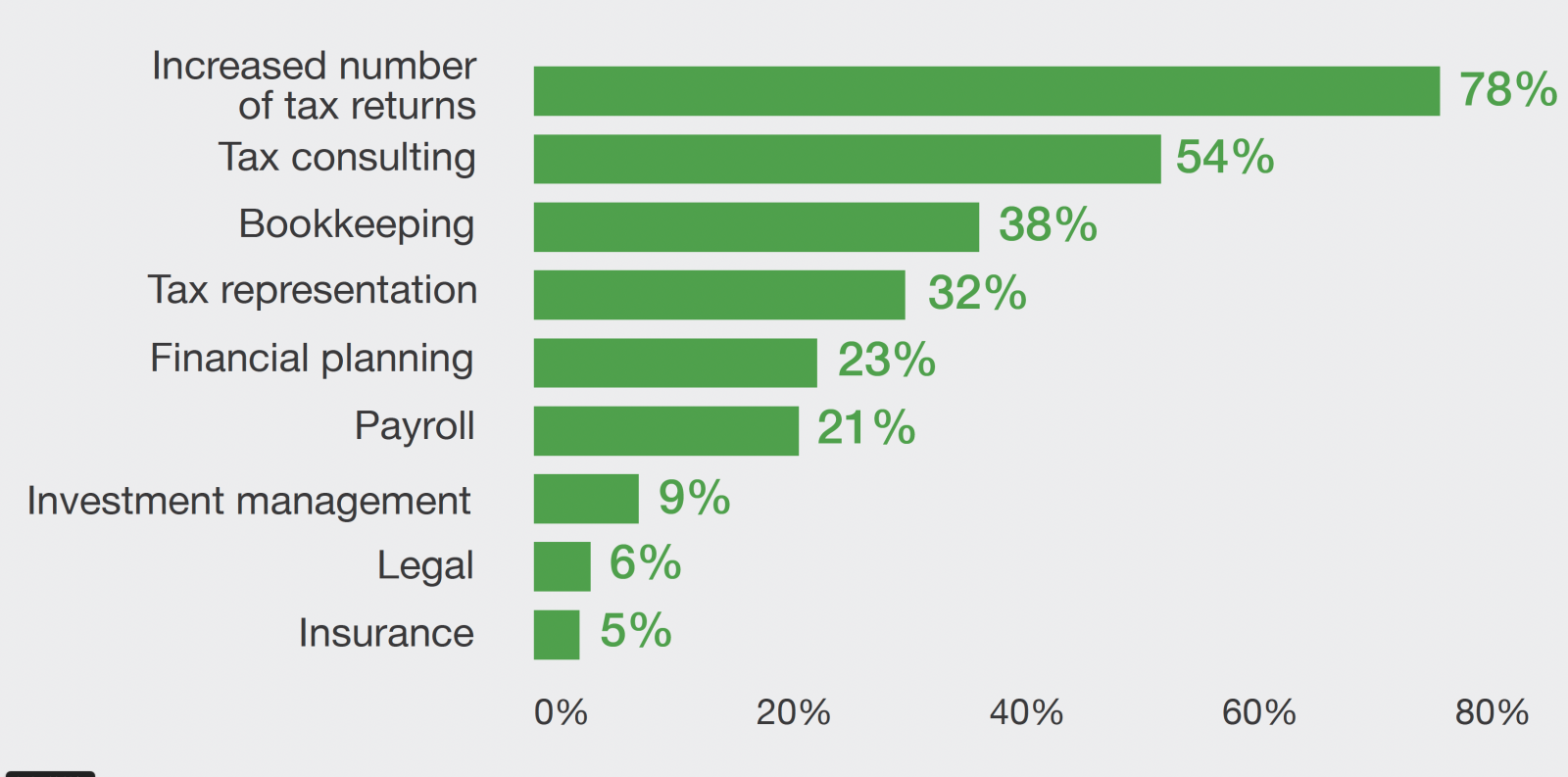
Volume and consulting drive growth: Of the 48% of firms reporting advances, 78% credit more business and 54% credit higher-grade services. Source: NATP
By CPA Trendlines
Tax preparation is getting markedly more expensive in 2026, and not in the slow, incremental way many firms have long assumed they can explain away.
In a widely used pricing model, the National Association of Tax Professionals reports the average base charge for a Form 1040 with Schedules is $236, up from a 2024 average of $162 reported in the same study series. That’s a 45.7% nominal increase in two years for the profession’s signature product, before a single schedule, state filing, or complexity premium is added.
The U.S. tax preparation market is not merely more expensive. It is increasingly stratified, with pricing that clearly distinguishes between complex professional work and the lower tiers of retail and do-it-yourself alternatives.
Across multiple independent pricing measures, certified public accountants and credentialed tax professionals command fees that are substantially higher than the base costs advertised by major retail chains, software platforms, and dwindling government-sponsored free filing options. The result is a world of tax preparation pricing that reflects not only the complexity of engagement but also client expectations, risk management, service delivery models, and clear segmentation of value. READ MORE →
The U.S. accounting profession is no longer moving along a single growth continuum. It is splitting into three distinct economic paths—each governed by a different logic, facing different challenges, and offering different prospects. In 2026, these paths are likely to diverge further.
At one end, solo and micro-firm accountants are increasingly choosing independence and control over scale. At the other end, large firms backed by private equity are consolidating aggressively in areas where profits are already concentrated. Between them sits the traditional mid-size firm, caught between two models that are pulling the profession apart.
For many mid-size firms, 2026 will force a choice: Grow larger and enter the consolidation race? Or deliberately shrink, specialize, and adopt a more solo-like economic model?
For smaller practices, it means they will find a supportive environment, provided they specialize and price their services intelligently. Large firms will accelerate consolidation and extract scale-driven returns. And mid-size firms will face increasing pressure to choose a direction. READ MORE →
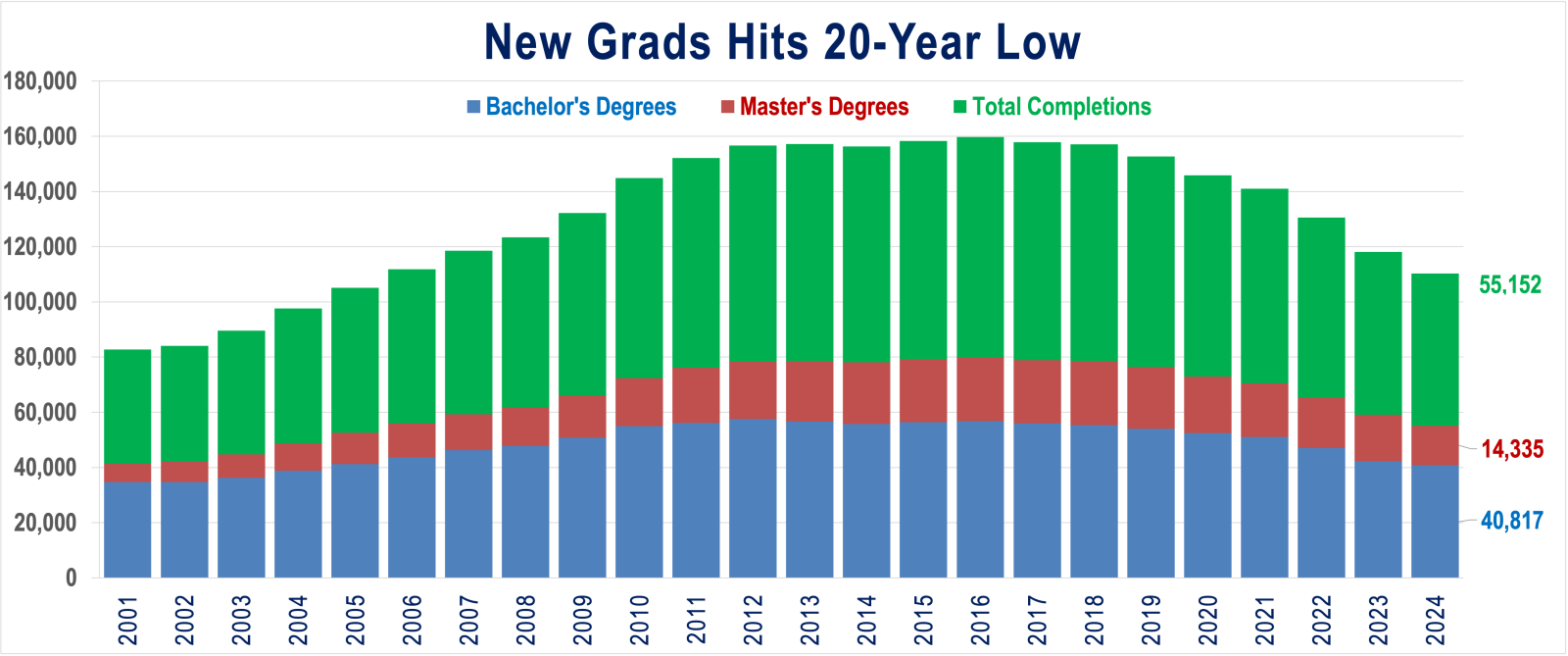
The pipeline of U.S. accounting graduates has fallen to its lowest level in roughly 20 years, capping a decade-long slide of about 17% in completions even as demand from public accounting firms remains strong, according to the latest release of a much-watched study.
In this report:
The tension between shrinking supply and resilient demand
Bachelor’s degrees: From mid-2010s peak to current lows
Master’s degrees: A steep 15% drop in the last academic year
CPA Exam Trends: The new baseline
Potential Turning Point? New growth in enrollments
In addition, the CPA exam pipeline has thinned over the past 10 years, with new candidates and successful passers both down from earlier peaks, though 2023 saw a temporary surge tied to the rollout of the CPA Evolution exam.
New research is also revealing that while auditors remain in steady supply, the tax profession is facing a severe and deepening talent drought.
And yet, new enrollment data point to a possible turning point, with accounting program enrollments up double digits in 2024–25 and firms signaling plans to keep hiring as many or more graduates in the year ahead.
 Expect strong demand for tax planning, business advisory and bookkeeping cleanup work.