Accountants Race to Tame AI before AI Outruns the Practice

Only 1 in 5 firms has an AI strategy, leaving most firms with varying degrees of chaos.
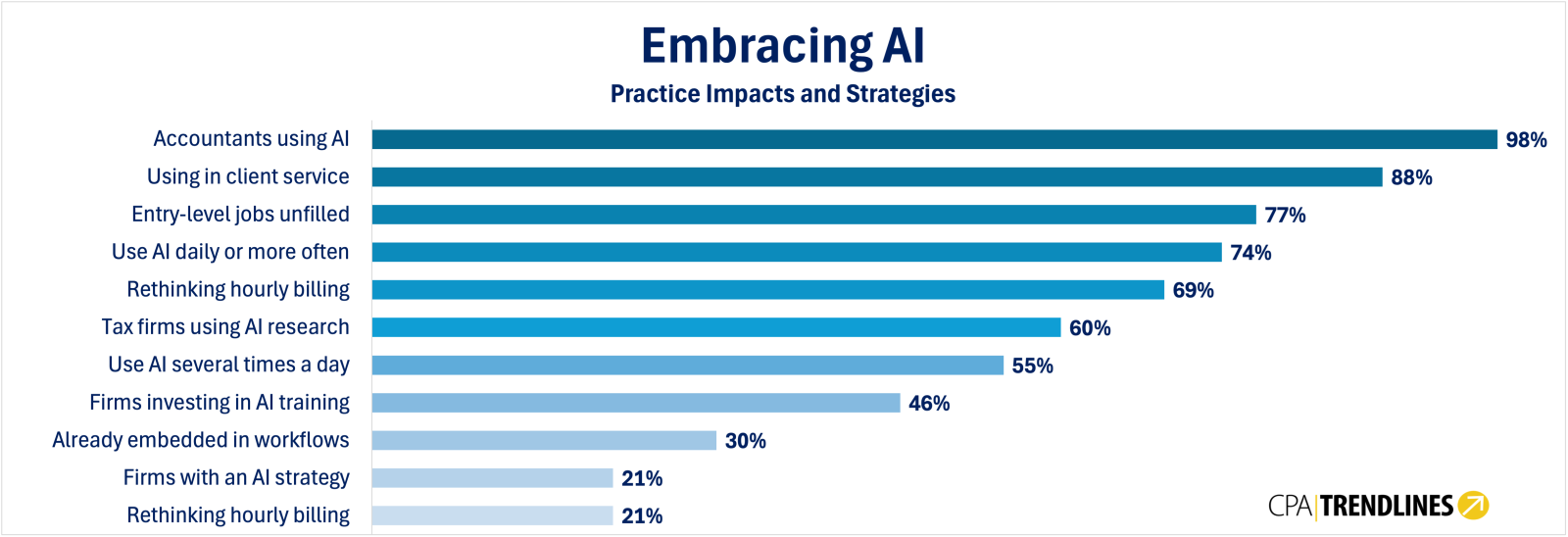
Barely three years since ChatGPT launched, 98% of accountants are using AI regularly. 88% use it in client service.

By CPA Trendlines Research

With artificial intelligence now firmly embedded in the daily life of tax and accounting firms, the profession’s next test is whether practitioners can learn to run AI before AI outruns the practice.

A new crop of research studies and benchmarking surveys suggests firms have yet to fully govern the tools, price the work, train the staff and protect client trust under AI regimes. Reports from the AICPA, Karbon, CPA.com, Blue J, Intuit Firm of the Future, KPMG, Personiv, the ACCA, Rightworks, Business.com and Citrin Cooperman show AI adoption is no longer in doubt. Coping with it is.

MORE Artificial intelligence | Supkis Cheek: Most Accountants Are Missing This AI Shift | |Private Equity’s Big Bet Faces an AI Shake-Up | Doug Slaybaugh: How to Define “Values in Motion” | At ENGAGE 2026, a Profession Richer and Less Certain Than Ever. | Jen Cryder: From Membership Model to Market Maker | Big 4 Transparency | Three Tech Priorities with Rapid ROI | The Google Playbook for Young Accountants | AI Can Fix Your Workflow—or Break It in Seconds |

Karbon says 98% of accounting professionals use AI, up 15 percentage points from last year, with 55% using it several times a day and 74% using it daily or more often.

Intuit says 88% of accounting professionals used AI for at least one client service in the last 12 months, and 86% used AI for at least one firm operation. Some 46% of firms are investing in AI training, 21% have an AI policy, and 21% have an AI strategy. Intuit says 30% describe AI as embedded by default in daily work, while 54% use it only when it seems useful.


READ MORE →

Lochhead, Yoon: What Accountants Do when AI Makes Accounting Free | The Distruptors

The old answers to old problems don’t work anymore.

This is a preview. PRO Members always get the full video, takeaways and transcript. Go PRO here.
Sponsored by True Advisor: The Definitive Success Guide for Client Advisory Services by Hitendra Patil
Subscribe to CPA Trendlines podcasts anywhere: Apple, Google/YouTube, Spotify, iHeart, Deezer, Amazon Music, Audible, Player FM, Audacy, RSS.
True Advisor: Buy now | Learn more

The Disruptors
With Liz Farr
For CPA Trendlines

Accountants, one of the most prized varieties of knowledge workers, are in trouble. AI is coming for the jobs. But Christopher Lochhead and Eddie Yoon may have an answer.

MORE DISRUPTORS: Ira Rosenbloom: PE Forces Firms to Pick a Future | Doug Slaybaugh: How to Define “Values in Motion” | Nancy McClelland: Bookkeepers Need a Safe Space to Collaborate |Chase Damiano: Good Operations Means Defining How the Hand-Offs Happen | Jeff Seibert: Digits Software Moves Toward Real-Time Accounting | Tyler Anderson: Audit Transformation Is a Mindset, Not a Destination | Sarah Flischel: The End of the SALY Audit | Sharrin Fuller: Build It Better, Then Let It Run Without You | Oz Demirdoven: Why U.S. Firms Lag the World in Advisory | Rebecca Driscoll: A Millennial and a Boomer Walk into a Bar… |

MORE CPA Trendlines Streaming Network

Lochhead and Yoon, who style themselves “the Category Pirates,” are suggesting the biggest change in the nature of work in decades.

In the age of AI, Eddie Yoon says, “knowledge is essentially free.” The credentials, specializations, and years of study that went into becoming an accountant are becoming commodities. Yoon describes a pyramid of knowledge work. At the base is “memorize and regurgitate,” where the majority of professionals have thrived. Above that is “synthesize and curate.” And at the rarefied top are the non-obvious connections: the insights that link disparate facts in ways no one else sees. AI, he argues, is already demolishing the lower tiers.

READ MORE →

Freeman, Dixon: What to Do When AI Steals Your Clients | Gear Up for Growth

Every client relationship is now up for renewal—and every partner has to learn how to compete.

Sponsored by True Advisor: The Definitive Success Guide for Client Advisory Services by Hitendra Patil | See Today’s Special Offer

Subscribe to CPA Trendlines podcasts anywhere: Apple, Google/YouTube, Spotify, iHeart, Deezer, Amazon Music, Audible, Player FM, Audacy, RSS.

Gear Up for Growth
with Jean Caragher
for CPA Trendlines

Buy now | Learn more

“The relationship gets you in the door, but it doesn’t get you the work,” says Karen Freeman, chief product officer, DCM Insights, and co-author of Activator Advantage: What Today’s Rainmakers Do Differently, in this episode of Gear Up for Growth, powered by CPA Trendlines and hosted by Jean Caragher, president of Capstone Marketing. “Once it’s competitive, it’s a lot harder to differentiate based on your past relationship.”

MORE Jean Caragher here | Get her best-selling handbook, The 90-Day Marketing Plan for CPA Firms, here |

Gear Up for Growth is tailored specifically for public accounting firms with up to 100 team members looking to expand their practices intelligently and efficiently.

MORE Gear Up for Growth here | MORE CPA Trendlines Streaming Network here

Freeman and co-author Matt Dixon, founding partner of DCM Insights, reflect on what they have learned one year after the release of their bestselling book. They discuss how AI, changing buyer behavior and increasing competition are reshaping growth strategies for accounting and advisory firms. Firms that rely on traditional relationship-based growth models risk falling behind.

READ MORE →

Private Equity’s Big Bet Faces an AI Shake-Up

But scale may matter more, not less, in the accounting and legal markets.

By CPA Trendlines Research

The same technology that promises higher margins could weaken the billable-hour economics that made professional services so attractive.

MORE Private Equity | What $1 Billion Buys in Today’s CPA Market

Private equity’s rush into law and accounting is running into a new question: What happens to a roll-up strategy built on professional labor when artificial intelligence starts doing more of the work?

READ MORE →

Doug Slaybaugh: How to Define “Values in Motion” | The Disruptors

Are your firm’s stated values consistent with its behavior?

This is a preview. PRO Members always get the full video, takeaways,  and transcript. Go PRO here.
True Advisor: Buy now | Learn more

The Disruptors
With Liz Farr

For CPA Trendlines

How does your firm define culture? Is your culture consistent with the values posted on the breakroom wall? Doug Slaybaugh, founder of CPA Coach, defines culture as “values in motion.” According to this definition, a firm’s stated values must be evident in the ways a firm actually behaves.

MORE DISRUPTORS: Candy Bellau: The $350 Pricing Mistake that Nearly Broke this Boutique Firm | The Disruptors | Poe: What P.E. Really Wants from Firms | The Disruptors  | Blake Oliver: Build a Biz that Runs Without You | Daiber: Use Succession as a Growth Strategy | Cannon: Busy Season is Self-Inflicted | Carroll: When One Person Can Break the Firm | Rampe: Build a Roadmap Even When the Road’s Not There | Chang: Killing SALY, One Agent at a Time |

MORE CPA Trendlines Streaming Network

A firm with the value of philanthropy, for example, should give team members the ability to volunteer or sponsor nonprofit events. “There should be evidence,” Slaybaugh explains. “Otherwise, there’s no evidence of that value. It’s really not your culture.”

Slaybaugh’s previous firm had the often-clichéd value of “people first,” but actually executed on that. Team members were offered the option to buy an additional month of PTO, prorated from their salaries, resulting in an 11-month year with nearly two months of vacation.

READ MORE →

At ENGAGE 2026, a Profession Richer and Less Certain Than Ever

On the agenda: Consolidation, ethics, AI, and talent.

By CPA Trendlines

The CPA profession arrives at its biggest annual gathering this month, carrying two truths that refuse to sit comfortably together: It has never been worth more money. And it has never been less sure of what it is becoming.

MORE AICPA

AICPA and CIMA convene ENGAGE 2026 at the ARIA in Las Vegas, June 8 through 11 and the 10th-anniversary theme — “The Next Wave: A Decade of Possibility Starts Now” — markets the milestone while signaling the unease beneath it.

READ MORE →

Jen Cryder: From Membership Model to Market Maker | Big 4 Transparency

State societies can evolve into engines of innovation, education, and workforce resilience.

This is a preview. The complete video episode, with commentary and transcript, is first available exclusively to PRO Members | Go PRO here
Sponsored by The Balanced Millionaire: The Advisor Edition by Dr. Jackie Meyer | See Today’s Special Offer

Subscribe to CPA Trendlines podcasts anywhere: Apple, Google/YouTube, Spotify, iHeart, Deezer, Amazon Music, Audible, Player FM, Audacy, RSS.
Build a 7-figure firm in just 4 hours a week!
.

Big 4 Transparency
By Dominic Piscopo, CPA
For CPA Trendlines

At a time when the accounting profession is undergoing its most rapid transformation in decades, Jen Cryder, CEO of the Pennsylvania Institute of Certified Public Accountants (PICPA), is quietly redefining what a state CPA society can (and arguably should) become. 

MORE Dominic Piscopo | MORE Private Equity | MORE Pay & Compensation

In this episode of the Big 4 Transparency Podcast, Cryder joins host Dominic Piscopo to discuss how advocacy, revenue diversification, and technology investment are converging to reshape the future of the CPA profession. 

Cryder, who spent 15 years in public accounting before joining PICPA more than a decade ago, now finds herself at the center of national conversations around licensure reform, continuing professional education (CPE), and the evolving definition of what it means to be a CPA. While state societies have historically focused on a relatively narrow set of services, Cryder argues that the profession’s accelerating rate of change has expanded that mandate dramatically. “For most of our 130-year history, the definition of a CPA was fairly static,” she notes. “In just the last few years, that list of issues has become infinite.” 

READ MORE →

Three Tech Priorities with Rapid ROI

Build advisory capacity without waiting for outside capital.

By Hitendra Patil

The technology gap between private equity-backed and independent firms is real, and it is also smaller than it appears from the outside.

Here is something I have consistently observed: PE-backed firms invest heavily in technology during their first 18 to 24 months post-acquisition because they have to. They are merging systems from multiple firms, migrating client data and standardizing workflows across a larger organization. That investment is substantial, but a meaningful portion of it solves problems that independent firms do not have, because they were never acquired in the first place.

MORE by Hitendra Patil
GoProCPA.comExclusively for PRO Members. Log in here or upgrade to PRO today.


The independent firm’s technology challenge is different: deliberate modernization at a pace that does not disrupt client service. That is a more tractable problem than integration at scale, and the firms that treat it as a sequenced project tend to close the gap faster than they expected.
READ MORE →

Make Clients Feel Seen, Heard and Helped

three magnifying glasses leaning on sidesUse a three-lens model for CAS conversations.
By Hitendra Patil

Many client accounting services professionals are eager to offer “advisory,” but they sometimes struggle to make their conversations truly feel like advice. The tools are available, and the data is clean, yet something still feels a bit off.

MORE by Hitendra Patil
GoProCPA.comExclusively for PRO Members. Log in here or upgrade to PRO today.


Why? Because most client interactions rely on reactive reporting, when they should be guided by proactive exploration, and that’s the problem. CAS is far more than just about what you say. It’s about how your insights meet your client’s world.
READ MORE →

Make Your Clients Look Forward to Meeting with You

illustration of the progression of economic value

Every interaction is an opportunity.

By Rory Henry
The Holistic Guide to Wealth Management

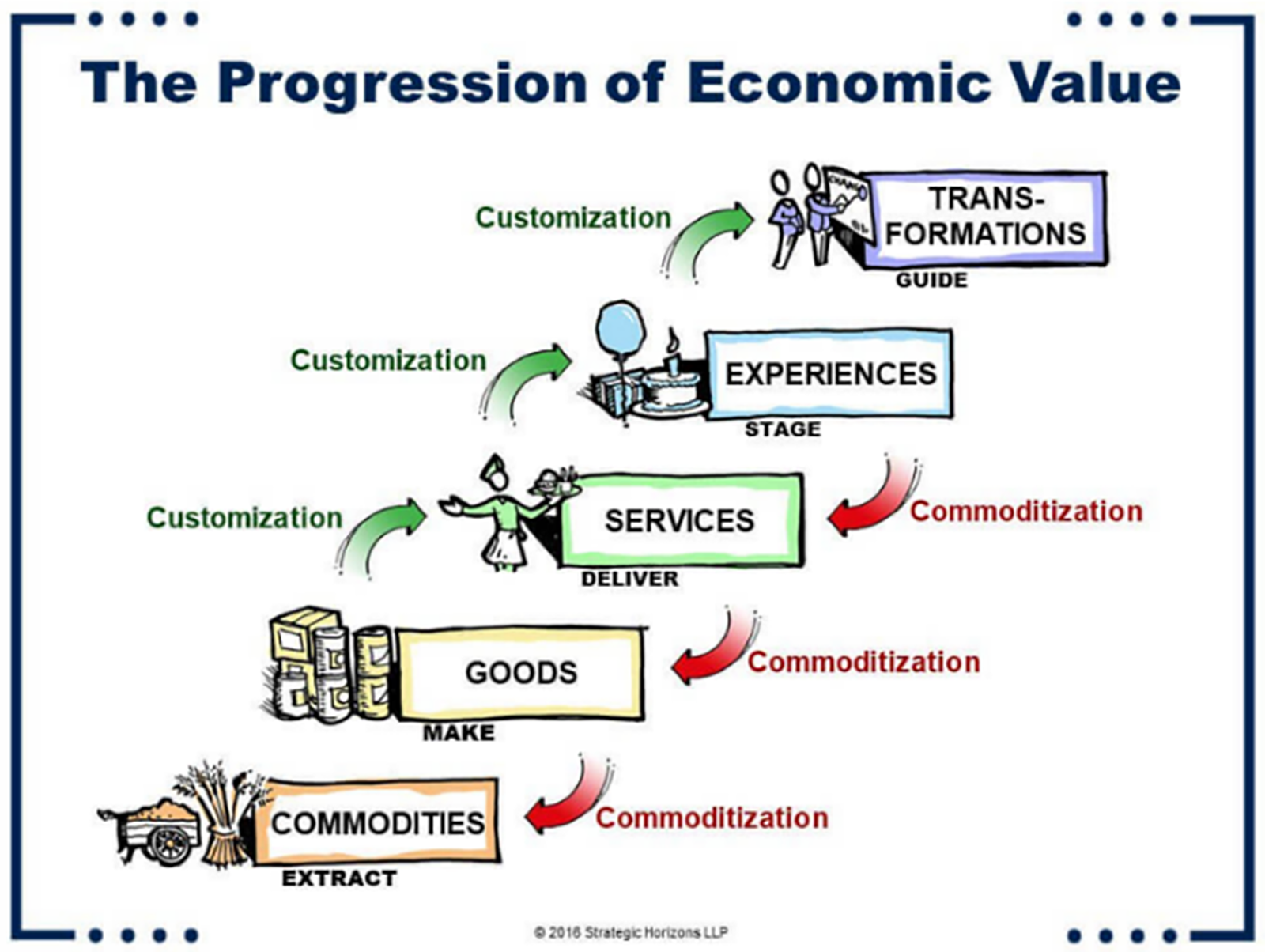
In tracing the trajectory of economic evolution, each phase represents a profound transformation, often driven by technological advancements. For instance, the Industrial Revolution transformed the U.S. from an agrarian economy to a manufacturing economy that created tangible assets (i.e., finished goods) out of raw materials. In recent decades, the U.S. went through a digital revolution, moving us from a manufacturing economy to a service-based economy that produces intangible assets.

MORE Rory Henry and The Holistic Guide to Wealth Management
GoProCPA.comExclusively for PRO Members. Log in here or upgrade to PRO today.


This shift was emblematic of a broader transition from making tangible goods to delivering intangible services. The service economy burgeoned, with a focus on delivering services, e.g., tax services, financial services and estate planning legal services.

Now, we are in the midst of another paradigm shift. Artificial intelligence (AI) is transforming us from a service economy to one based on providing the consumer with experiences and guiding them through life transformations. The AI era is not just about automating routine tasks, but fostering an environment in which we transcend traditional service delivery.
READ MORE →