5 Other Systems for Paying Partners

Money falling from the sky; moneyon whiteWhy Balanced Scorecard is MBO in new clothing.

By Marc Rosenberg
Partner Comp: Art & Science

There are many partner compensation formulas, some performance-based and some not, some more subjective than others.

MORE ON PARTNER COMPENSATION: 3 Non-Performance-Based Comp Systems | The 3 Best Partner Compensation Formulas | 11 Points in Designing a Partner Comp System | What Partners Earn and How They Earn It | Partner Compensation: An Art, Not a Science | How Partners View Compensation: It’s Not All about the Money | Why Most Partner Comp Systems Are Performance-Based

The systems below are less common than others, but some firms are attracted to them, especially small firms.
READ MORE →

The 3 Best Partner Compensation Formulas

Two hands honing a large knife4 common carve-outs, 9 challenges and 10 complications of ALL compensation systems.

By Marc Rosenberg
Partner Comp: Art & Science

Compensation formulas are the most common system for allocating partner income.

MORE PARTNER COMPENSATION for PRO Members (Go PRO here): Why Firms Use Partner Comp Formulas|3 Subjective Compensation Systems | 11 Points in Designing a Partner Comp System | 3 Tiers of Compensation | Partner Compensation 101|What Partners Earn and How They Earn It | Partner Compensation: An Art, Not a Science | How Partners View Compensation: It’s Not All about the Money | Why Most Partner Comp Systems Are Performance-Based

Now let’s look at some of the better formula systems we’ve seen:

READ MORE →

System vs. System: Partner Compensation Best Practices

Chart outlining multitier system
For full size, see full article

BONUS LISTS: 12 allocation systems and 22 intangible performance attributes.

By Marc Rosenberg
CPA Firm Retreats

“If people are concerned about their absolute level of compensation, then they can be satisfied. However, if their focus is on relative standing, then they can never be satisfied.” – Andrew Grove, Former Chairman of Intel

You’ve decided you’re going to discuss partner compensation at your next retreat, then you’ll need to start with some warm-up materials.

Begin with this partner compensation best practices13-point checklist:

READ MORE →

Partner Comp: Three Subjective Compensation Systems

Plus balloting details for those who use paper and pencil.judge gavel,dollar banknotes and calculators

By Marc Rosenberg
Partner Comp: Art & Science

There are at least three performance-based systems for partner compensation. None rely completely on intractable formulas, but instead introduce various degrees of subjectivity. Needless to say, none are without some controversy.

MORE ON PARTNER COMPENSATION: 11 Points in Designing a Partner Comp System | 3 Tiers of Compensation | What Partners Earn and How They Earn It | How Partners View Compensation: It’s Not All about the Money

But each system requires serious thought. Here’s a comprehensive of the three approaches. Which does your firm use now? Why? Which might be a better approach?

Let’s take a closer look:

READ MORE →

How to Address Partner Compensation at a Retreat

Woman leading meeting, flipchart in backgroundHow do you feel about evaluations … and tying compensation to them?

By Marc Rosenberg
CPA Firm Retreats

Before formally beginning the discussion part of a retreat session, it’s always a good idea to begin by asking the participants what they want to be sure to cover. As issues are suggested, the retreat facilitator should write them down on a flipchart.

READ MORE →

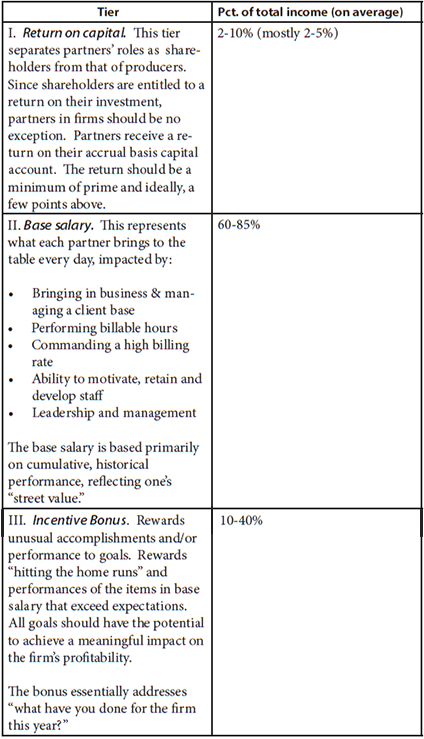
3 Tiers of Partner Compensation

Chart of 3 tiers of partner compensationPLUS: 6 major factors impacting bonuses. And 4 notes from a master.

By Marc Rosenberg
Partner Comp: Art & Science

Most CPA firm partner compensation systems consist of three tiers, each of which compensates the partners in a different way.

MORE ON PARTNER COMPENSATION: Partner Compensation 101| What Partners Earn and How They Earn It | Partner Compensation: An Art, Not a Science | How Partners View Compensation: It’s Not All about the Money | Why Most Partner Comp Systems Are Performance-Based

What is base compensation (or salary)?

It’s common to define partners’ base compensation as their historical or street value to the firm. What they bring to the firm every day. A managing partner once told me: “It’s what we would have to pay a partner at another firm to come work with us.”

Practice debunked: Many firms have equal bases for all partners. Their thinking is that the base is merely a level of compensation that (1) is above what managers are paid and (2) is enough for the partners to live comfortably on. Firms like this are operating a modified pay-equal system, which is widely viewed in the CPA industry as ineffective and unfair. Not only do partners NOT perform equally, there is almost always a wide variation from highest to lowest performer. The case for equal bases is a weak one at best.

Practice debunked: I’ve seen some firms impute partner bases as follows: First, compute hourly pay rate by dividing the standard billing rate by the firm’s billing rate multiple. Then, multiply the hourly pay rate by 2,000 hours to arrive at imputed base pay. Billing rate multiple is a staff person’s billing rate divided by the hourly pay rate. Eighty to ninety percent of all firms are in the 3.5 to 4.0 range.

READ MORE →

Partner Compensation 101

BONUS CHECKLISTS: 26 intangible performance attributes and 9 teamwork rules.

By Marc Rosenberg

A performance-based system links partners’ compensation with their performance.

MORE ON PARTNER COMPENSATION: What Partners Earn and How They Earn It | Partner Compensation: An Art, Not a Science | How Partners View Compensation: It’s Not All about the Money | Why Most Partner Comp Systems Are Performance-Based

If partners have a “good year,” however “good” is measured, they will most likely earn more. Partners experiencing a “bad” year or an “off ” year should expect to earn less.

READ MORE →

Partner Compensation: An Art, Not a Science

The 4 engines that drive management.

By Marc Rosenberg

The allocation of partner income is much more an art than a science. Anyone who thinks otherwise is either naïve or has never been a partner whose income was subjected to an income allocation process.

MORE ON PARTNER COMPENSATION: How Partners View Compensation: It’s Not All about the Money | Why Most Partner Comp Systems Are Performance-Based

Partner compensation is not a science. If allocating partner income were a science, it would be easy to concoct the perfect formula that factors in all relevant performance metrics, both tangible (production) and intangible (leadership, mentoring staff, loyalty, teamwork, etc.), producing results that would be considered fair and acceptable to most or all partners. There would be few arguments among the partners because they would feel the formula says it all and leaves nothing for debate.
READ MORE →

How Partners View Compensation: It’s Not All about the Money

businessman on the ladder attracts dollar notes using a magnet. Sky with clouds on the background.

It’s more than a dollar figure – it’s a ranking.

By Marc Rosenberg

In an ideal world, partners could objectively discuss and debate the firm’s partner compensation system without regard for its impact on their individual earnings. But of course, we don’t live in an ideal world. It’s almost impossible for partners to weigh in on the system without thinking about its impact on their individual earnings.

MORE ON PARTNER COMPENSATION: Why Most Partner Comp Systems Are Performance-Based

This is the essence of why partner compensation is such a sensitive and critically important topic to partners.

READ MORE →

Today’s Top Six Partner Compensation Trends

Money in hand

Why so many pay-for-performance plans are a flop.

By August Aquila
Creating the Effective Partnership

Many of us, including myself, thought that the right compensation plan would solve the answer to underperformance and motivation. Over the last ten years or so, firms have moved from a formula-based plan to a pay-for-performance plan which takes into consideration, production, business development, value enhancement and behavioral factors. And, while this has helped place more emphasis on performance, it hasn’t been a magic bullet. Why are so many firms still missing the boat when it comes to motivating partners and staff to perform at a higher level?

MORE on LEADERSHIP: 5 Questions About Your Firm’s Direction | 6 Reasons to Keep Partners from Retiring | 6 Reasons Why CPA Firms Fail in Innovation | 6 Steps to Handle Staffing Problems in a Merger | 7 Signs Your Firm Is Headed for an Implosion | It’s Not Always about Money: 16 Tweaks for Your Comp System | Eight Key Goal Areas for Partners | Like Herding Cats: Partners Must ‘Walk Together’ | Managing Partners Must Remember Partners’ Needs | New Times Call for New CPA Firm Metrics | Partners Have Love-Hate Relationship with Leadership | 6 Things Leaders Must Do | 8 Financial Ducks to Line Up Now| Partnership Is About Persuasion

Janice Kaplan, in the new book, “The Gratitude Diaries: How a Year Looking on the Bright Side Can Transform Your Life,” refers to a survey on gratitude in which some 80% Americans say that receiving gratitude makes them work harder, but only 10% of the survey respondents managed to express gratitude to others on a daily basis.

READ MORE →